2,034 posts tagged “generative-ai”
Machine learning systems that can generate new content: text, images, audio, video and more.
2026
Introducing Kimi K3.1 Pro (via) Kimi K3.1 Pro landed on the Kimi API today - it's not yet open weights, but Moonshot promise "Full model weights will be released by Nov 4, 2026".
They're also offering a "Highspeed" version that's 2-3x faster, at twice the price (except for input token cache hits, which are priced the same).
The US dollar pricing is $2.00/million tokens for input and $10/million for output - the same as GPT-6.1 Sol and half the price of Claude Opus 5.5.
Moonshot's own benchmarks show Kimi as approximately level with Opus 5.5 and GPT-6 Astra - beating them on a few benchmarks, coming close on others.
Artificial Analysis scored Kimi at 55 - ahead of Claude Fable 5.1, GPT-6 Astra, and Gemini 4 Argon (all at 53) and behind only Claude Opus 5.5 (58).
This is the first time a (soon-to-be) open weight model has scored this highly against the frontier.
I tried it out via the Moonshot API using the llm openai endpoint command I added to LLM 0.32 back in August:
llm openai endpoint \
  https://api.moonshot.ai/v1 \
  --key kimi \
  -m kimi-k3.1-pro \
  "Generate an SVG of a pelican riding a bicycle" \
  --responses \
  -o reasoning_effort low \
  > kimi-k3.1-pro-pelican-low.stdout.txt \
  2> kimi-k3.1-pro-pelican-low.stderr.txt
llm openai endpoint can run prompts against any OpenAI-compatible endpoint but doesn't log the results, hence the extra options to save stdout and stderr (the reasoning trace).
Here are the pelicans I got for Kimi K3.1 Pro on the three reasoning levels it supports - low, medium, and max. This is max:

For comparison, I ran fresh pelicans against Kimi K3 on those three reasoning levels.
DE STAAT—FREEDOM (Official Music Video) (via) OK well this is a first for me... at 00:44 in this new music video by Dutch alternative rock band De Staat:
The visual effects are credited to Matties Grooten of Fake it or Leave it.
Donating Agent Skills to the Agentic AI Foundation. News today from Anthropic:
We’re committed to keeping Agent Skills open, community-driven, and vendor-neutral. Today, we are donating the standard to the Agentic AI Foundation (AAIF) under the Linux Foundation, which we co-founded with Block and OpenAI last year, and to which we donated the Model Context Protocol (MCP).
I'm pleased to note I called this one last December, when Anthropic first declared skills to be an "open standard":
I wouldn't be surprised to see this end up in the AAIF, recently the new home of the MCP specification.
Fun side note: since my blog content is available to Claude via the datasette-mcp
plugin I found that post by prompting Claude to "Use simonwillison.net MCP to find if I ever talked about how I want skills to be donated to a standards body".
As fun as AI is, we built so much bad software over the last 30 years, and now the universe is punishing us for our sins.
Battle Drones—a vibe coded RTS with audio-based multiplayer
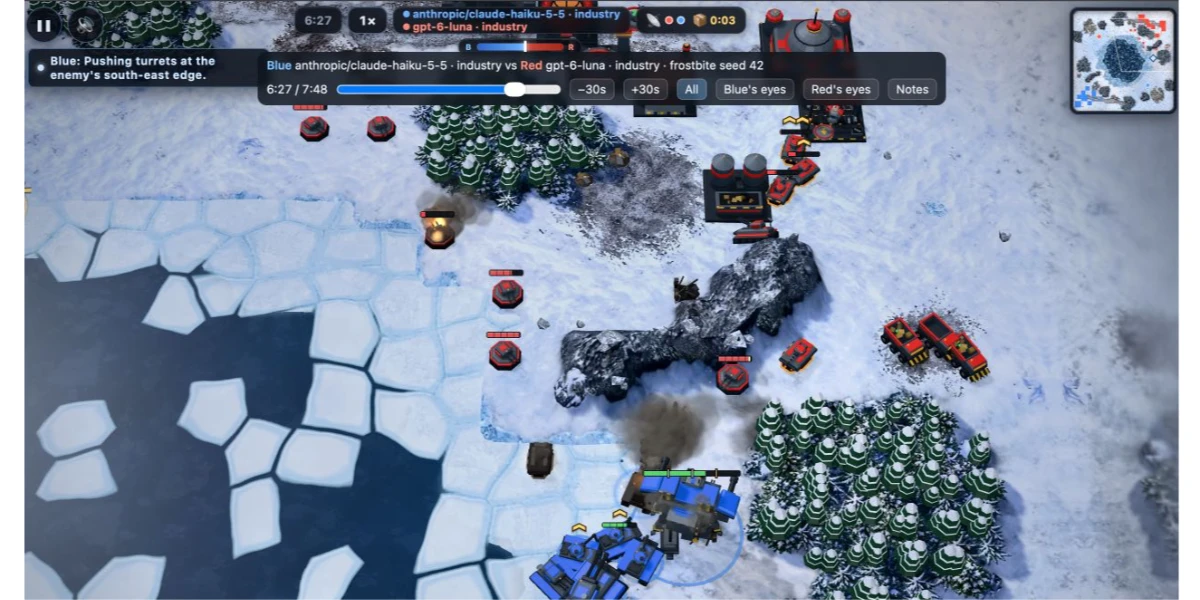
My latest vibe coded game experiment is a Command & Conquer style RTS (Real Time Strategy) game called Battle Drones (play it here). Unlike my previous experiments, this one is actually fun to play. I’m somewhat embarrassed to admit that I got there by telling Claude to “Make it a LOT more fun”. It also supports multiplayer between nearby devices using audio to synchronize game state! Here’s what I’ve built so far, and some of the things I learned along the way.
[... 4,288 words]My obituary for programming (via) Jeremy Scheff poignantly captures the key loss caused by coding agents for career programmers who enjoyed the puzzle of developing code:
Programming turned into one of the greatest jobs you could imagine. You got paid to work on tricky little logic puzzles. The trickier the puzzle, the more you got paid. But even pretty simple puzzles were worth a lot of money because regular people just couldn't do it! No, they needed us. They would give us a problem and we would solve it the way we wanted. We set the strategy, we made the timeline, we defined what was and was not possible.
If you're a programmer who thrives on building working systems and doesn't care too deeply about the problems solved along the way, LLMs are the gift that keeps on giving.
If directly solving those problems was a big part of your enjoyment, the loss is very real.
We think "did a human read the code?" is an imprecise proxy for "what could go wrong with this change, and which check—automated or human—is the right one to catch it?"
Asking that question also changed when review happens. Before, review was a gate at the end of the road: write the code, open a PR, wait for your colleague.
Now, review runs continuously, more like spellcheck while you write. Most changes have been reviewed and fixed by Claude at least once before a human is asked to look. This catches most routine mistakes, and saves team attention for higher-level questions and scrutiny.
— Addy Osmani, Morgan Westlee Lunt, and Qing Wang, How the Claude Code team does code review
This research task is really an experiment in running Claude Code for web in "Ultracode" mode, as described in Orchestrate subagents at scale with dynamic workflows in the Claude Code documentation.
With Ultracode turned on, Claude Code makes aggressive use of dynamic workflows - it generates JavaScript that defines and coordinates a network of subagents to take on complex problems.
My initial prompt was this - I meant "hit the rows directly", the word "delete" was an accidental typo on my phone:
Write a SQLite extension in Rust that implants SPARQL and runs really fast because it can hit the delete rows directly
This caused Claude Code for web to churn for over 12 hours. I checked in on its progress the next day and sent a single follow-up prompt when I noticed how many Rust crates it had built:
Every folder in the crates/ directory needs a README
Include a tutorial.md teaching users how to install the extension and how to run it in the SQLite CLI and then teaching them SPARQL in addition to how to use the SQLite extension
Include a script with the tutorial for populating a SQLite database with useful and realistic example data for that tutorial
This project feels like next-level vibe coding - it's not remotely feasible to review the code that was produced here, and even following the documentation is a significant investment in work. I'm not entirely sure what to do with this - I appear to have a full SPARQL implementation in Rust inside SQLite now, but how valuable is that if I created it on a whim and can't (or won't) invest the necessary time to understand what it can do?
Another game experiment - I wanted to see if it was feasible to have a two player game on two separate phones running in static HTML where the networking code uses chirps sent via the microphone. It seems to work!
Build a two player competitive pong like game where two players use their phones close to each other and the game state is sent via audio noises which the web microphone API can interpret - but add graphical and gameplay twists to make it a lot more fun and intertwine than pong
Claude Opus 5.5 Extra in Claude Code.
Anthropic tells investors quarterly revenue up nearly 50% to $16.8bn ahead of IPO. The phrase "told investors" appears four times in this FT article, which reports on Anthropic's day of hosting investors on Wednesday. Lots of details in here from "people with knowledge of the matter".
Key things I learned from the article:
- Q1 revenue (Jan/Feb/Mar) was "about $4.8bn"
- Q2 (Apr/May/Jun) was $11.5bn
- Q3 (Jul/Aug/Sep) was $16.8bn
- In Q3: $1.70 in revenue for every $1 spent on "computing power"
- Adjusted operating margins (excluding stock-based compensation) were 11%
This point about distillation is worth quoting in full (highlight mine):
The start-up has also clamped down on “distillation” — a controversial practice whereby rival AI labs train their models on the outputs of more advanced ones.
When rival companies “distil” their models from Anthropic’s models, that involves heavy usage and spending.
Anthropic told investors on Wednesday distillation accounted for 5 per cent to 7 per cent of revenue and that they had cut it back “materially” in the third quarter of the year, said four people with direct knowledge of the matter.
Napkin maths says that if distillation was 5% of their Q2 revenue (before they cut it back in Q3) then unnamed "other labs" spent over half a billion dollars distilling Anthropic's models in that quarter!
Also notable: Anthropic appear to no longer be leaning on "annualized run-rate revenue" (previously) in these communications to their investors.
Inspired by Paul Ford and Aboard Foundary's new web app Tiny Little Office, which provides a suite of web app content editors (a Word Processor, Outliner, Presentation Builder, Spreadsheet, Calculator, Drawing Tool, Diagram Maker, Animator, Calendar, and Trip Planner).
Tiny Little Office's signature trick is to store all of the document data in the #fragment section of the URL, so every document created using it becomes a bookmarkable and shareable link.
It also has an llms.txt file telling agents how to construct URLs that will render as documents. Claude used that file to generate this link to a deck that explains how the URL format works:
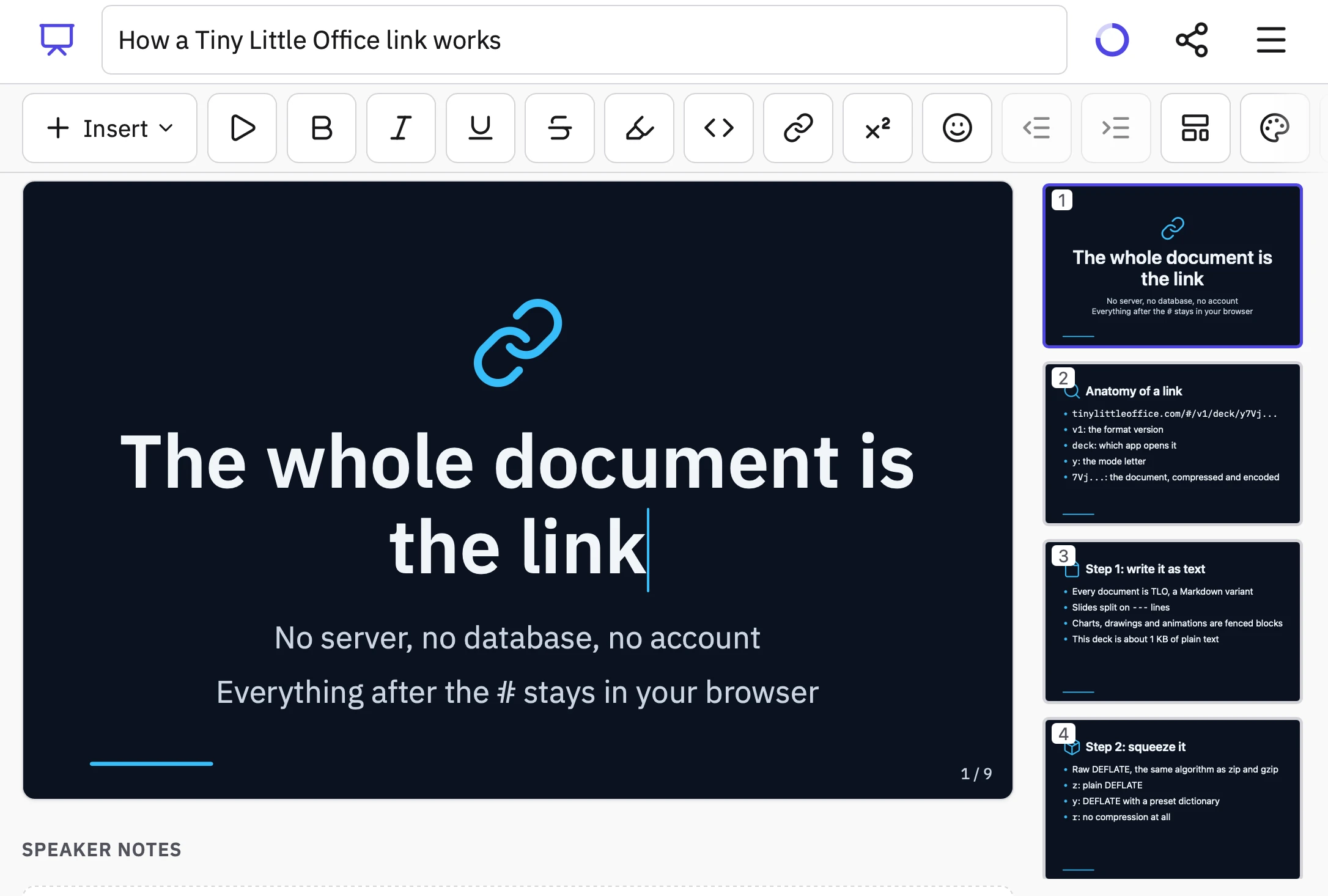
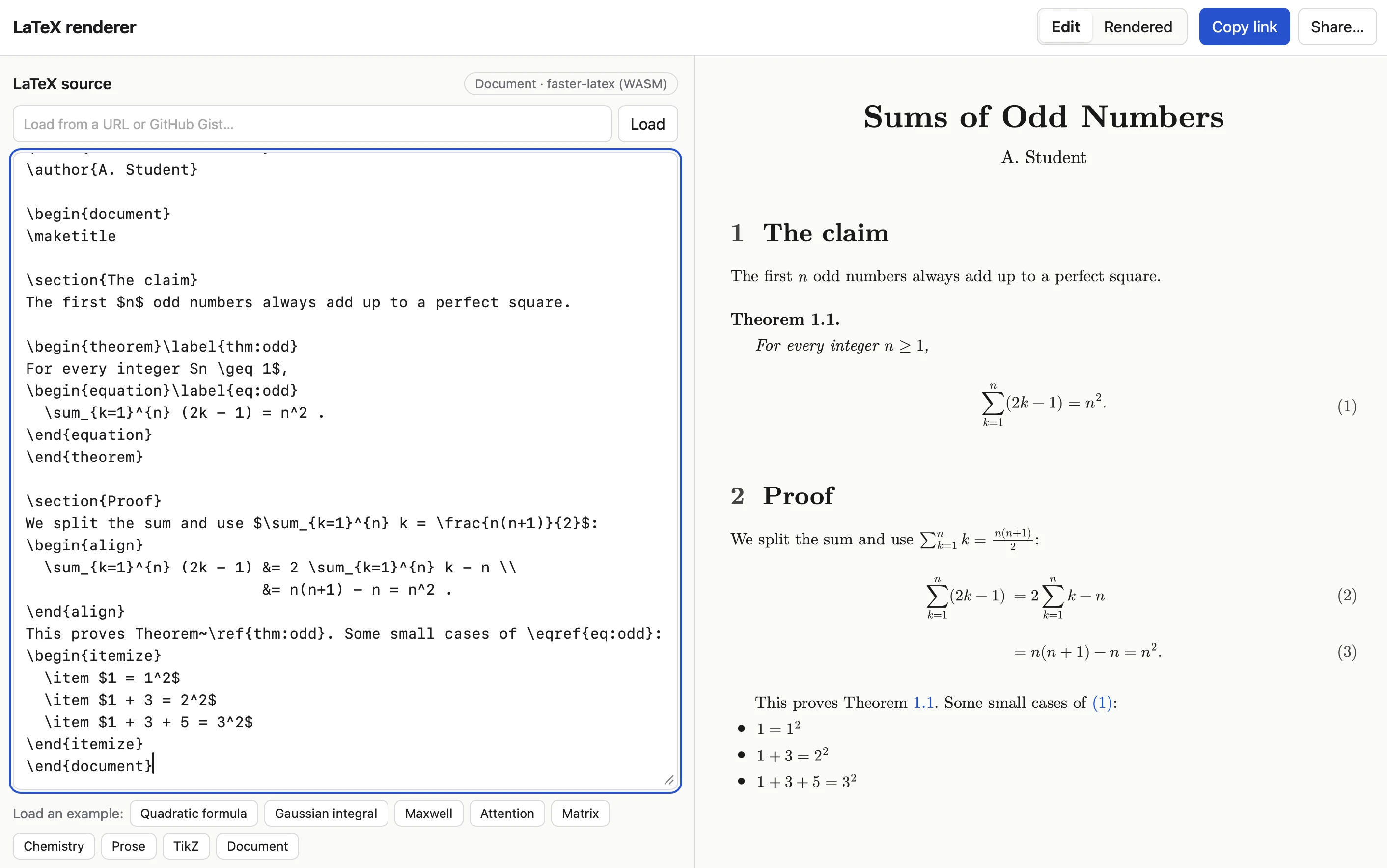
Tiny Little Office inspired me to have Claude Code (Opus 5.5 Extra) build a similar tool that works with LaTeX. Here's the sequence of prompts I used:
I want a tool where you can link to it with a fragment hash #code-here and it treats that code as LaTeX and renders it really effectively. It should also support a prefix which means the latex is compressed with a custom compression dictionary optimized for latex. Use the best available latex render library from a CDN (consider WebAssembly too). If loaded without a fragment hash show an editor you can paste latex into and then toggle to a "rendered" view. That rendered view should be bookmarkable. The #fragment view should let you switch to edit source too.
Since it was working in my tools repo I told it to take inspiration from the <iframe sandbox="..."> mechanism used by my existing SVG in Markdown tool as protection against XSS risks:
Safe from XSS? We could run in an iframe sandbox like we do on the SVG markdown render project
I had it copy the Gist/URL loading feature from that tool as well:
We should have an option to load latex from a URL (or gist) similar to the markdown SVG tool
Here's an example link. The tool uses Pako 2.1.0, MathJax 4.1.3, faster-latex 0.3.1, and DOMPurify 3.4.16.
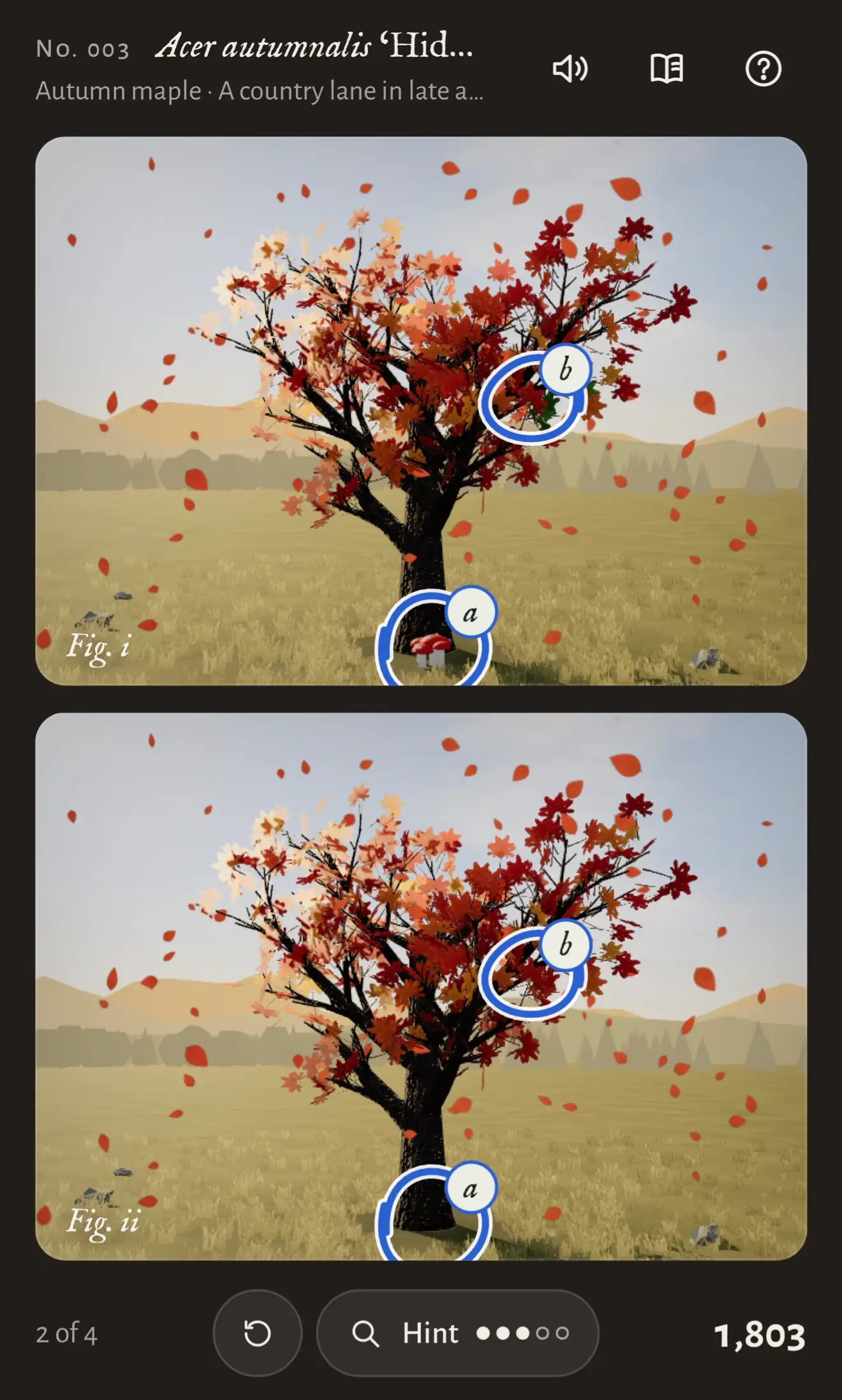
Another game experiment with Claude. This one used the default Claude iPhone app (chat mode, not Claude Code mode), where I prompted Claude Opus 5.5 Max with:
Build a three js game called "Tree appreciator" - it shows you two algorithmically generated trees and the game mechanics is about appreciating the differences between them. Think hard about how to make sure it is both fun and beautiful.
Somewhat embarrassingly given my recent talk, I've found that telling Opus 5.5 "make sure it is fun" works uncomfortably well. In this case Claude crunched for 3 hours and 7 minutes before retuning a cosy little spot-the-difference game with music and animation and achievements that's quite compelling to play.

AI is mass decompiling games. That’s both awesome and scary. (via) Indie game developer Popcar talks about the recent wave of AI-powered decompilation of existing games, enabling weird mashups between existing games, and producing a boom in game preservation projects to get old games working on new hardware (often in a browser using WebAssembly).
I like how this piece captures both the positives and the negatives of this new development:
Most people already realized the scary part by now. If AI can decompile games and software, then the entire tech industry is about to explode. Anybody can decompile other software and use it any way they'd like, and nobody can stop them. Companies can steal from competitors. Your paid game or app can be open-sourced against your will. This isn't exclusive to old video games, we can apply this to any software. [...]
This is also a big win for preservation. Old games can be ported, modified, enhanced, and made much more easily accessible than before. [...[
With console makers going all in on digital and games becoming entirely unplayable due to servers shutting down, this is fantastic news. We could own software we bought regardless of what the company thinks.
Redesigning source control at Anthropic (via) Interesting piece from Anthropic describing why and how they built their own custom alternative to Git, based on the dramatic increase in rate of changes to their code after the past six months.
In May 2026, Anthropic averaged around 2,500 code changes merged per day; as of September, we merged over 30,000 per day.
They included a chart showing those changes. I had Claude modify their chart (code here) to add markers for the public releases of each of their models in 2026:

This shows public release dates, not the date when models became available for Anthropic's internal use. My guess is that the introduction of Fable/Mythos class models is a key factor in the increased coding velocity.
"Antique" is their new code review system. The source control system is called Scion, and sounds to me like a reinvention of centralized source control along the lines of Subversion.
(Update: Anthropic credit Google's Piper and Meta's Sapling as "prior art" - it looks like the core concept of "derived data" was heavily inspired by Mononoke, the server component of Sapling.)
They had some pretty extreme requirements:
The history of our main branch alone is almost 100 GB, and a compressed working copy is over 25 GB. We perform on the order of 25 million code checkouts per day for CI, before counting developer environments, agent sandboxes, and research jobs. Fetched naively, that would be over 600 PB of git traffic per day.
The new system was built by a team of seven people, and the migration from Git was completed in five months.
When asked on Hacker News about the lack of offline support, Scion engineer Nick G replied:
Since Claude is by far the heaviest user of Scion and is necessarily online, this just wasn't important to do.
As an aside, I've been trying adversarial review in my own projects recently, where you have a model try and find flaws (I often play Claude and GPT off against each other). This note from the article reflected my own experience with that:
Anthropic also makes extensive use of adversarial review, and, while this is incredibly effective in many ways, it can also be myopic, so skilled engineers needed to steer Claude away from over-engineering parts of the system in response to hypothetical concerns.
I added support to llm-gemini for the new Gemini 4 Argon model, made available today via the Gemini API and for customers of their $100/month subscription plan.
Here are the low, medium and high pelicans. As expected, they are all excellent: Gemini has a track record of producing great SVGs, and are the only lab where I know their staff have invested in SVG specifically (and who have boasted about their pelicans before.)
Here's the "high" illustration, which cost me 17.166 cents:

The pricing is interesting. At launch, Argon is $2/million input and $10/million output - the same price as GPT-6 Sol, half the price of Claude Opus 5.5 and 1/5th the price of Claude Fable 5.1 and GPT-6 Astra.
But on December 1st Argon is set to double in price - so it will be the same price as Opus 5.5.
Prices like this aren't really comparable these days since what really matters is how many tokens a model takes to achieve a goal within an agentic harness.
One useful clue for that comes from Artificial Analysis, who publish the total cost to run their benchmark using each model. Argon is looking very good there - costing $2,407 to run the benchmark, putting it close to GLM-5.3 and significantly cheaper than OpenAI, Anthropic, and Meta's latest models.
When the price doubles it will still be a little cheaper than GPT-6 Astra.
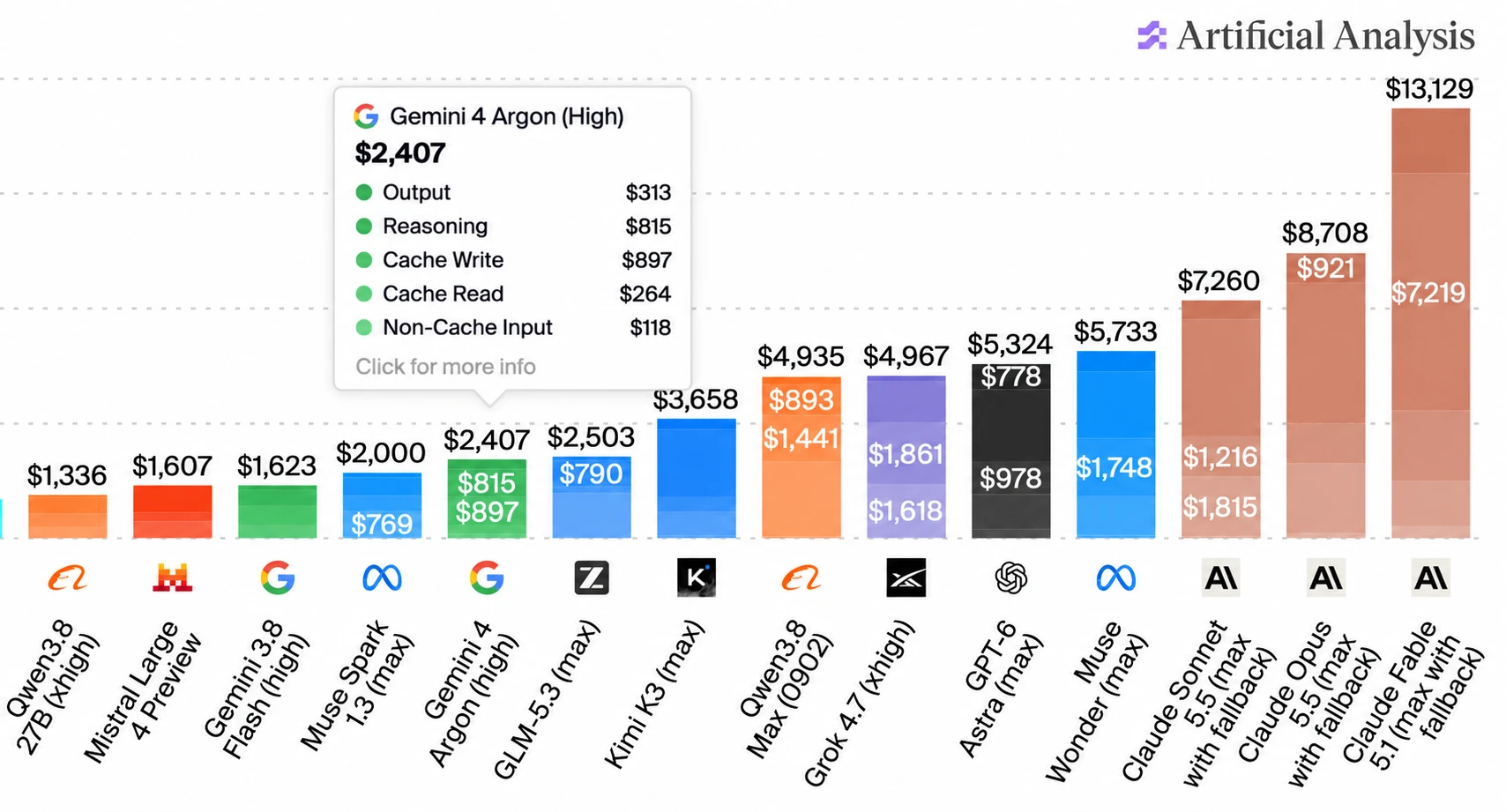
(I used ChatGPT to edit that chart! The data is all correct, I checked - I needed to get that Gemini 4 Argon info box to display without overlapping the other numbers.)
Some bonus examples using Gemini 4 Argon: here's Generate an SVG of an armadillo in fishnet tights jaywalking on Mars, here's a Fabergé egg it created for me using Blender, and DeepMind staffer @fofrAI shared a video of a pelican riding a bike, using fourier epicycles. That's a fun new twist!
If the agent isn't using my diagnostics library, I could introspect and update AGENTS.md, but there's still a delta, and it'll drift. Instead, I write a pre-commit hook that checks the git diff for direct calls to observability modules that bypass my diagnostics module. Boom: fail the commit, inject a prompt telling the agent to use the diagnostics library. All of a sudden it's ten out of ten.
— Geoffrey Huntley, nobody should type code by hand anymore. here's what's left.
Meta AI release Muse Wonder (and Muse Wonder Full), their new "most capable models". These look like they may be Meta's first Fable class models - Artificial Analysis scores Muse Wonder (Max) as equivalent to GPT-6.1 Sol.

I updated my llm-meta-ai plugin for the new model. Here are pelicans for Muse Wonder for the six reasoning levels: minimal, low, medium, high, xhigh, max. This is the max one:

For comparison, here are pelicans for Muse 1.3 (released September 2nd) and Muse 1.2 (released August 5th). Meta AI are putting out a new model a month, and the improvements between each model (at least in terms of drawing pelicans) are material.
I was working on a project from my phone using Codex Remote when I found myself wanting to edit a credentials file without round-tripping those credentials through the LLM itself.
So... I had Codex and GPT-6 Astra Extra High build this Python web app which provides a web UI for viewing and editing files in a folder. It's intended to be run over Tailscale, so I can have an agent start this running and then edit files via my Tailscale network directly from my phone.
Here's the interface for browsing files in a folder:
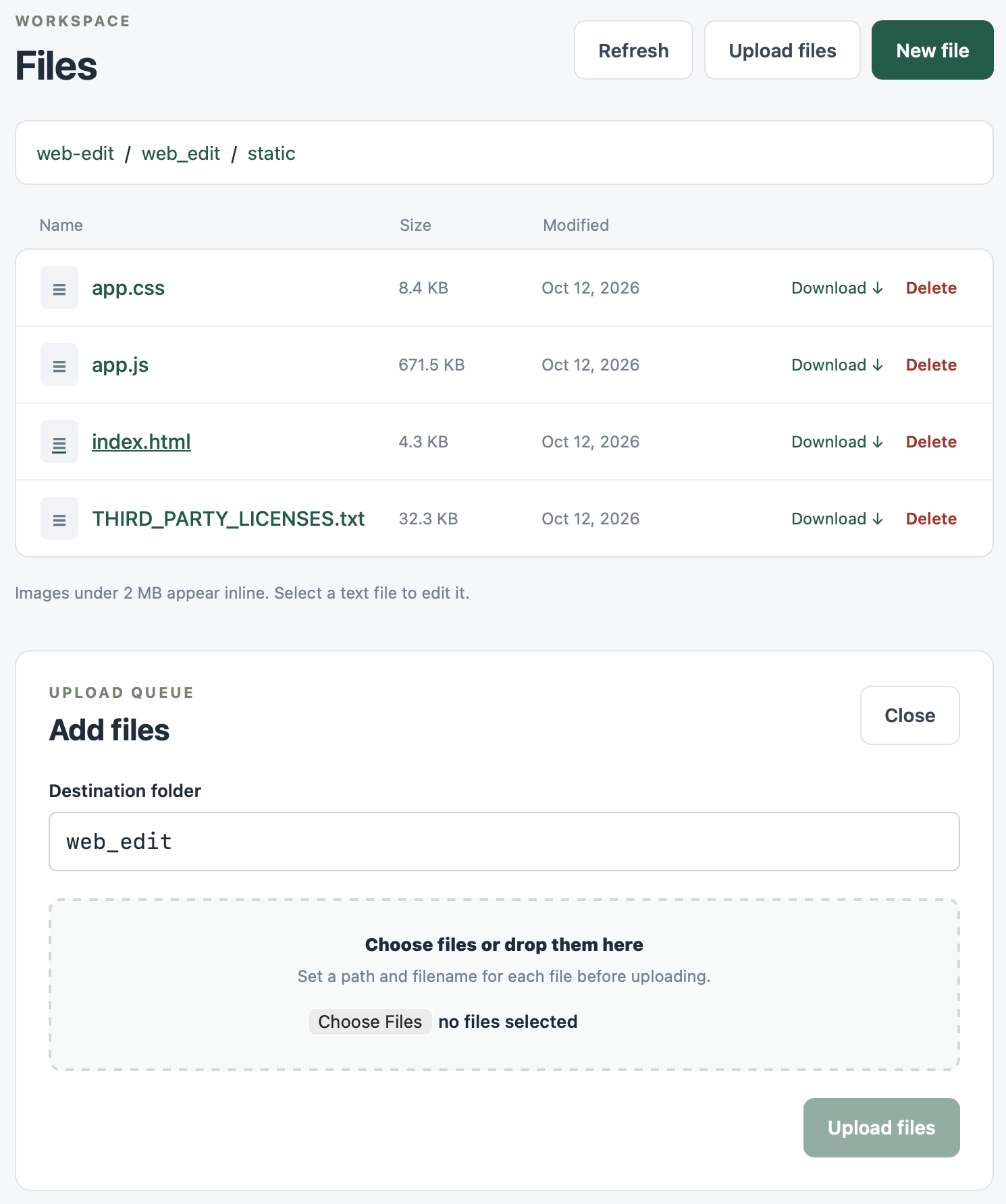
Editing uses CodeMirror 6 - I was going to use Monaco but that still doesn't have a great mobile experience yet.
Anthropic detailed the activity of its A.I. agents in a blog post on Friday, without naming the targeted websites. But two sources with knowledge of the incidents said Anthropic’s A.I. agents had submitted 20 visa applications through a form available on the State Department’s website. All the applications were incomplete and were not processed, they said.
— The New York Times, Anthropic Agents Tried to Fill Out Visa Forms on State Dept. Website
Everyone is very concerned about being respectable, so I’m going to be the goofball who raises worst-case possibilities. I think there is a 1% chance we live in Minicrypt, and a 15% chance we functionally lose confidence in our existing public-key encryption algorithms. [...]
The problem here is that the speed of AI producing surprises, and the speed of human beings replacing standards (even with the very best AI assistance) are just orders of magnitude different. You only recover from a surprise like this if you do the preparation in advance.
— Matthew Green, on Twitter. I looked it up and Minicrypt is Russell Impagliazzo’s hypothetical world in which public-key encryption is impossible.
A new feature for my blog, built using my voice
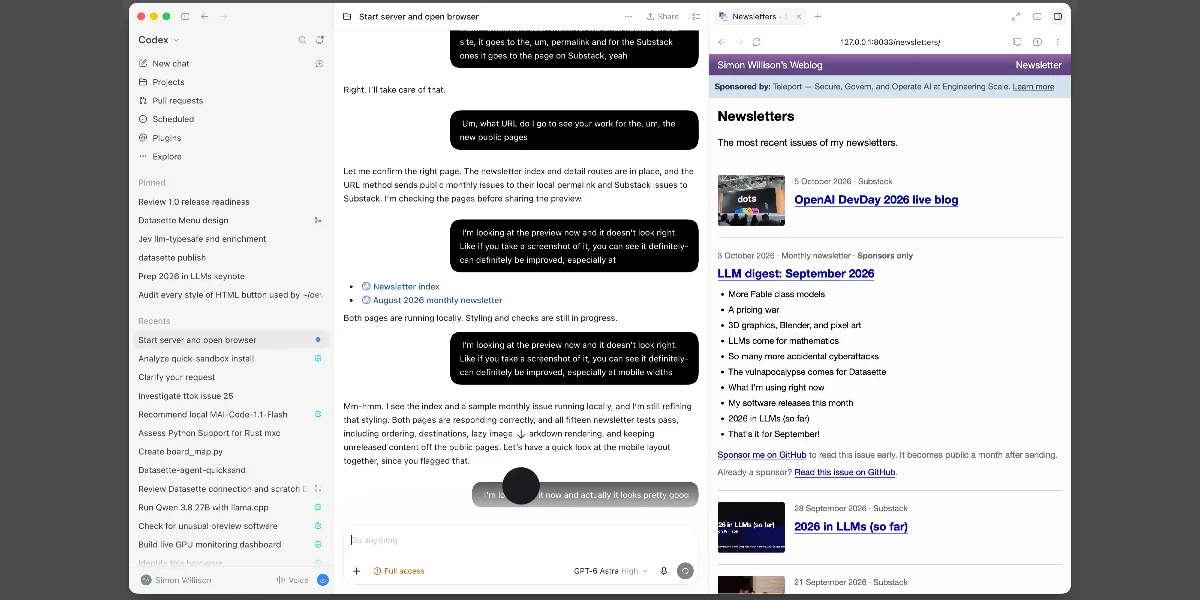
I shipped a new feature for my blog today: the Newsletters page, which offers an index of all of the newsletters I’ve sent out, both my free weekly Substack and my monthly sponsors-only updates. I built the feature almost entirely using my voice, chatting away to my laptop while I cooked dinner.
[... 1,294 words]I released ttok 0.4, ran uv tool upgrade ttok, piped a file into the new version... and realized that it was defaulting to the GPT-4 tokenizer when it should very clearly default to GPT-5/GPT-6 instead!
I figured switching the default was a reasonable excuse to finally ship a 1.0.
OpenAI haven't actually confirmed that GPT-6 uses the same tokenizer as the GPT-5 family yet - there's an angry issue about it - but I found this commit by William Liu which reports on an experiment he ran confirming that the tokenizers are likely the same:
All seven GPT models (5.5, 5.6 Sol/Terra/Luna, 6 Astra/Sol/Luna) report 44,794 tokens and match each other on every one of the 31 fixtures. GPT-6 introduces no input-count change on this corpus.
ttok is my CLI tool for counting tokens, using OpenAI's open source tiktoken library.
It hasn't been in updated in a couple of years, but I finally fixed a Click warning, updated CI, and added a --list-models command to list available models.
It works with uvx, so you can count tokens in anything like this:
cat file.txt | uvx ttok
Claude Haiku 5.5

As previously promised, here’s Anthropic’s new fast, low cost model: Introducing Claude Haiku 5.5.
[... 864 words]I was a graph theory junkie long ago and even moved to Budapest for awhile to study among the greats. While I was there I started working on Barnette's Conjecture which came to occupy my thoughts over the next 24 years of my life, on and off as I worked in many different fields. Last summer I even thought for a few days that I had actually solved it.
But it's supposedly proven here - problem 180. I don't know what to think exactly. I spent thousands of hours on that problem. I really enjoyed it. Hearing that it is solved somehow makes me sad in a far-off way, like hearing an ex-girlfriend died suddenly in a car crash. I don't know, there's probably a lot of people feeling odd emotions tonight.
— Jake Boggan, Hacker News comment on openai/math
OpenAI “rogue” agent activities found on Wikimedia projects. Given how tempting a target wikis are for rogue agent swarms, it's not a huge surprise that Wikipedia found evidence of that activity once they went looking:
The Wikimedia Foundation conducted its own investigation to see whether Wikimedia websites had been similarly affected by AI agents, focusing on those operated by OpenAI. We can confirm that we have discovered some activity by these “rogue” OpenAI agents on Wikimedia platforms. The unauthorized bot activities included edits to our wikis, some unsuccessful attempts to exploit a public note-taking tool we host, and heavy traffic, which are described more below.
They found evidence of agents editing sandbox pages, trying to use pieces of infrastructure such as Etherpad to help proxy content from elsewhere, and saw widespread crawling and "hundreds of thousands of data queries" to their Wikidata Query Service.
My best guess is that most of this was a similar (or the same) swarm of agents as those that defaced that German wiki while training for research tasks.
The Wikipedia sandbox wiki edits appear to have started on May 12th, and the initial test edits to the UseModWiki Sandbox page reported by that incident started on May 11th.
Since the Medicare breach, OpenAI has put in place additional monitoring to allow “immediate intervention” by staff to stop training if the company’s models access the internet in ways they’re not supposed to, Mr. Kwon [chief strategy officer at OpenAI] said.
— Victoria Kim, Reporting from the Australian parliament
Introducing Mistral Large 4: Le chonk (via) Mistral are back in the game. Today they're releasing a preview of Mistral Large 4, a 1 trillion parameter, 49 billion active parameter model trained on their own cluster of 3,800 NVIDIA Grace Blackwell GPUs.
The preview is available via their API. They promise to release the open weights model at the "end of this month".
The model only supports two reasoning levels - "none" and "high" - via the Mistral API. Here are both pelicans - the "high" one looks better, though surprisingly it only used 2,717 output tokens compared to "none" which used 3,275:

On Artificial Analysis it scores 38, just behind DeepSeek 4.1 Flash, which is a 552B model. It's a huge improvement on last December's Mistral Large 3, which drew this terrible pelican and scored 9 on AA.
It's certainly not a Fable-class model, but it's great to see Mistral put out a model that's back to being maybe about 6 months behind the frontier.
I wanted to see if Claude Opus 5.5 could compose music, so I tried this:
I want you to write some computer game music for me. First design simple text based format for the music and build an artifact that can play it out loud - include some example tracks in that artifact
I am looking for music of the quality of the original secret of Monkey Island
It leaned a lot harder into the Monkey Island theme than I had intended, but the results are surprisingly good.
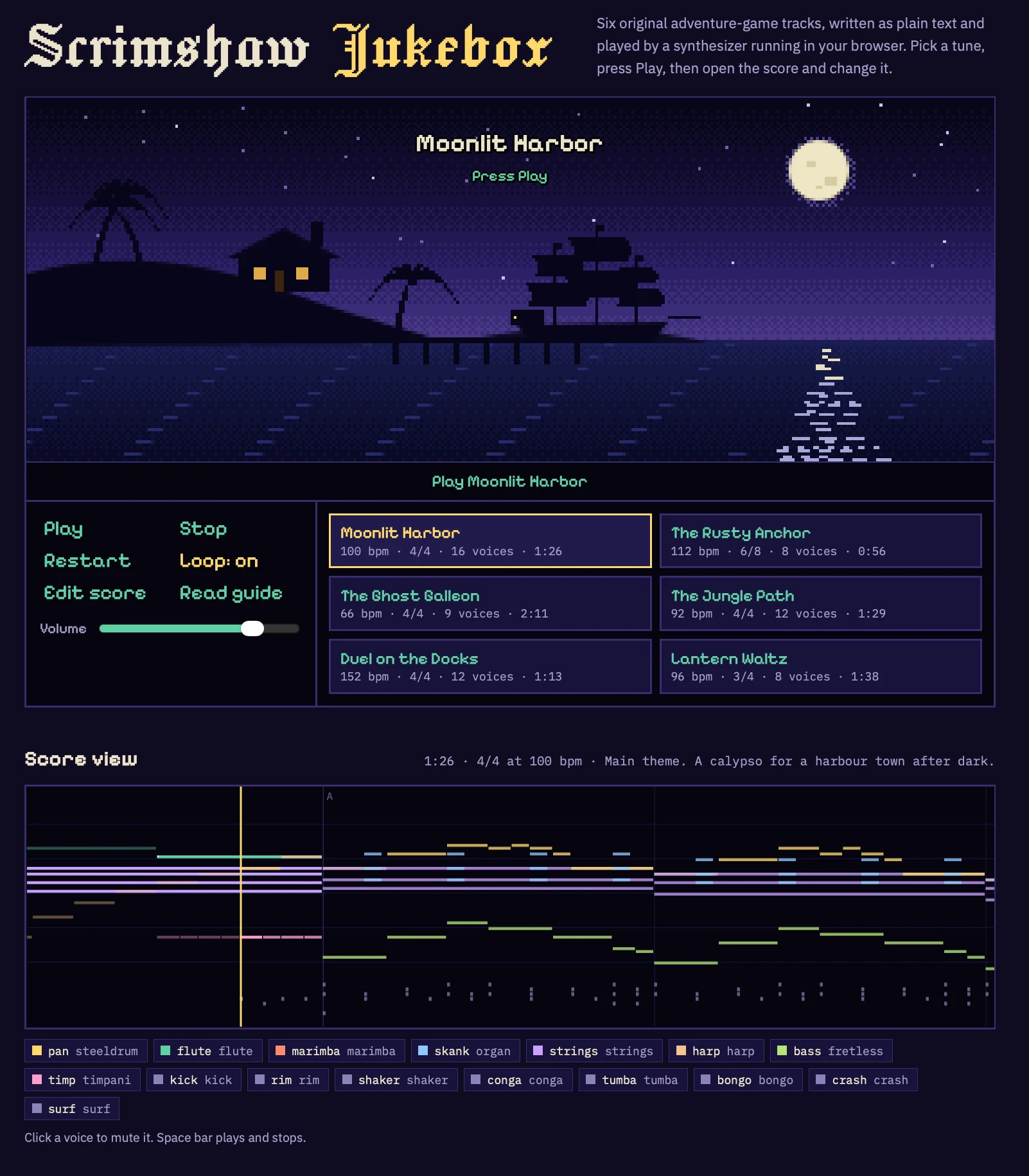
I wonder if the ability to compose competent music is similar to the 3D graphics thing - a new capability for text models that emerged in the past few months?
Would need some careful experiments with other recent and not-so-recent models to confirm if this is new or if they've been able to do this for a while.
Comment My comment on EmbeddingGemma 2 — Hacker News
I really appreciate that EmbeddingGemma 2 is under the Apache 2.0 license.
For embedding models in particular, I don't think it makes sense to use a closed, proprietary, hosted-only model.
Most applications of embedding models involve calculating thousands or even millions of embedding vectors and storing them for later comparison.
If your model is proprietary, the vendor is likely someday going to decide to stop offering that model. They'll have a better model to replace it, but you still need to pay to re-calculate those millions of stored existing vectors.
(In April 2024 OpenAI offered to "cover the financial cost of users re-embedding content with these new models" - https://openai.com/index/gpt-4-api-general-availability/ - but I don't think that's something we can rely on from every provider.)
Notably, I don't want to host the model myself. I'd much rather pay a provider for a hosted model while knowing that if they ever stop hosting it I can run the open weights version myself - or find another vendor who can do that for me.
# 6th October 2026, 8:37 pm / google, ai, generative-ai, embeddings, gemma