488 posts tagged “sqlite”
SQLite is the world's most widely deployed database engine.
2022
How SQLite Helps You Do ACID (via) Ben Johnson’s series of posts explaining the internals of SQLite continues with a deep look at how the rollback journal works. I’m learning SO much from this series.
sqlite-zstd: Transparent dictionary-based row-level compression for SQLite. Interesting SQLite extension from phiresky, the author of that amazing SQLite WASM hack from a while ago which could fetch subsets of a large SQLite database using the HTTP range header. This extension, written in Rust, implements row-level compression for a SQLite table by creating compression dictionaries for larger chunks of the table, providing better results than just running compression against each row value individually.
Introducing sqlite-html: query, parse, and generate HTML in SQLite (via) Another brilliant SQLite extension module from Alex Garcia, this time written in Go. sqlite-html adds a whole family of functions to SQLite for parsing and constructing HTML strings, built on the Go goquery and cascadia libraries. Once again, Alex uses an Observable notebook to describe the new features, with embedded interactive examples that are backed by a Datasette instance running in Fly.
Introducing sqlite-lines—a SQLite extension for reading files line-by-line (via) Alex Garcia wrote a brilliant C module for SQLIte which adds functions (and a table-valued function) for efficiently reading newline-delimited text into SQLite. When combined with SQLite’s built-in JSON features this means you can read a huge newline-delimited JSON file into SQLite in a streaming fashion so it doesn’t exhaust memory for a large file. Alex also compiled the extension to WebAssembly, and his post here is an Observable notebook post that lets you exercise the code directly.
Weeknotes: Joining the board of the Python Software Foundation
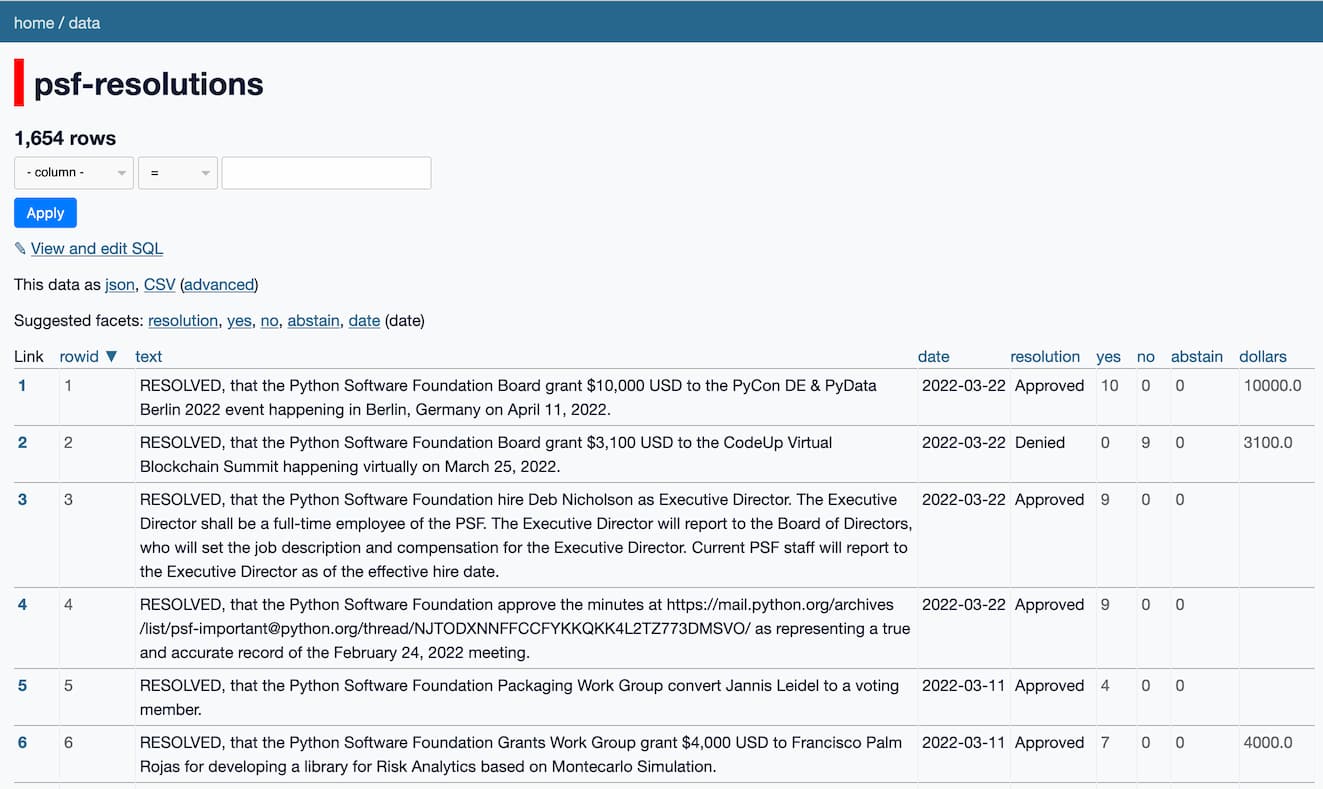
A few weeks ago I was elected to the board of directors for the Python Software Foundation.
[... 2,081 words]SQLite Internals: Pages & B-trees (via) Ben Johnson provides a delightfully clear introduction to SQLite internals, describing the binary format used to store rows on disk and how SQLite uses 4KB pages for both row storage and for the b-trees used to look up records.
Sqitch tutorial for SQLite (via) Sqitch is an interesting implementation of database migrations: it’s a command-line tool written in Perl with an interface similar to Git, providing commands to create, run, revert and track migration scripts. The scripts the selves are written as SQL in whichever database engine you are using. The tutorial for SQLite gives a good idea as to how the whole system works.
sqlite-comprehend: run AWS entity extraction against content in a SQLite database
I built a new tool this week: sqlite-comprehend, which passes text from a SQLite database through the AWS Comprehend entity extraction service and stores the returned entities.
[... 1,146 words]Bun. “Bun is a fast all-in-one JavaScript runtime”—this is very interesting. It’s the first project I’ve seen written using the Zig language, which I see as somewhat equivalent to Rust. Bun provides a full Node.js-style JavaScript environment plus a host of packaged tools—an npm install client, a TypeScript transpiler, bundling tools—all wrapped up in a single binary. The JavaScript engine itself extends JavaScriptCore. Bun also ships with its own wrapper for SQLite.
WarcDB (via) Florents Tselai built this tool for loading web crawl data stored in WARC (Web ARChive) format into a SQLite database for smaller-scale analysis with SQL, on top of my sqlite-utils Python library.
Lesser Known Features of ClickHouse (via) I keep hearing positive noises about ClickHouse. I learned about a whole bunch of capabilities from this article—including that ClickHouse can directly query tables that are stored in SQLite or PostgreSQL.
sqlite-utils: a nice way to import data into SQLite for analysis (via) Julia Evans on my sqlite-utils Python library and CLI tool.
Simple declarative schema migration for SQLite (via) This is an interesting, clearly explained approach to the database migration problem. Create a new in-memory database and apply the current schema, then run some code to compare that with the previous schema—which tables are new, and which tables have had columns added. Then apply those changes.
I’d normally be cautious of running something like this because I can think of ways it could go wrong—but SQLite backups are so quick and cheap (just copy the file) that I could see this being a relatively risk-free way to apply migrations.
Litestream: Live Read Replication (via) The documentation for the read replication implemented in the latest Litestream beta (v0.4.0-beta.2). The design is really simple and clever: the primary runs a web server on a port, and replica instances can then be started with a configured URL pointing to the IP and port of the primary. That’s all it takes to have a SQLite database replicated to multiple hosts, each of which can then conduct read queries against their local copies.
SQLite Happy Hour—a Twitter Spaces conversation about three interesting projects building on SQLite
Yesterday I hosted SQLite Happy Hour. my first conversation using Twitter Spaces. The idea was to dig into three different projects that were doing interesting things on top of SQLite. I think it worked pretty well, and I’m curious to explore this format more in the future.
[... 1,998 words]redbean (via) “redbean makes it possible to share web applications that run offline as a single-file αcτµαlly pδrταblε εxεcµταblε zip archive which contains your assets. All you need to do is download the redbean.com program below, change the filename to .zip, add your content in a zip editing tool, and then change the extension back to .com”.
redbean is implemented as a single C file with a dazzling array of clever tricks—most impressively, the single executable works on Linux, macOS, Windows and various BSDs!
It embeds Lua, and in June last year added SQLite too—so self-contained distributable web applications built with Redbean can now use Lua and SQLite for dynamic scripting. Performance sounds incredible: “redbean can serve 1 million+ gzip encoded responses per second on a cheap personal computer”.
Using SQLite and Datasette with Fly Volumes
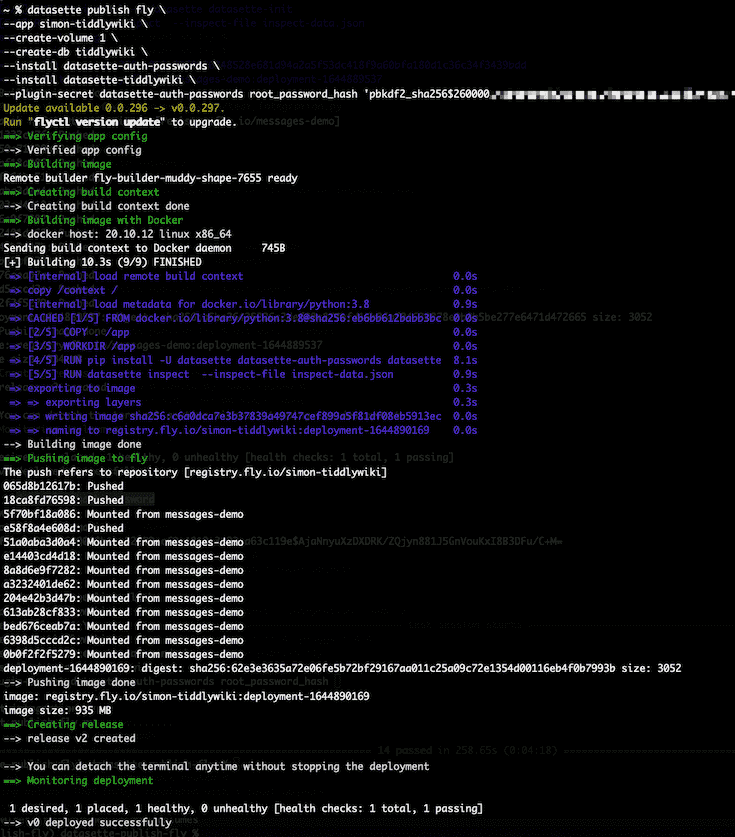
A few weeks ago, Fly announced Free Postgres Databases as part of the free tier of their hosting product. Their announcement included this snippet:
[... 1,463 words]A CGo-free port of SQLite. Fascinating Go version of SQLite, which uses Go code that has been translated from the original SQLite C using ccgo, a package by the same author which “translates cc ASTs to Go source code”. It claims to pass the full public SQLite test suite, which is very impressive.
SQLime: SQLite Playground (via) Anton Zhiyanov built this useful mobile-friendly online playground for trying things out it SQLite. It uses the sql.js library which compiles SQLite to WebAssembly, so it runs everything in the browser—but it also supports saving your work to Gists via the GitHub API. The JavaScript source code is fun to read: the site doesn’t use npm or Webpack or similar, opting instead to implement everything library-free using modern JavaScript modules and Web Components.
What’s new in sqlite-utils 3.20 and 3.21: --lines, --text, --convert
sqlite-utils is my combined CLI tool and Python library for manipulating SQLite databases. Consider this the annotated release notes for sqlite-utils 3.20 and 3.21, both released in the past week.
[... 2,456 words]