6 posts tagged “jake-archibald”
2026
Launching Interop 2026. Jake Archibald reports on Interop 2026, the initiative between Apple, Google, Igalia, Microsoft, and Mozilla to collaborate on ensuring a targeted set of web platform features reach cross-browser parity over the course of the year.
I hadn't realized how influential and successful the Interop series has been. It started back in 2021 as Compat 2021 before being rebranded to Interop in 2022.
The dashboards for each year can be seen here, and they demonstrate how wildly effective the program has been: 2021, 2022, 2023, 2024, 2025, 2026.
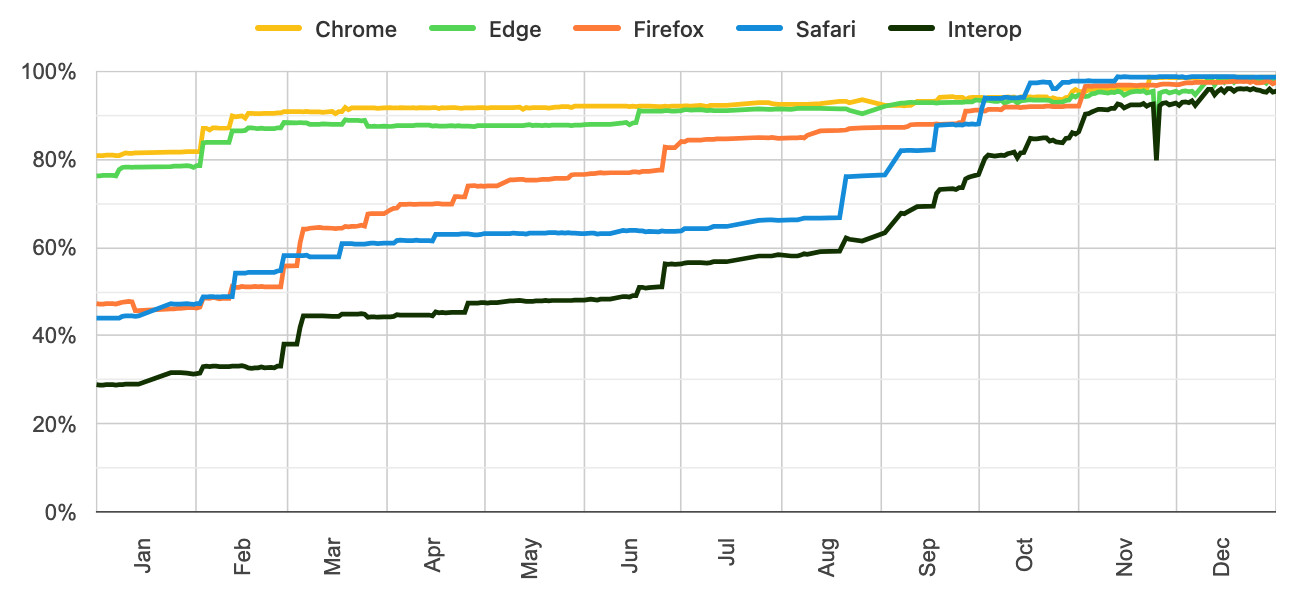
Here's the progress chart for 2025, which shows every browser vendor racing towards a 95%+ score by the end of the year:
The feature I'm most excited about in 2026 is Cross-document View Transitions, building on the successful 2025 target of Same-Document View Transitions. This will provide fancy SPA-style transitions between pages on websites with no JavaScript at all.
As a keen WebAssembly tinkerer I'm also intrigued by this one:
JavaScript Promise Integration for Wasm allows WebAssembly to asynchronously 'suspend', waiting on the result of an external promise. This simplifies the compilation of languages like C/C++ which expect APIs to run synchronously.
2025
Removing XSLT for a more secure browser (via) Previously discussed back in August, it looks like it's now official:
Chrome intends to deprecate and remove XSLT from the browser. [...] We intend to remove support from version 155 (November 17, 2026). The Firefox and WebKit projects have also indicated plans to remove XSLT from their browser engines. [...]
The continued inclusion of XSLT 1.0 in web browsers presents a significant and unnecessary security risk. The underlying libraries that process these transformations, such as libxslt (used by Chromium browsers), are complex, aging C/C++ codebases. This type of code is notoriously susceptible to memory safety vulnerabilities like buffer overflows, which can lead to arbitrary code execution.
I mostly encounter XSLT on people's Atom/RSS feeds, converting those to a more readable format in case someone should navigate directly to that link. Jake Archibald shared an alternative solution to that back in September.
Making XML human-readable without XSLT. In response to the recent discourse about XSLT support in browsers, Jake Archibald shares a new-to-me alternative trick for making an XML document readable in a browser: adding the following element near the top of the XML:
<script
  xmlns="http://www.w3.org/1999/xhtml"
  src="script.js" defer="" />
That script.js will then be executed by the browser, and can swap out the XML with HTML by creating new elements using the correct namespace:
const htmlEl = document.createElementNS(
  'http://www.w3.org/1999/xhtml',
  'html',
);
document.documentElement.replaceWith(htmlEl);
// Now populate the new DOM
2022
Bringing page transitions to the web (via) Jake Archibald’s 13 minute Google I/O talk demonstrating the page transitions API that’s now available in Chrome Canary. This is a fascinating piece of API design—it works by effectively creating a static image screenshot of the before and after states of the transition, then letting you define CSS animations that animate a transition between the two static images. By default the screenshot encompasses the full viewport, but you can instead define multiple elements within the page and apply separate transitions to them. It’s only available for SPAs right now but the final design should include support for multi-page applications as well—which means transitions with no JavaScript needed at all!
2021
How to win at CORS (via) Jake Archibald’s definitive guide to CORS, including a handy CORS playground interactive tool. Also includes a useful history explaining why we need CORS in the first place.
2020
AVIF has landed. AVIF support landed in Chrome 85 a few weeks ago. It’s a new lossy royalty-free image format derived from AV1 video and it’s really impressive—it can achieve similar results to JPEG using a quarter of the file size! Jake digs into AVIF in detail, providing lots of illustrative examples created using the Squoosh online compressor, which now supports AVIF encoding. Jake used the same WebAssembly encoder from Squoosh to decode AVIF images in a web worker so that the demos in his article would work even for browsers that don’t yet support AVIF natively.