Sunday, 22nd February 2026
How I think about Codex. Gabriel Chua (Developer Experience Engineer for APAC at OpenAI) provides his take on the confusing terminology behind the term "Codex", which can refer to a bunch of of different things within the OpenAI ecosystem:
In plain terms, Codex is OpenAI’s software engineering agent, available through multiple interfaces, and an agent is a model plus instructions and tools, wrapped in a runtime that can execute tasks on your behalf. [...]
At a high level, I see Codex as three parts working together:
Codex = Model + Harness + Surfaces [...]
- Model + Harness = the Agent
- Surfaces = how you interact with the Agent
He defines the harness as "the collection of instructions and tools", which is notably open source and lives in the openai/codex repository.
Gabriel also provides the first acknowledgment I've seen from an OpenAI insider that the Codex model family are directly trained for the Codex harness:
Codex models are trained in the presence of the harness. Tool use, execution loops, compaction, and iterative verification aren’t bolted on behaviors — they’re part of how the model learns to operate. The harness, in turn, is shaped around how the model plans, invokes tools, and recovers from failure.
London Stock Exchange: Raspberry Pi Holdings plc. Striking graph illustrating stock in the UK Raspberry Pi holding company spiking on Tuesday:
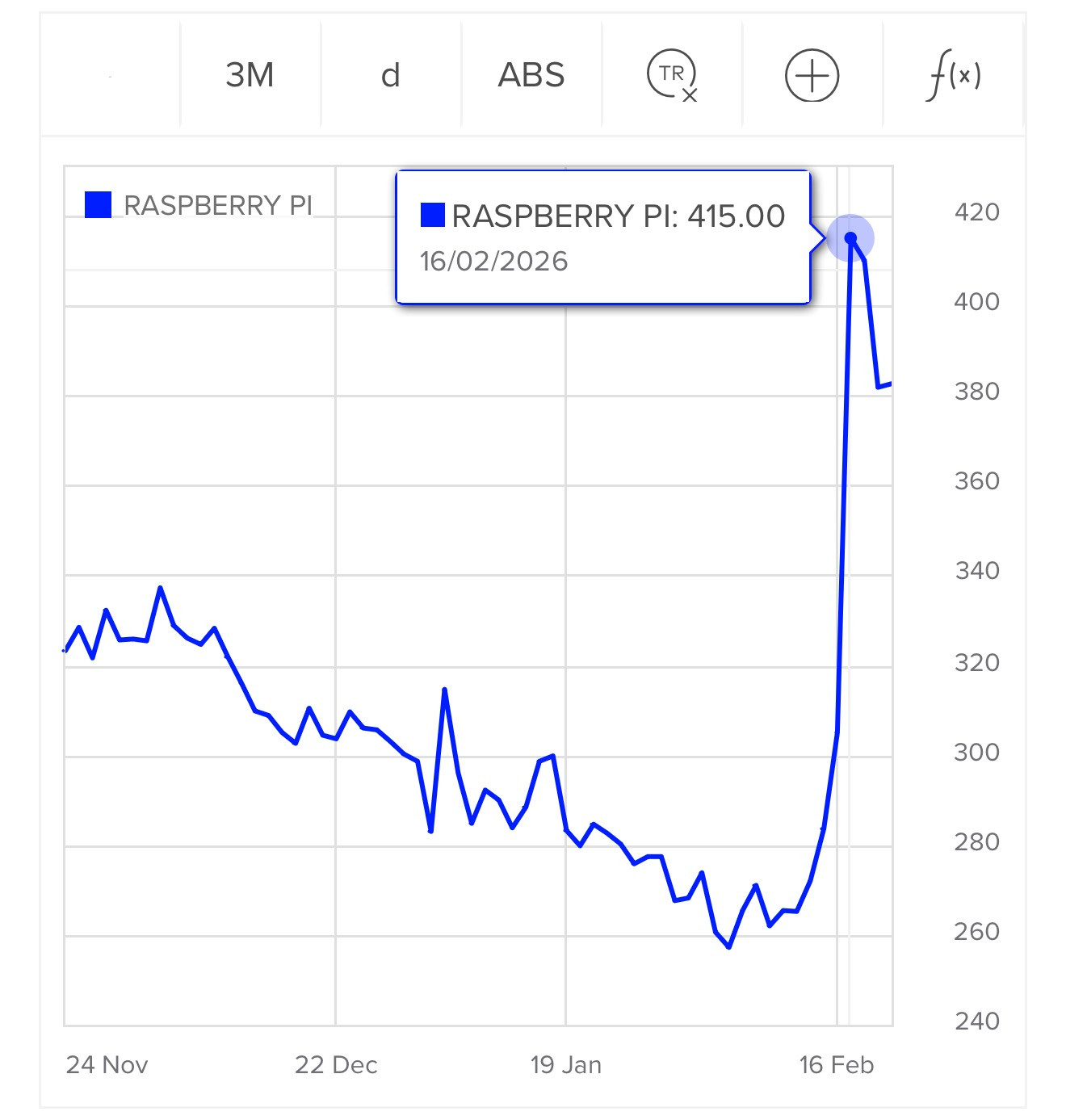
The Telegraph credited excitement around OpenClaw:
Raspberry Pi's stock price has surged 30pc in two days, amid chatter on social media that the company's tiny computers can be used to power a popular AI chatbot.
Users have turned to Raspberry Pi's small computers to run a technology known as OpenClaw, a viral AI personal assistant. A flood of posts about the practice have been viewed millions of times since the weekend.
Reuters also credit a stock purchase by CEO Eben Upton:
Shares in Raspberry Pi rose as much as 42% on Tuesday in a record two‑day rally after CEO Eben Upton bought stock in the beaten‑down UK computer hardware firm, halting a months‑long slide, as chatter grew that its products could benefit from low‑cost artificial‑intelligence projects.
Two London traders said the driver behind the surge was not clear, though the move followed a filing showing Upton bought about 13,224 pounds worth of shares at around 282 pence each on Monday.
The Claude C Compiler: What It Reveals About the Future of Software. On February 5th Anthropic's Nicholas Carlini wrote about a project to use parallel Claudes to build a C compiler on top of the brand new Opus 4.6
Chris Lattner (Swift, LLVM, Clang, Mojo) knows more about C compilers than most. He just published this review of the code.
Some points that stood out to me:
- Good software depends on judgment, communication, and clear abstraction. AI has amplified this.
- AI coding is automation of implementation, so design and stewardship become more important.
- Manual rewrites and translation work are becoming AI-native tasks, automating a large category of engineering effort.
Chris is generally impressed with CCC (the Claude C Compiler):
Taken together, CCC looks less like an experimental research compiler and more like a competent textbook implementation, the sort of system a strong undergraduate team might build early in a project before years of refinement. That alone is remarkable.
It's a long way from being a production-ready compiler though:
Several design choices suggest optimization toward passing tests rather than building general abstractions like a human would. [...] These flaws are informative rather than surprising, suggesting that current AI systems excel at assembling known techniques and optimizing toward measurable success criteria, while struggling with the open-ended generalization required for production-quality systems.
The project also leads to deep open questions about how agentic engineering interacts with licensing and IP for both open source and proprietary code:
If AI systems trained on decades of publicly available code can reproduce familiar structures, patterns, and even specific implementations, where exactly is the boundary between learning and copying?