18th March 2025 - Link Blog
Building and deploying a custom site using GitHub Actions and GitHub Pages. I figured out a minimal example of how to use GitHub Actions to run custom scripts to build a website and then publish that static site to GitHub Pages. I turned the example into a template repository, which should make getting started for a new project extremely quick.
I've needed this for various projects over the years, but today I finally put these notes together while setting up a system for scraping the iNaturalist API for recent sightings of the California Brown Pelican and converting those into an Atom feed that I can subscribe to in NetNewsWire:
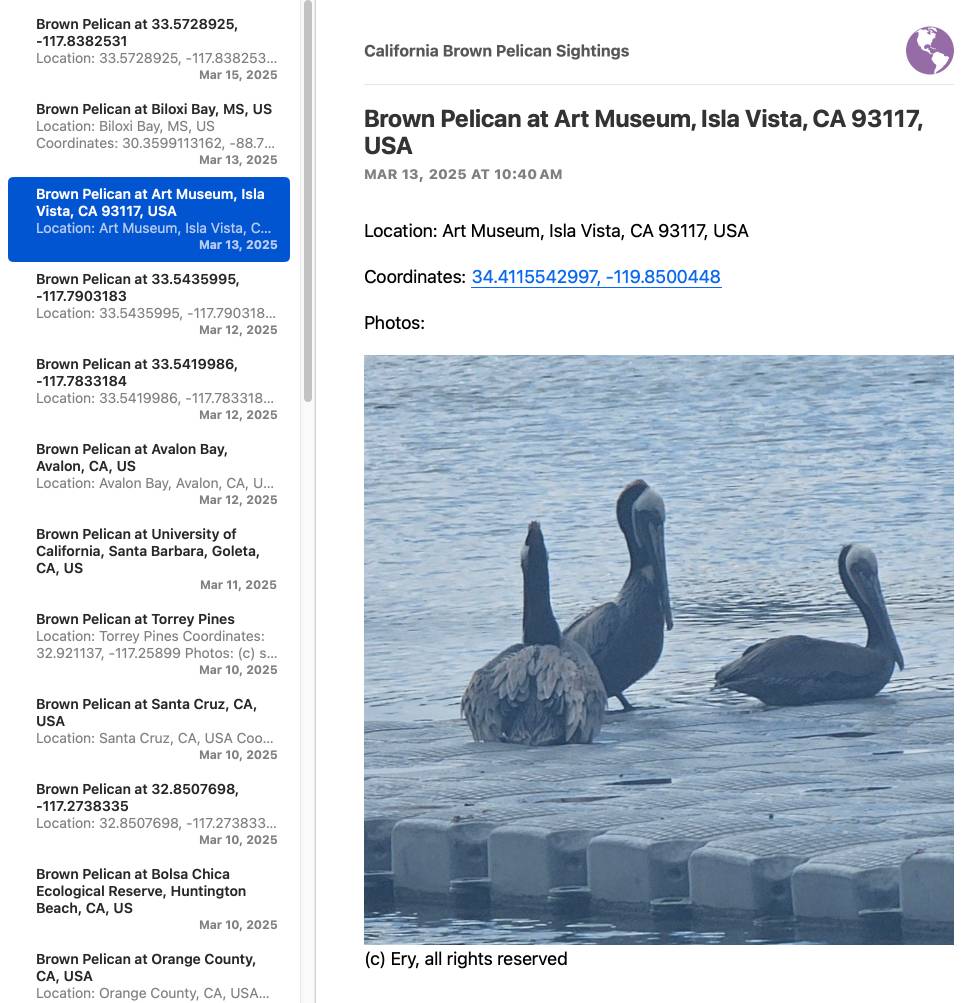
I got Claude to write me the script that converts the scraped JSON to atom.
Update: I just found out iNaturalist have their own atom feeds! Here's their own feed of recent Pelican observations.
Recent articles
- Hello Python 3.15, goodbye 3.10, and now I can use 3.11 - 12th October 2026
- A new feature for my blog, built using my voice - 9th October 2026
- Claude Haiku 5.5 - 7th October 2026
- We're going to need default hard budget caps on pretty much everything - 3rd October 2026