1,536 posts tagged “datasette”
Datasette is an open source tool for exploring and publishing data.
2025
LLM 0.27, the annotated release notes: GPT-5 and improved tool calling
I shipped LLM 0.27 today (followed by a 0.27.1 with minor bug fixes), adding support for the new GPT-5 family of models from OpenAI plus a flurry of improvements to the tool calling features introduced in LLM 0.26. Here are the annotated release notes.
[... 1,174 words]We're hosting the sixth in our series of Datasette Public Office Hours livestream sessions this Friday, 6th of June at 2pm PST (here's that time in your location).
The topic is going to be tool support in LLM, as introduced here.
I'll be walking through the new features, and we're also inviting five minute lightning demos from community members who are doing fun things with the new capabilities. If you'd like to present one of those please get in touch via this form.
Here's a link to add it to Google Calendar.
Saying Bye to Glitch (via) Pirijan, co-creator of Glitch - who stopped working on it six years ago, so has the benefit of distance:
Here lies Glitch, a place on the web you could go to write up a website or a node.js server that would be hosted and updated as you type. 🥀 RIP 2015 – 2025.
Pirijan continues with a poignant retrospective about Glitch's early origins at Fog Greek with the vision of providing "web development with real code that was as easy as editing a Google Doc". Their conclusion:
I still believe there’s a market for easy and fun web development and hosting, but a product like this needs power-users and enthusiasts willing to pay for it. To build any kind of prosumer software, you do have to be an optimist and believe that enough of the world still cares about quality and craft.
Glitch will be shutting down project hosting and user profiles on July 8th.
Code will be available to download until the end of the year. Glitch have an official Python export script that can download all of your projects and assets.
Jenn Schiffer, formerly Director of Community at Glitch and then Fastly, is a little more salty:
all that being said, i do sincerely want to thank fastly for giving glitch the opportunity to live to its 3-year acqui-versary this week. they generously took in a beautiful flower and placed it upon their sunny window sill with hopes to grow it more. the problem is they chose to never water it, and anyone with an elementary school education know what happens then. i wish us all a merry august earnings call season.
I'm very sad to see Glitch go. I've been pointing people to my tutorial on Running Datasette on Glitch for 5 years now, it was a fantastic way to help people quickly get started hosting their own projects.
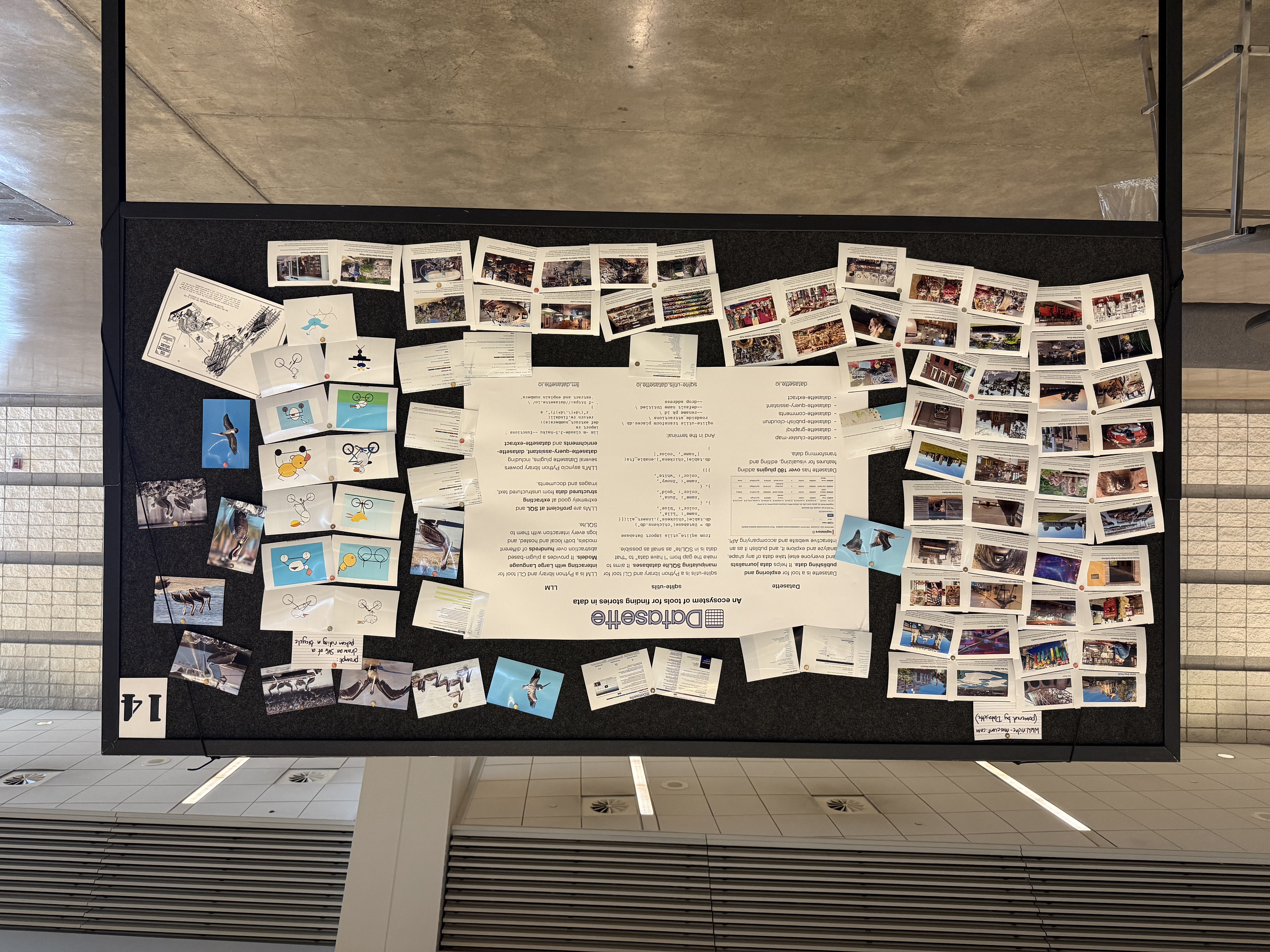
In addition to my workshop the other day I'm also participating in the poster session at PyCon US this year.
This means that tomorrow (Sunday 18th May) I'll be hanging out next to my poster from 10am to 1pm in Hall A talking to people about my various projects.
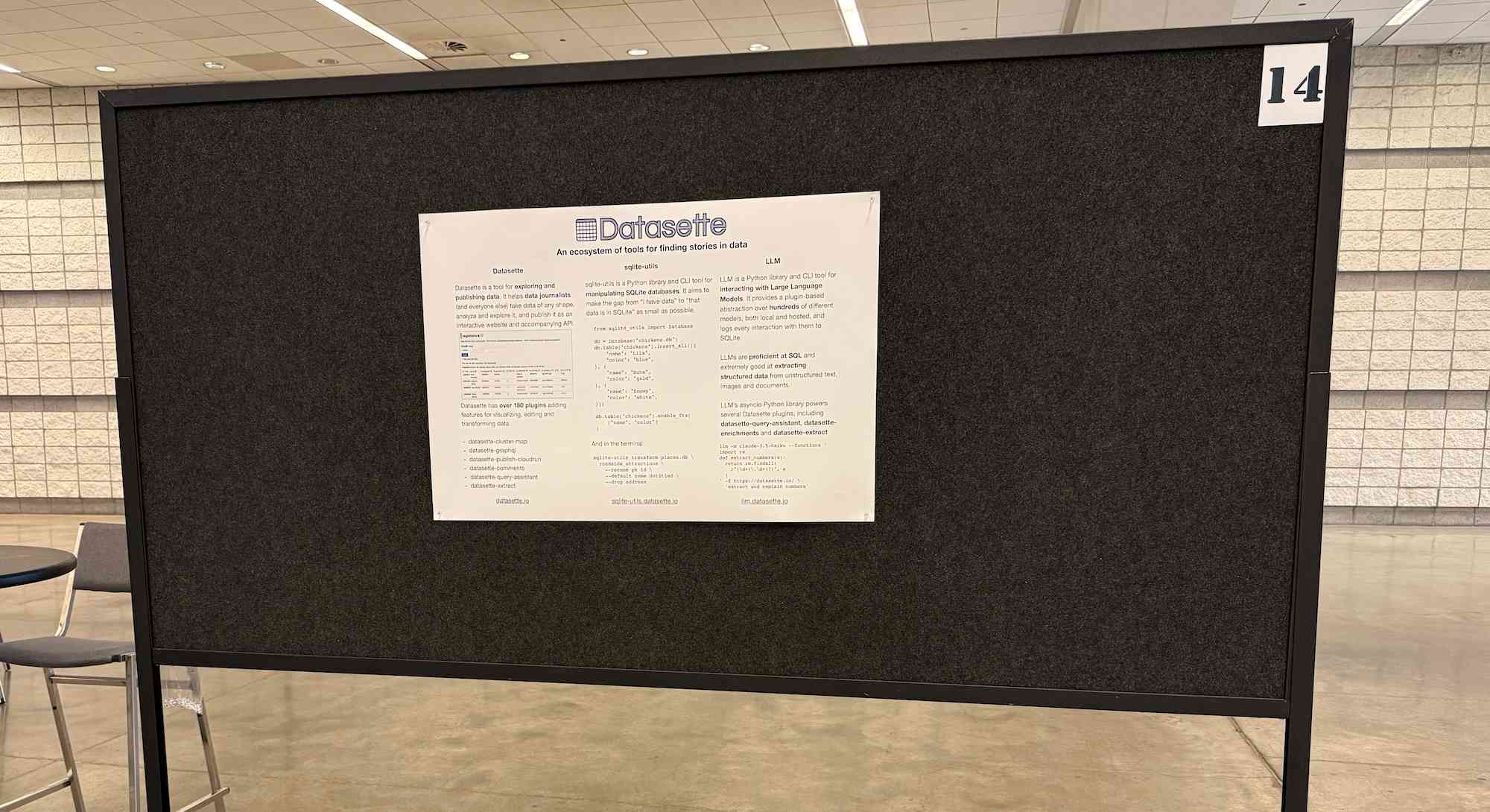
I'll confess: I didn't pay close enough attention to the poster information, so when I first put my poster up it looked a little small:
... so I headed to the nearest CVS and printed out some photos to better represent my interests and personality. I'm going for a "teenage bedroom" aesthetic here, I'm very happy with the result:
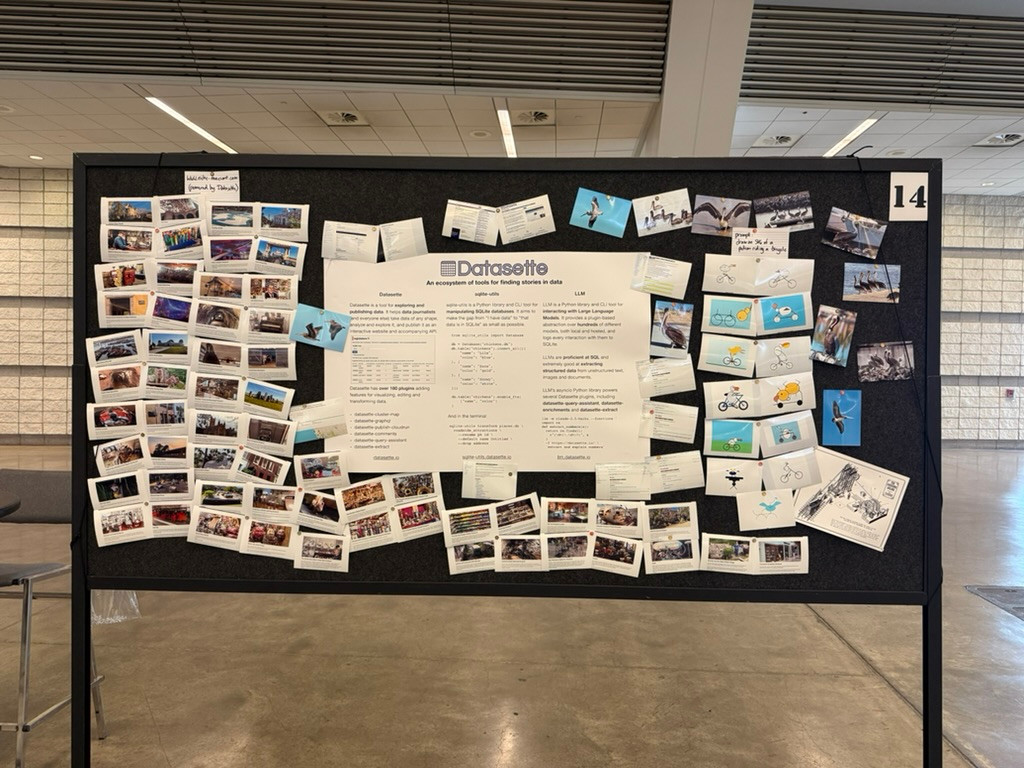
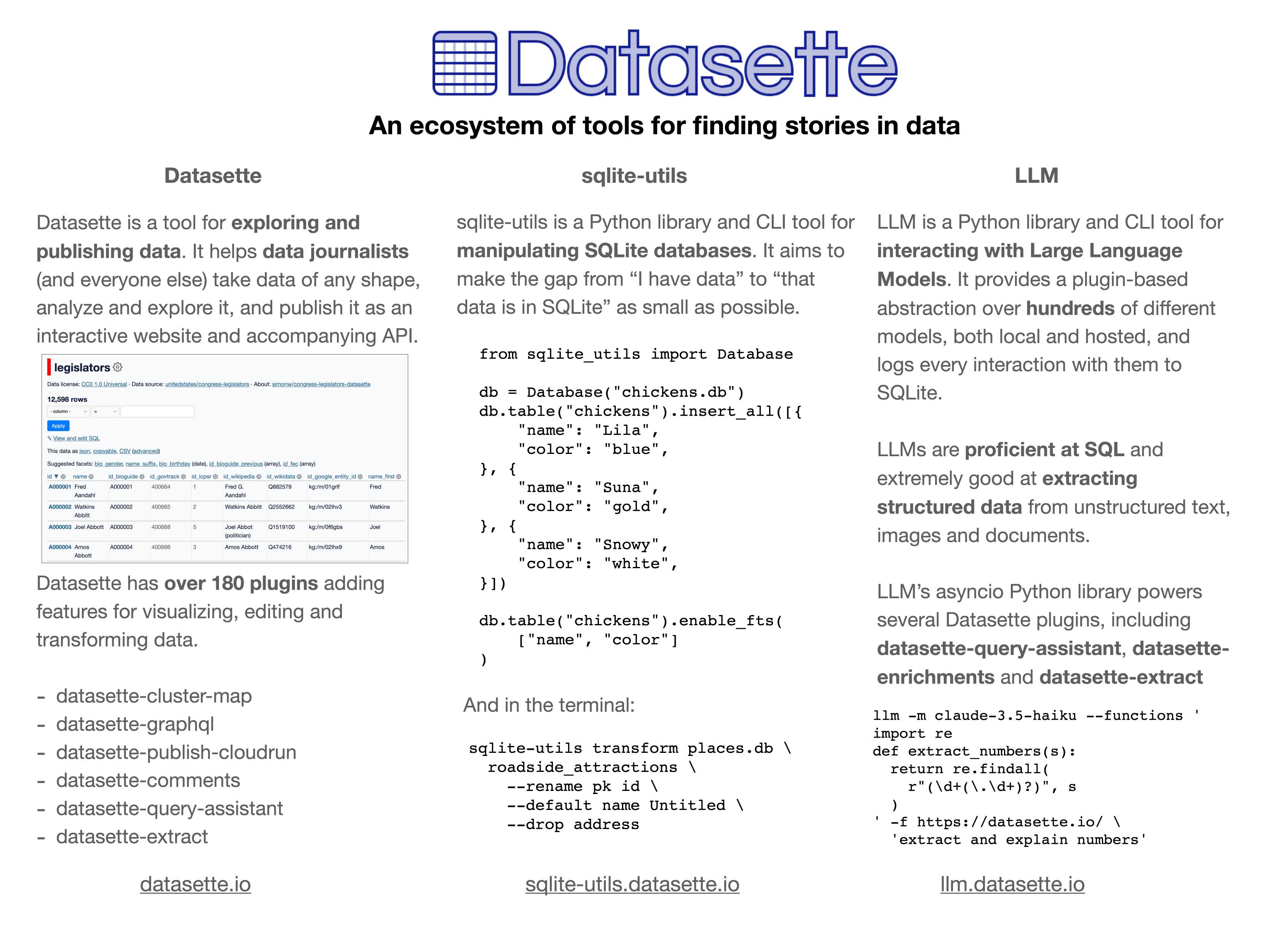
Here's the poster in the middle (also available as a PDF). It has columns for Datasette, sqlite-utils and LLM.
If you're at PyCon I'd love to talk to you about things I'm working on!
Update: Thanks to everyone who came along. Here's a 6MB photo of the poster setup. The museums were all from my www.niche-museums.com site and the pelicans riding a bicycle SVGs came from my pelican-riding-a-bicycle tag.
django-simple-deploy. Eric Matthes presented a lightning talk about this project at PyCon US this morning. "Django has a deploy command now". You can run it like this:
pip install django-simple-deploy[fly_io]
# Add django_simple_deploy to INSTALLED_APPS.
python manage.py deploy --automate-all
It's plugin-based (inspired by Datasette!) and the project has stable plugins for three hosting platforms: dsd-flyio, dsd-heroku and dsd-platformsh.
Currently in development: dsd-vps - a plugin that should work with any VPS provider, using Paramiko to connect to a newly created instance and run all of the commands needed to start serving a Django application.
Introducing Datasette for Newsrooms. We're introducing a new product suite today called Datasette for Newsrooms - a bundled collection of Datasette Cloud features built specifically for investigative journalists and data teams. We're describing it as an all-in-one data store, search engine, and collaboration platform designed to make working with data in a newsroom easier, faster, and more transparent.
If your newsroom could benefit from a managed version of Datasette we would love to hear from you. We're offering it to nonprofit newsrooms for free for the first year (they can pay us in feedback), and we have a two month trial for everyone else.
Get in touch at hello@datasette.cloud if you'd like to try it out.
One crucial detail: we will help you get started - we'll load data into your instance for you (you get some free data engineering!) and walk you through how to use it, and we will eagerly consume any feedback you have for us and prioritize shipping anything that helps you use the tool. Our unofficial goal: we want someone to win a Pulitzer for investigative reporting where our tool played a tiny part in their reporting process.
Here's an animated GIF demo (taken from our new Newsrooms landing page) of my favorite recent feature: the ability to extract structured data into a table starting with an unstructured PDF, using the latest version of the datasette-extract plugin.

The single most impactful investment I’ve seen AI teams make isn’t a fancy evaluation dashboard—it’s building a customized interface that lets anyone examine what their AI is actually doing. I emphasize customized because every domain has unique needs that off-the-shelf tools rarely address. When reviewing apartment leasing conversations, you need to see the full chat history and scheduling context. For real-estate queries, you need the property details and source documents right there. Even small UX decisions—like where to place metadata or which filters to expose—can make the difference between a tool people actually use and one they avoid. [...]
Teams with thoughtfully designed data viewers iterate 10x faster than those without them. And here’s the thing: These tools can be built in hours using AI-assisted development (like Cursor or Loveable). The investment is minimal compared to the returns.
— Hamel Husain, A Field Guide to Rapidly Improving AI Products
files-to-prompt 0.5.
My files-to-prompt tool (originally built using Claude 3 Opus back in April) had been accumulating a bunch of issues and PRs - I finally got around to spending some time with it and pushed a fresh release:
- New
-n/--line-numbersflag for including line numbers in the output. Thanks, Dan Clayton. #38- Fix for utf-8 handling on Windows. Thanks, David Jarman. #36
--ignorepatterns are now matched against directory names as well as file names, unless you pass the new--ignore-files-onlyflag. Thanks, Nick Powell. #30
I use this tool myself on an almost daily basis - it's fantastic for quickly answering questions about code. Recently I've been plugging it into Gemini 2.0 with its 2 million token context length, running recipes like this one:
git clone https://github.com/bytecodealliance/componentize-py
cd componentize-py
files-to-prompt . -c | llm -m gemini-2.0-pro-exp-02-05 \
  -s 'How does this work? Does it include a python compiler or AST trick of some sort?'
I ran that question against the bytecodealliance/componentize-py repo - which provides a tool for turning Python code into compiled WASM - and got this really useful answer.
Here's another example. I decided to have o3-mini review how Datasette handles concurrent SQLite connections from async Python code - so I ran this:
git clone https://github.com/simonw/datasette
cd datasette/datasette
files-to-prompt database.py utils/__init__.py -c | \
  llm -m o3-mini -o reasoning_effort high \
  -s 'Output in markdown a detailed analysis of how this code handles the challenge of running SQLite queries from a Python asyncio application. Explain how it works in the first section, then explore the pros and cons of this design. In a final section propose alternative mechanisms that might work better.'
Here's the result. It did an extremely good job of explaining how my code works - despite being fed just the Python and none of the other documentation. Then it made some solid recommendations for potential alternatives.
I added a couple of follow-up questions (using llm -c) which resulted in a full working prototype of an alternative threadpool mechanism, plus some benchmarks.
One final example: I decided to see if there were any undocumented features in Litestream, so I checked out the repo and ran a prompt against just the .go files in that project:
git clone https://github.com/benbjohnson/litestream
cd litestream
files-to-prompt . -e go -c | llm -m o3-mini \
  -s 'Write extensive user documentation for this project in markdown'
Once again, o3-mini provided a really impressively detailed set of unofficial documentation derived purely from reading the source.