8 posts tagged “predictions”
2026
Oxide and Friends: The Open Weight Revolution with Simon Willison. On Monday Bryan Cantrill and Adam Leventhal invited me to join their podcast to talk about the wild week we've had - with Kimi K3 showing open weight models can stand toe-to-toe with proprietary frontier ones, accidental cybersecurity attacks, and public letters about Open Weights and American AI Leadership signed by almost every big name in AI (with one notable exception).
It was a great conversation, even though it's already out-of-date! DeepSeek V4 Flash 0731 and Anthropic's own embarrassing cyber incident would absolutely have made the cut if we had recorded just a few days later.
We also talk about Golden Gate Claude, the Zizians, Alameda wild turkey attacks, Soviet Marburg virus research, the Lead-crime hypothesis, and a bunch of other worthy digressions.
Finally, we revisited some of our predictions from January, and we added a new Pope prediction:
Prediction by the end of this year: the Pope says something about open models.
Notes on Pope Leo XIV’s encyclical on AI
Dropped this morning by the Vatican: Magnifica Humanitas of His Holiness Pope Leo XIV on Safeguarding the Human Person in the Time of Artificial Intelligence. This is a very interesting document. It’s some of the clearest writing I’ve seen on the ethics of integrating AI into modern society.
[... 1,865 words]One Human + One Agent = One Browser From Scratch (via) embedding-shapes was so infuriated by the hype around Cursor's FastRender browser project - thousands of parallel agents producing ~1.6 million lines of Rust - that they were inspired to take a go at building a web browser using coding agents themselves.
The result is one-agent-one-browser and it's really impressive. Over three days they drove a single Codex CLI agent to build 20,000 lines of Rust that successfully renders HTML+CSS with no Rust crate dependencies at all - though it does (reasonably) use Windows, macOS and Linux system frameworks for image and text rendering.
I installed the 1MB macOS binary release and ran it against my blog:
chmod 755 ~/Downloads/one-agent-one-browser-macOS-ARM64
~/Downloads/one-agent-one-browser-macOS-ARM64 https://simonwillison.net/
Here's the result:
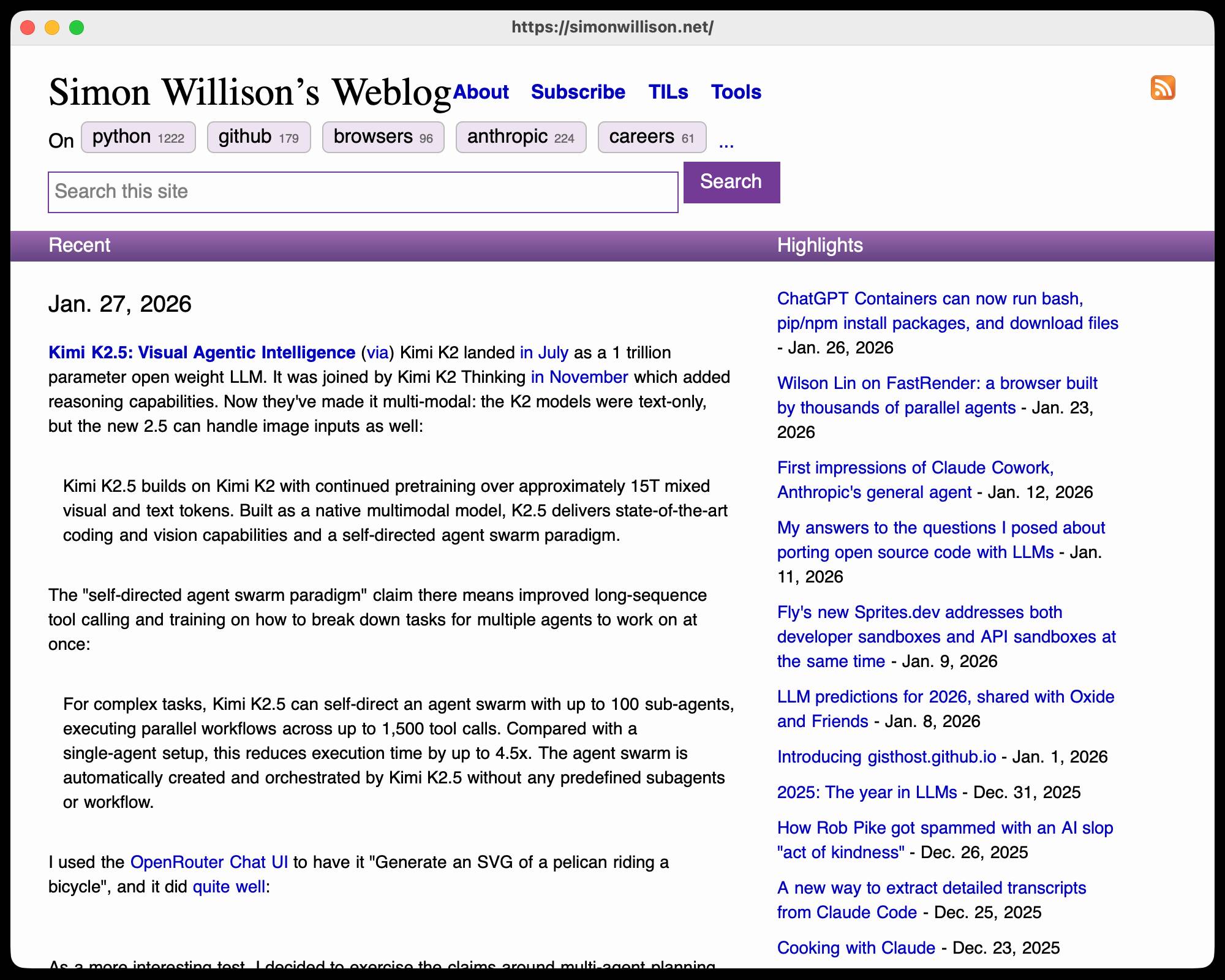
It even rendered my SVG feed subscription icon! A PNG image is missing from the page, which looks like an intermittent bug (there's code to render PNGs).
The code is pretty readable too - here's the flexbox implementation.
I had thought that "build a web browser" was the ideal prompt to really stretch the capabilities of coding agents - and that it would take sophisticated multi-agent harnesses (as seen in the Cursor project) and millions of lines of code to achieve.
Turns out one agent driven by a talented engineer, three days and 20,000 lines of Rust is enough to get a very solid basic renderer working!
I'm going to upgrade my prediction for 2029: I think we're going to get a production-grade web browser built by a small team using AI assistance by then.
LLM predictions for 2026, shared with Oxide and Friends

I joined a recording of the Oxide and Friends podcast on Tuesday to talk about 1, 3 and 6 year predictions for the tech industry. This is my second appearance on their annual predictions episode, you can see my predictions from January 2025 here. Here’s the page for this year’s episode, with options to listen in all of your favorite podcast apps or directly on YouTube.
[... 1,773 words]2025
Prediction: AI will make formal verification go mainstream (via) Martin Kleppmann makes the case for formal verification languages (things like Dafny, Nagini, and Verus) to finally start achieving more mainstream usage. Code generated by LLMs can benefit enormously from more robust verification, and LLMs themselves make these notoriously difficult systems easier to work with.
The paper Can LLMs Enable Verification in Mainstream Programming? by JetBrains Research in March 2025 found that Claude 3.5 Sonnet saw promising results for the three languages I listed above.
My AI/LLM predictions for the next 1, 3 and 6 years, for Oxide and Friends
The Oxide and Friends podcast has an annual tradition of asking guests to share their predictions for the next 1, 3 and 6 years. Here’s 2022, 2023 and 2024. This year they invited me to participate. I’ve never been brave enough to share any public predictions before, so this was a great opportunity to get outside my comfort zone!
[... 2,675 words]2023
Scaling laws allow us to precisely predict some coarse-but-useful measures of how capable future models will be as we scale them up along three dimensions: the amount of data they are fed, their size (measured in parameters), and the amount of computation used to train them (measured in FLOPs). [...] Our ability to make this kind of precise prediction is unusual in the history of software and unusual even in the history of modern AI research. It is also a powerful tool for driving investment since it allows R&D teams to propose model-training projects costing many millions of dollars, with reasonable confidence that these projects will succeed at producing economically valuable systems.
2008
The strain due to the fact that most business desktops are locked into the Microsoft platform, at a time when both the Apple and GNU/Linux alternatives are qualitatively safer, better, and cheaper to operate, will start to become impossible to ignore.
— Tim Bray