March 2022
74 posts: 9 entries, 10 links, 2 quotes, 53 beats
Monday, 14th March 2022
Scraping web pages from the command line with shot-scraper
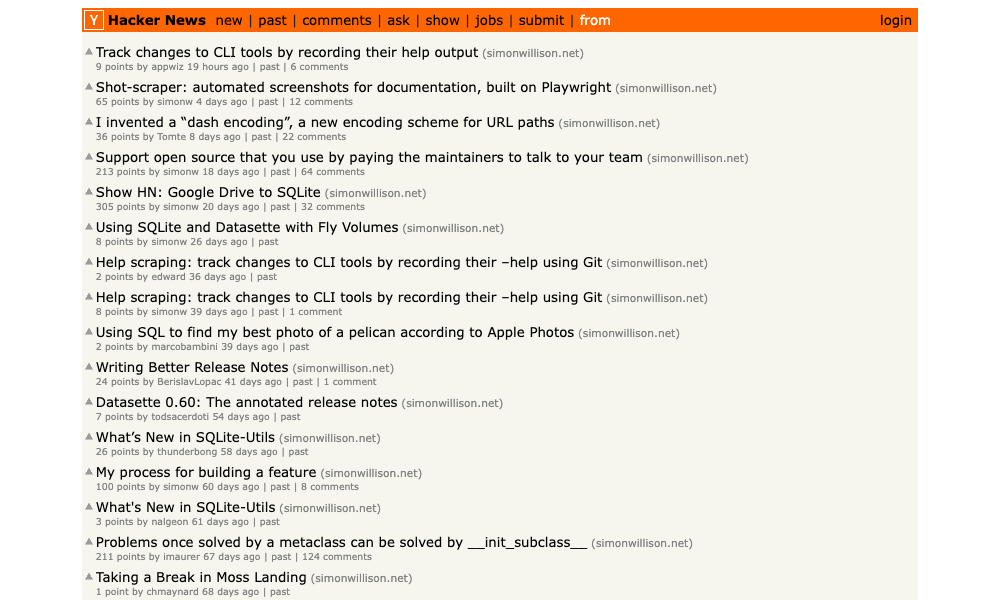
I’ve added a powerful new capability to my shot-scraper command line browser automation tool: you can now use it to load a web page in a headless browser, execute JavaScript to extract information and return that information back to the terminal as JSON.
[... 1,277 words]Instantly create a GitHub repository to take screenshots of a web page
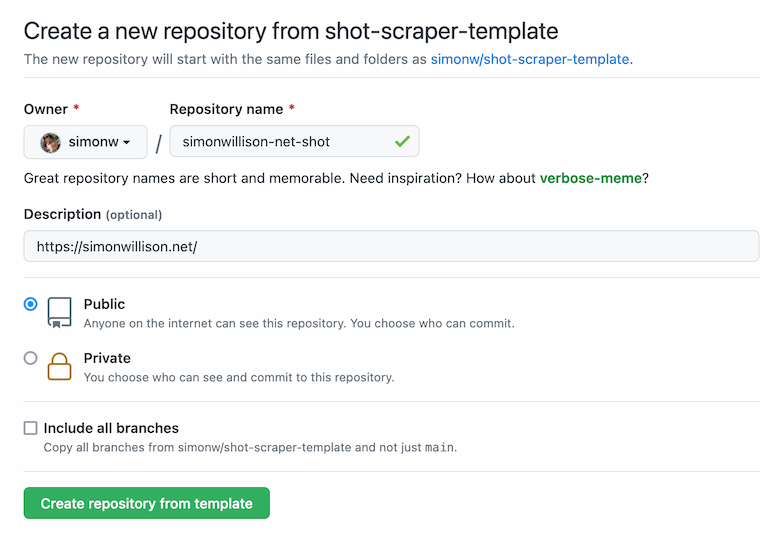
I just released shot-scraper-template, a GitHub repository template that helps you start taking automated screenshots of a web page by filling out a form.
[... 1,177 words]Tuesday, 15th March 2022
Contributing to Complex Projects (via) Mitchell Hashimoto describes in detail his process for understanding and eventually contributing to a complex new codebase. I picked up a whole bunch of useful tips from this.
Bugs in Hello World. If a Unix program attempts to send its standard output to /dev/full it should return an error code. Many classic “hello world” programs fail to correctly handle this case.
typesplainer (via) A Python module that produces human-readable English descriptions of Python type definitions—also available as a web interface.
Wednesday, 16th March 2022
Thursday, 17th March 2022
Deno by example (via) Interesting approach to documentation: a big list of annotated examples illustrating the Deno way of solving a bunch of common problems.
Saturday, 19th March 2022
Weeknotes: Tildes not dashes, and the big refactor
After last week’s shot-scraper distractions with Playwright, this week I finally managed to make some concrete progress on the path towards Datasette 1.0.
[... 1,292 words]
Sunday, 20th March 2022
Monday, 21st March 2022
Tuesday, 22nd March 2022


Wednesday, 23rd March 2022
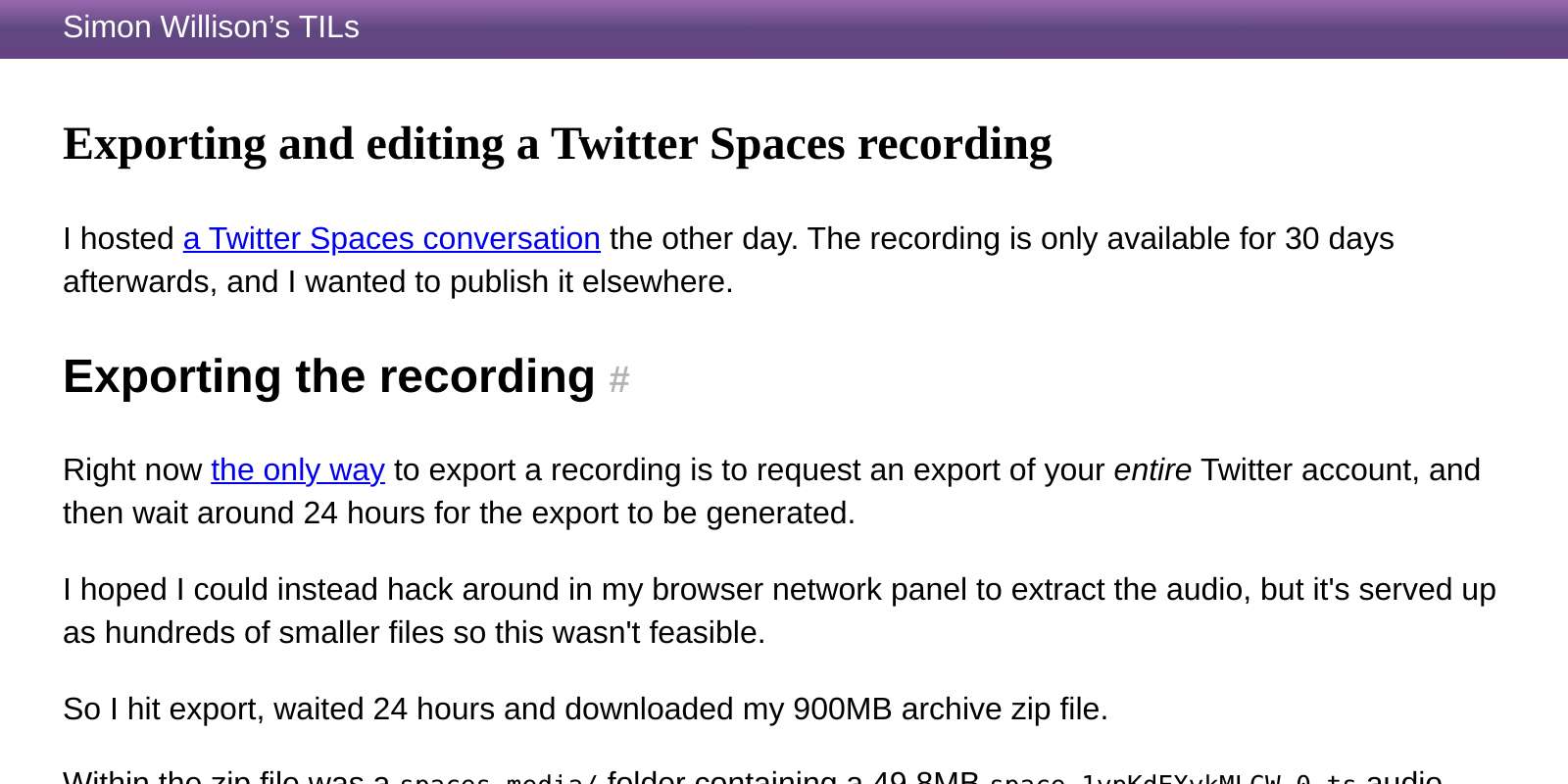
SQLite Happy Hour—a Twitter Spaces conversation about three interesting projects building on SQLite
Yesterday I hosted SQLite Happy Hour. my first conversation using Twitter Spaces. The idea was to dig into three different projects that were doing interesting things on top of SQLite. I think it worked pretty well, and I’m curious to explore this format more in the future.
[... 1,998 words]Thursday, 24th March 2022
Datasette 0.61: The annotated release notes
I released Datasette 0.61 this morning—closely followed by 0.61.1 to fix a minor bug. Here are the annotated release notes.
[... 1,465 words]DAOs are, I think, one of the best illustrations of the problem with a lot of these Web3 projects: They are trying to find technological solutions that will somehow codify very complex social structures. A lot of them also seem to operate under the assumption that everyone is acting in good faith, and that project members’ interests will generally align—a baffling assumption given the amount of bad actors in the crypto space.
geoBoundaries. This looks useful: “The world’s largest open, free and research-ready database of political administrative boundaries.” Founded by the geoLab at William & Mary university, and released under a Creative Commons Attribution license that includes a requirement for a citation. File formats offered include shapefiles, GeoJSON and TopoJSON.
