April 2023
116 posts: 17 entries, 45 links, 19 quotes, 29 beats, 6 newsletters
Saturday, 22nd April 2023
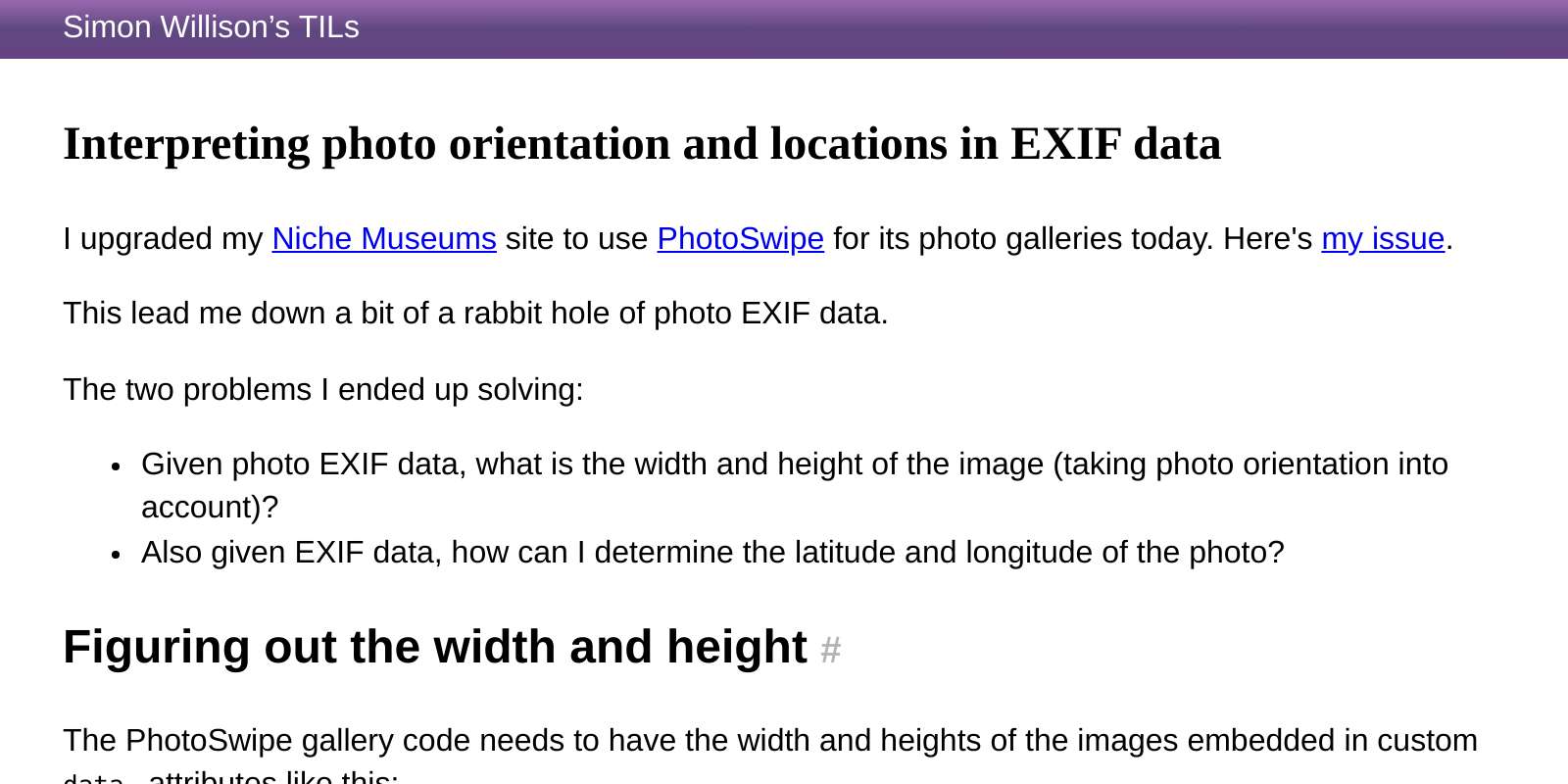
Sunday, 23rd April 2023
A lot of people who claim to be doing prompt engineering today are actually just blind prompting. "Blind Prompting" is a term I am using to describe the method of creating prompts with a crude trial-and-error approach paired with minimal or no testing and a very surface level knowedge of prompting. Blind prompting is not prompt engineering. [...] In this blog post, I will make the argument that prompt engineering is a real skill that can be developed based on real experimental methodologies.
Weeknotes: Citus Con, PyCon and three new niche museums
I’ve had a busy week in terms of speaking: on Tuesday I gave an online keynote at Citus Con, “Big Opportunities in Small Data”. I then flew to Salt Lake City for PyCon that evening and gave a three hour workshop on Wednesday, “Data analysis with SQLite and Python”.
[... 225 words]Introducing PyPI Organizations. Launched at PyCon US today: Organizations allow packages on the Python Package Index to be owned by a group, not an individual user account. “We’re making organizations available to community projects for free, forever, and to corporate projects for a small fee.”—this is the first revenue generating PyPI feature.
Monday, 24th April 2023
Rye.
Armin Ronacher's take on a Python packaging tool. There are a lot of interesting ideas in this one - it's written in Rust, configured using pyproject.toml and has some very strong opinions, including completely hiding pip from view and insisting you use rye add package instead. Notably, it doesn't use the system Python at all: instead, it downloads a pre-compiled standalone Python from Gregory Szorc's python-build-standalone project - the same approach I used for the Datasette Desktop Electron app.
Armin warns that this is just an exploration, with no guarantees of future maintenance - and even has an issue open titled Should Rye exist?
Tuesday, 25th April 2023

The Dual LLM pattern for building AI assistants that can resist prompt injection
I really want an AI assistant: a Large Language Model powered chatbot that can answer questions and perform actions for me based on access to my private data and tools.
[... 2,632 words]
Wednesday, 26th April 2023
The Consumer Financial Protection Bureau (CFPB) supervises, sets rules for, and enforces numerous federal consumer financial laws and guards consumers in the financial marketplace from unfair, deceptive, or abusive acts or practices and from discrimination [...] the fact that the technology used to make a credit decision is too complex, opaque, or new is not a defense for violating these laws.
How prompt injection attacks hijack today’s top-end AI – and it’s really tough to fix. Thomas Claburn interviewed me about prompt injection for the Register. Lots of direct quotes from our phone call in here—we went pretty deep into why it’s such a difficult problem to address.
urllib3 v2.0.0 is now generally available. urllib3 is 12 years old now, and is a common low-level dependency for packages like requests and httpx. The biggest new feature in v2 is a higher-level API: resp = urllib3.request(“GET”, “https://example.com”)—a very welcome addition to the library.
Thursday, 27th April 2023

GPT-3 token encoder and decoder. I built an Observable notebook with an interface to encode, decode and search through GPT-3 tokens, building on top of a notebook by EJ Fox and Ian Johnson.
Friday, 28th April 2023
Trainbot (via) “Trainbot watches a piece of train track, detects passing trains, and stitches together images of them”—check out the site itself too, which shows beautifully stitched panoramas of trains that have recently passed near Jo M’s apartment. Found via the best Hacker News thread I’ve seen in years, “Ask HN: Most interesting tech you built for just yourself?”.

IF by DeepFloyd Lab (via) New image generation AI model, financially backed by StabilityAI but based on the Google Imagen paper. Claims to be much better at following complex prompts, including being able to generate text! I tried the Colab notebook with “a photograph of raccoon in the woods holding a sign that says ’I will eat your trash’” and it didn’t quite get the text right, see via link for the result.
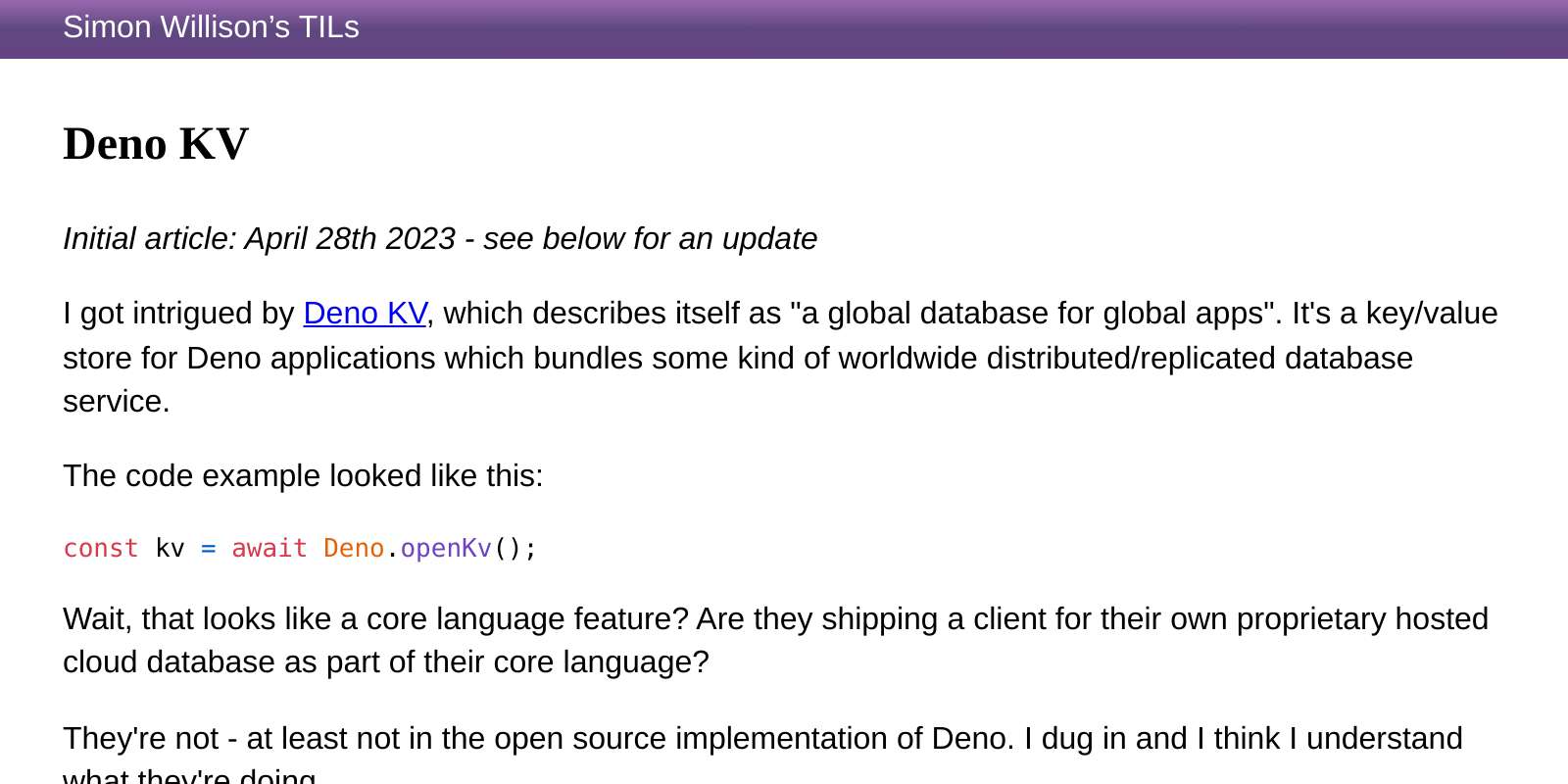
Saturday, 29th April 2023
MLC LLM (via) From MLC, the team that gave us Web LLM and Web Stable Diffusion. “MLC LLM is a universal solution that allows any language model to be deployed natively on a diverse set of hardware backends and native applications”. I installed their iPhone demo from TestFlight this morning and it does indeed provide an offline LLM that runs on my phone. It’s reasonably capable—the underlying model for the app is vicuna-v1-7b, a LLaMA derivative.
Enriching data with GPT3.5 and SQLite SQL functions
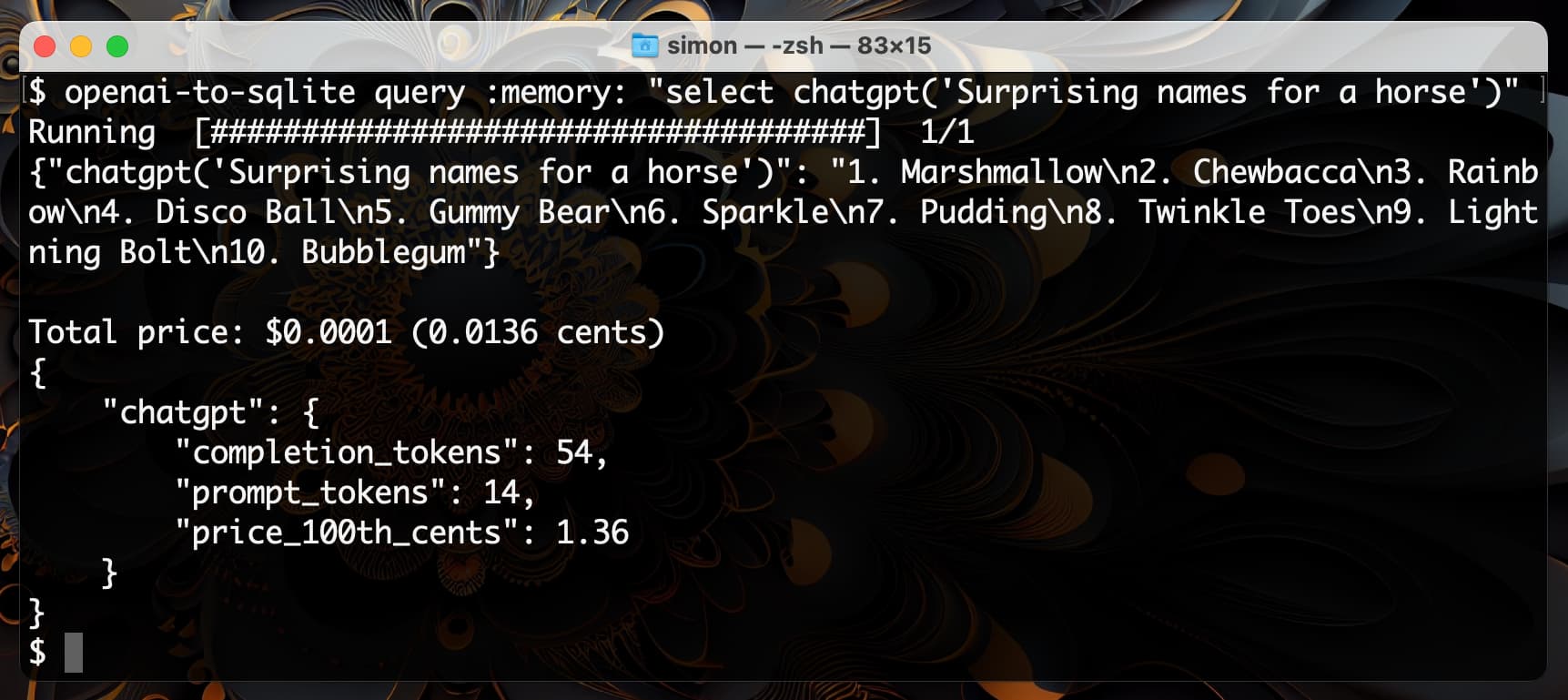
I shipped openai-to-sqlite 0.3 yesterday with a fun new feature: you can now use the command-line tool to enrich data in a SQLite database by running values through an OpenAI model and saving the results, all in a single SQL query.
[... 1,219 words]MRSK. A new open source web application deployment tool from 37signals, developed to help migrate their Hey webmail app out of the cloud and onto their own managed hardware. The key feature is one that I care about deeply: it enables zero-downtime deploys by running all traffic through a Traefik reverse proxy in a way that allows requests to be paused while a new deployment is going out—so end users get a few seconds delay on their HTTP requests before being served by the replaced application.
Sunday, 30th April 2023
