Monday, 1st December 2025
YouTube embeds fail with a 153 error. I just fixed this bug on my blog. I was getting an annoying "Error 153: Video player configuration error" on some of the YouTube video embeds (like this one) on this site. After some digging it turns out the culprit was this HTTP header, which Django's SecurityMiddleware was sending by default:
Referrer-Policy: same-origin
YouTube's embedded player terms documentation explains why this broke:
API Clients that use the YouTube embedded player (including the YouTube IFrame Player API) must provide identification through the
HTTP Refererrequest header. In some environments, the browser will automatically setHTTP Referer, and API Clients need only ensure they are not setting theReferrer-Policyin a way that suppresses theReferervalue. YouTube recommends usingstrict-origin-when-cross-originReferrer-Policy, which is already the default in many browsers.
The fix, which I outsourced to GitHub Copilot agent since I was on my phone, was to add this to my settings.py:
SECURE_REFERRER_POLICY = "strict-origin-when-cross-origin"
This explainer on the Chrome blog describes what the header means:
strict-origin-when-cross-originoffers more privacy. With this policy, only the origin is sent in the Referer header of cross-origin requests.This prevents leaks of private data that may be accessible from other parts of the full URL such as the path and query string.
Effectively it means that any time you follow a link from my site to somewhere else they'll see this in the incoming HTTP headers even if you followed the link from a page other than my homepage:
Referer: https://simonwillison.net/
The previous header, same-origin, is explained by MDN here:
Send the origin, path, and query string for same-origin requests. Don't send the
Refererheader for cross-origin requests.
This meant that previously traffic from my site wasn't sending any HTTP referer at all!
More than half of the teens surveyed believe journalists regularly engage in unethical behaviors like making up details or quotes in stories, paying sources, taking visual images out of context or doing favors for advertisers. Less than a third believe reporters correct their errors, confirm facts before reporting them, gather information from multiple sources or cover stories in the public interest — practices ingrained in the DNA of reputable journalists.
— David Bauder, AP News, A lost generation of news consumers? Survey shows how teenagers dislike the news media
I just sent out the November edition of my sponsors-only monthly newsletter. If you are a sponsor (or if you start a sponsorship now) you can access a copy here. In the newsletter this month:
- The best model for code changed hands four times
- Significant open weight model releases
- Nano Banana Pro
- My major coding projects with LLMs this month
- Prompt injection news for November
- Pelican on a bicycle variants
- Two YouTube videos and a podcast
- Miscellaneous extras
- Tools I'm using at the moment
Here's a copy of the October newsletter as a preview of what you'll get. Pay $10/month to stay a month ahead of the free copy!
DeepSeek-V3.2 (via) Two new open weight (MIT licensed) models from DeepSeek today: DeepSeek-V3.2 and DeepSeek-V3.2-Speciale, both 690GB, 685B parameters. Here's the PDF tech report.
DeepSeek-V3.2 is DeepSeek's new flagship model, now running on chat.deepseek.com.
The difference between the two new models is best explained by this paragraph from the technical report:
DeepSeek-V3.2 integrates reasoning, agent, and human alignment data distilled from specialists, undergoing thousands of steps of continued RL training to reach the final checkpoints. To investigate the potential of extended thinking, we also developed an experimental variant, DeepSeek-V3.2-Speciale. This model was trained exclusively on reasoning data with a reduced length penalty during RL. Additionally, we incorporated the dataset and reward method from DeepSeekMath-V2 (Shao et al., 2025) to enhance capabilities in mathematical proofs.
I covered DeepSeek-Math-V2 last week. Like that model, DeepSeek-V3.2-Speciale also scores gold on the 2025 International Mathematical Olympiad so beloved of model training teams!
I tried both models on "Generate an SVG of a pelican riding a bicycle" using the chat feature of [OpenRouter](https://openrouter.ai/). DeepSeek V3.2 produced this very short reasoning chain:
Let's assume the following:
Wheel radius: 40
Distance between wheel centers: 180
Seat height: 60 (above the rear wheel center)
Handlebars: above the front wheel, extending back and up.We'll set the origin at the center of the rear wheel.
We'll create the SVG with a viewBox that fits the entire drawing.
Let's start by setting up the SVG.
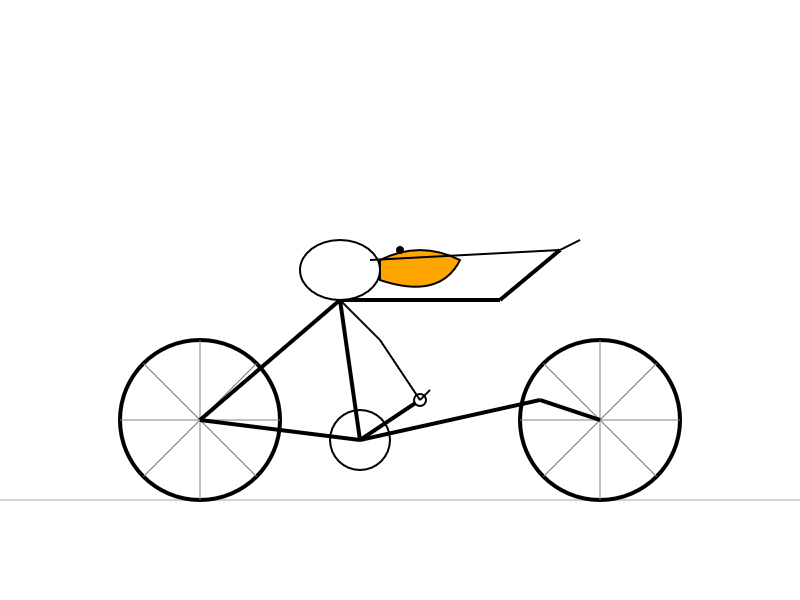
Followed by this illustration:
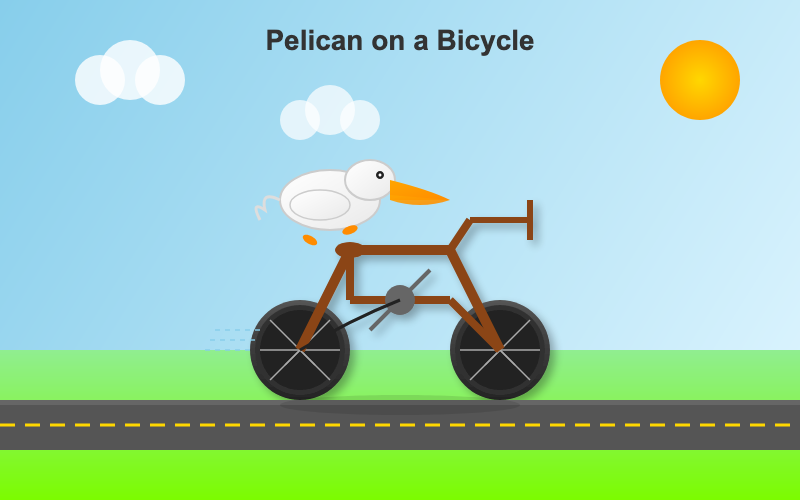
Here's what I got from the Speciale model, which thought deeply about the geometry of bicycles and pelicans for a very long time (at least 10 minutes) before spitting out this result: