Thursday, 5th February 2026
Spotlighting The World Factbook as We Bid a Fond Farewell (via) Somewhat devastating news today from CIA:
One of CIA’s oldest and most recognizable intelligence publications, The World Factbook, has sunset.
There's not even a hint as to why they decided to stop maintaining this publication, which has been their most useful public-facing initiative since 1971 and a cornerstone of the public internet since 1997.
In a bizarre act of cultural vandalism they've not just removed the entire site (including the archives of previous versions) but they've also set every single page to be a 302 redirect to their closure announcement.
The Factbook has been released into the public domain since the start. There's no reason not to continue to serve archived versions - a banner at the top of the page saying it's no longer maintained would be much better than removing all of that valuable content entirely.
Up until 2020 the CIA published annual zip file archives of the entire site. Those are available (along with the rest of the Factbook) on the Internet Archive.
I downloaded the 384MB .zip file for the year 2020 and extracted it into a new GitHub repository, simonw/cia-world-factbook-2020. I've enabled GitHub Pages for that repository so you can browse the archived copy at simonw.github.io/cia-world-factbook-2020/.
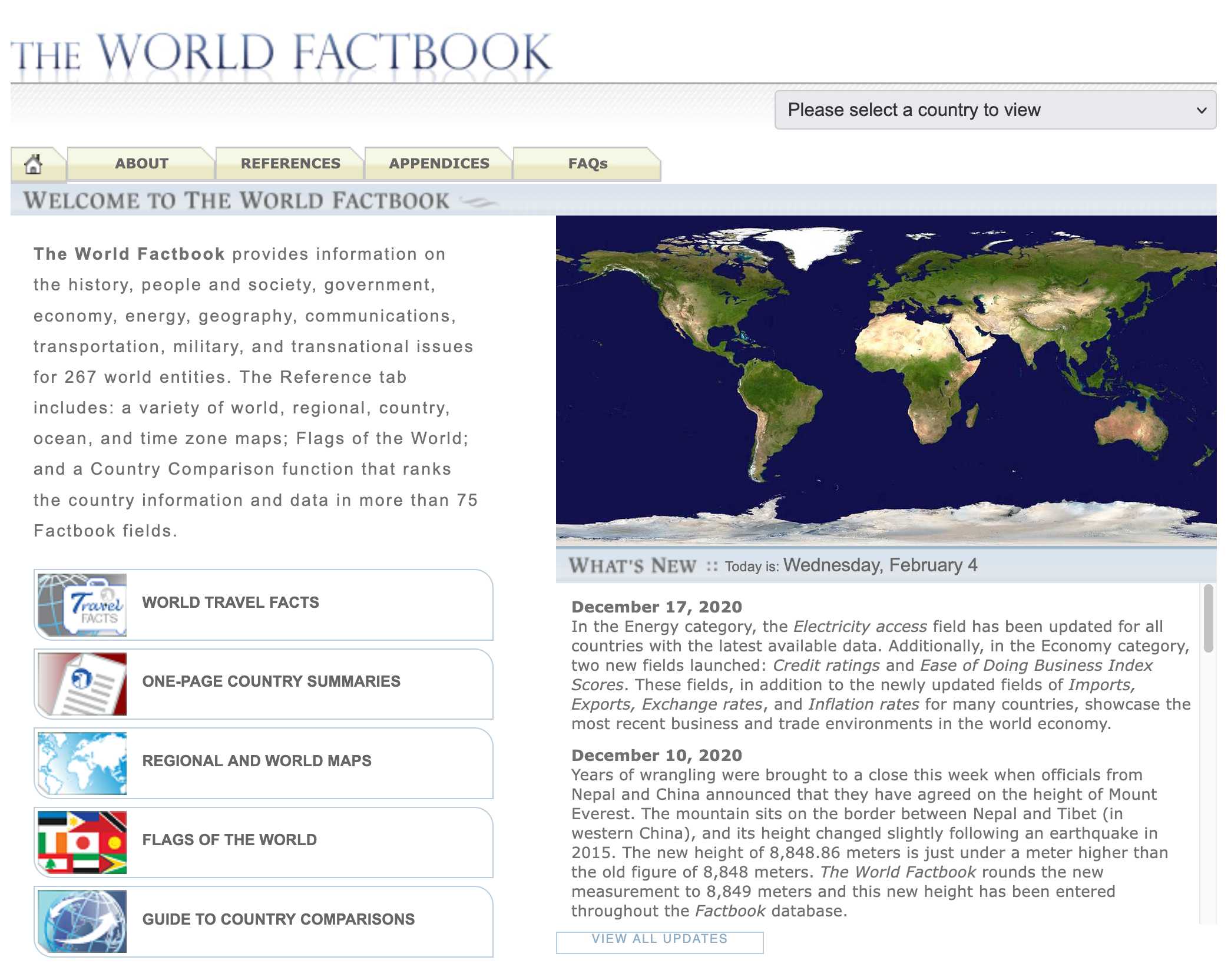
Here's a neat example of the editorial voice of the Factbook from the What's New page, dated December 10th 2020:
Years of wrangling were brought to a close this week when officials from Nepal and China announced that they have agreed on the height of Mount Everest. The mountain sits on the border between Nepal and Tibet (in western China), and its height changed slightly following an earthquake in 2015. The new height of 8,848.86 meters is just under a meter higher than the old figure of 8,848 meters. The World Factbook rounds the new measurement to 8,849 meters and this new height has been entered throughout the Factbook database.
Two major new model releases today, within about 15 minutes of each other.
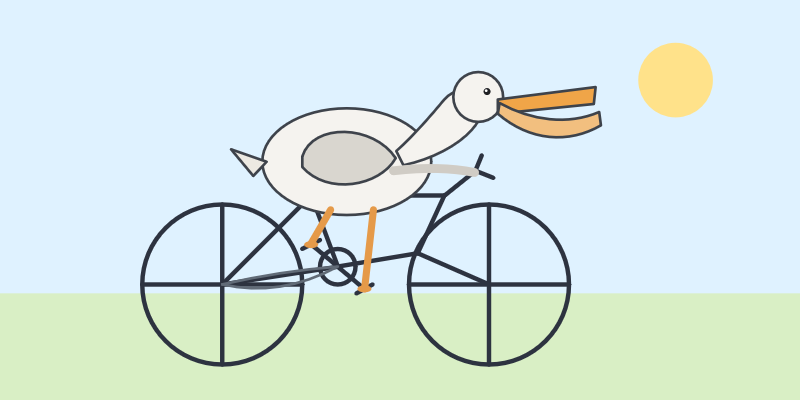
Anthropic released Opus 4.6. Here's its pelican:

OpenAI release GPT-5.3-Codex, albeit only via their Codex app, not yet in their API. Here's its pelican:
I've had a bit of preview access to both of these models and to be honest I'm finding it hard to find a good angle to write about them - they're both really good, but so were their predecessors Codex 5.2 and Opus 4.5. I've been having trouble finding tasks that those previous models couldn't handle but the new ones are able to ace.
The most convincing story about capabilities of the new model so far is Nicholas Carlini from Anthropic talking about Opus 4.6 and Building a C compiler with a team of parallel Claudes - Anthropic's version of Cursor's FastRender project.
Mitchell Hashimoto: My AI Adoption Journey (via) Some really good and unconventional tips in here for getting to a place with coding agents where they demonstrably improve your workflow and productivity. I particularly liked:
-
Reproduce your own work - when learning to use coding agents Mitchell went through a period of doing the work manually, then recreating the same solution using agents as an exercise:
I literally did the work twice. I'd do the work manually, and then I'd fight an agent to produce identical results in terms of quality and function (without it being able to see my manual solution, of course).
-
End-of-day agents - letting agents step in when your energy runs out:
To try to find some efficiency, I next started up a new pattern: block out the last 30 minutes of every day to kick off one or more agents. My hypothesis was that perhaps I could gain some efficiency if the agent can make some positive progress in the times I can't work anyways.
-
Outsource the Slam Dunks - once you know an agent can likely handle a task, have it do that task while you work on something more interesting yourself.