10 posts tagged “conformance-suites”
Test suites that are designed to be run against different implementations of the same protocol or standard to help ensure they are compatible with each other.
2026
Ladybird adopts Rust, with help from AI (via) Really interesting case-study from Andreas Kling on advanced, sophisticated use of coding agents for ambitious coding projects with critical code. After a few years hoping Swift's platform support outside of the Apple ecosystem would mature they switched tracks to Rust their memory-safe language of choice, starting with an AI-assisted port of a critical library:
Our first target was LibJS , Ladybird's JavaScript engine. The lexer, parser, AST, and bytecode generator are relatively self-contained and have extensive test coverage through test262, which made them a natural starting point.
I used Claude Code and Codex for the translation. This was human-directed, not autonomous code generation. I decided what to port, in what order, and what the Rust code should look like. It was hundreds of small prompts, steering the agents where things needed to go. [...]
The requirement from the start was byte-for-byte identical output from both pipelines. The result was about 25,000 lines of Rust, and the entire port took about two weeks. The same work would have taken me multiple months to do by hand. We’ve verified that every AST produced by the Rust parser is identical to the C++ one, and all bytecode generated by the Rust compiler is identical to the C++ compiler’s output. Zero regressions across the board.
Having an existing conformance testing suite of the quality of test262 is a huge unlock for projects of this magnitude, and the ability to compare output with an existing trusted implementation makes agentic engineering much more of a safe bet.
Scaling long-running autonomous coding. Wilson Lin at Cursor has been doing some experiments to see how far you can push a large fleet of "autonomous" coding agents:
This post describes what we've learned from running hundreds of concurrent agents on a single project, coordinating their work, and watching them write over a million lines of code and trillions of tokens.
They ended up running planners and sub-planners to create tasks, then having workers execute on those tasks - similar to how Claude Code uses sub-agents. Each cycle ended with a judge agent deciding if the project was completed or not.
In my predictions for 2026 the other day I said that by 2029:
I think somebody will have built a full web browser mostly using AI assistance, and it won’t even be surprising. Rolling a new web browser is one of the most complicated software projects I can imagine[...] the cheat code is the conformance suites. If there are existing tests that it’ll get so much easier.
I may have been off by three years, because Cursor chose "building a web browser from scratch" as their test case for their agent swarm approach:
To test this system, we pointed it at an ambitious goal: building a web browser from scratch. The agents ran for close to a week, writing over 1 million lines of code across 1,000 files. You can explore the source code on GitHub.
But how well did they do? Their initial announcement a couple of days ago was met with unsurprising skepticism, especially when it became apparent that their GitHub Actions CI was failing and there were no build instructions in the repo.
It looks like they addressed that within the past 24 hours. The latest README includes build instructions which I followed on macOS like this:
cd /tmp
git clone https://github.com/wilsonzlin/fastrender
cd fastrender
git submodule update --init vendor/ecma-rs
cargo run --release --features browser_ui --bin browser
This got me a working browser window! Here are screenshots I took of google.com and my own website:
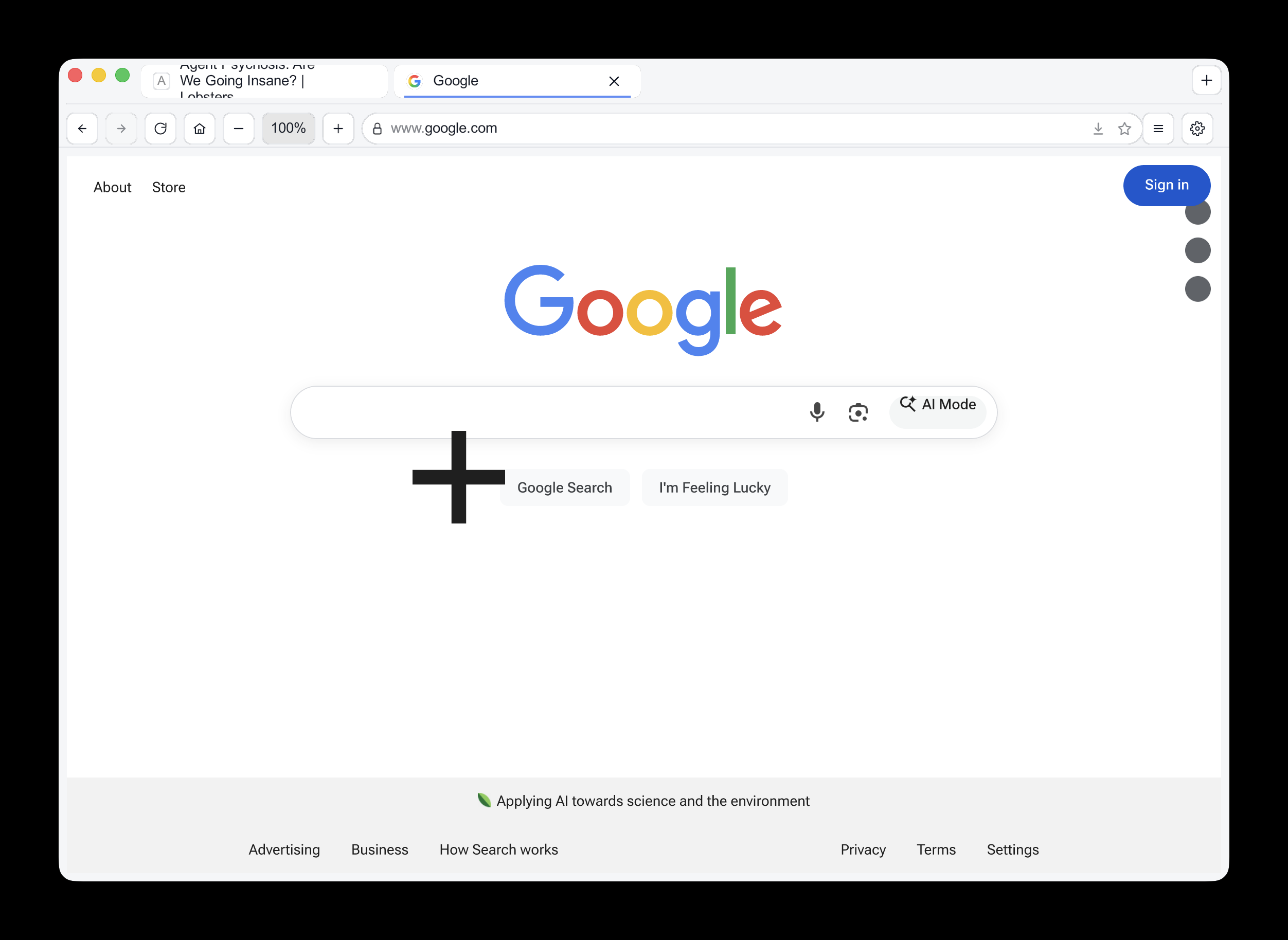
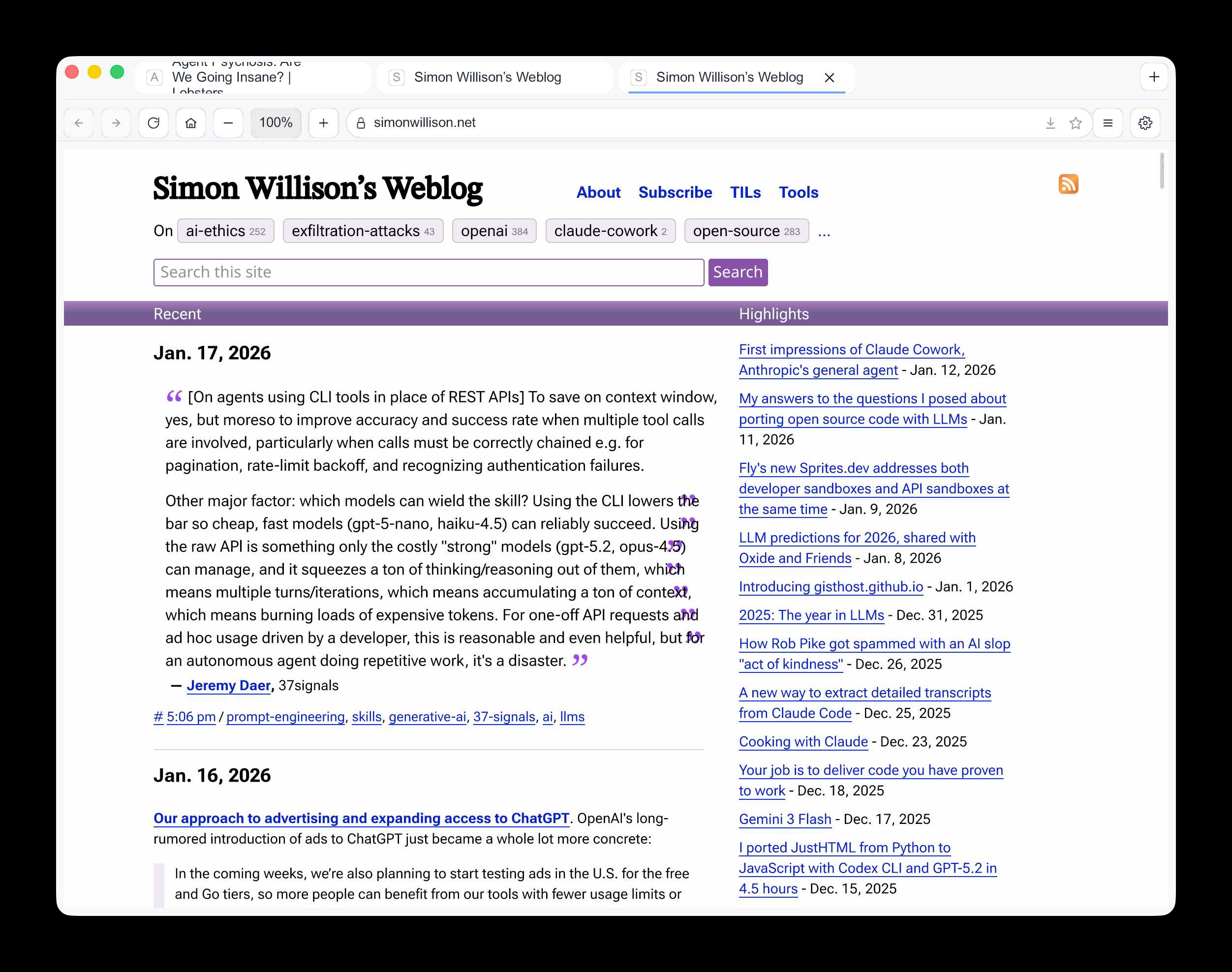
Honestly those are very impressive! You can tell they're not just wrapping an existing rendering engine because of those very obvious rendering glitches, but the pages are legible and look mostly correct.
The FastRender repo even uses Git submodules to include various WhatWG and CSS-WG specifications in the repo, which is a smart way to make sure the agents have access to the reference materials that they might need.
This is the second attempt I've seen at building a full web browser using AI-assisted coding in the past two weeks - the first was HiWave browser, a new browser engine in Rust first announced in this Reddit thread.
When I made my 2029 prediction this is more-or-less the quality of result I had in mind. I don't think we'll see projects of this nature compete with Chrome or Firefox or WebKit any time soon but I have to admit I'm very surprised to see something this capable emerge so quickly.
Update 23rd January 2026: I recorded a 47 minute conversation with Wilson about this project and published it on YouTube. Here's the video and accompanying highlights.
Open Responses (via) This is the standardization effort I've most wanted in the world of LLMs: a vendor-neutral specification for the JSON API that clients can use to talk to hosted LLMs.
Open Responses aims to provide exactly that as a documented standard, derived from OpenAI's Responses API.
I was hoping for one based on their older Chat Completions API since so many other products have cloned the already, but basing it on Responses does make sense since that API was designed with the feature of more recent models - such as reasoning traces - baked into the design.
What's certainly notable is the list of launch partners. OpenRouter alone means we can expect to be able to use this protocol with almost every existing model, and Hugging Face, LM Studio, vLLM, Ollama and Vercel cover a huge portion of the common tools used to serve models.
For protocols like this I really want to see a comprehensive, language-independent conformance test site. Open Responses has a subset of that - the official repository includes src/lib/compliance-tests.ts which can be used to exercise a server implementation, and is available as a React app on the official site that can be pointed at any implementation served via CORS.
What's missing is the equivalent for clients. I plan to spin up my own client library for this in Python and I'd really like to be able to run that against a conformance suite designed to check that my client correctly handles all of the details.
My answers to the questions I posed about porting open source code with LLMs
Last month I wrote about porting JustHTML from Python to JavaScript using Codex CLI and GPT-5.2 in a few hours while also buying a Christmas tree and watching Knives Out 3. I ended that post with a series of open questions about the ethics and legality of this style of work. Alexander Petros on lobste.rs just challenged me to answer them, which is fair enough! Here’s my attempt at that.
[... 1,034 words]A Software Library with No Code. Provocative experiment from Drew Breunig, who designed a new library for time formatting ("3 hours ago" kind of thing) called "whenwords" that has no code at all, just a carefully written specification, an AGENTS.md and a collection of conformance tests in a YAML file.
Pass that to your coding agent of choice, tell it what language you need and it will write it for you on demand!
This meshes nearly with my recent interest in conformance suites. If you publish good enough language-independent tests it's pretty astonishing how far today's coding agents can take you!
LLM predictions for 2026, shared with Oxide and Friends

I joined a recording of the Oxide and Friends podcast on Tuesday to talk about 1, 3 and 6 year predictions for the tech industry. This is my second appearance on their annual predictions episode, you can see my predictions from January 2025 here. Here’s the page for this year’s episode, with options to listen in all of your favorite podcast apps or directly on YouTube.
[... 1,773 words]2025
2025: The year in LLMs
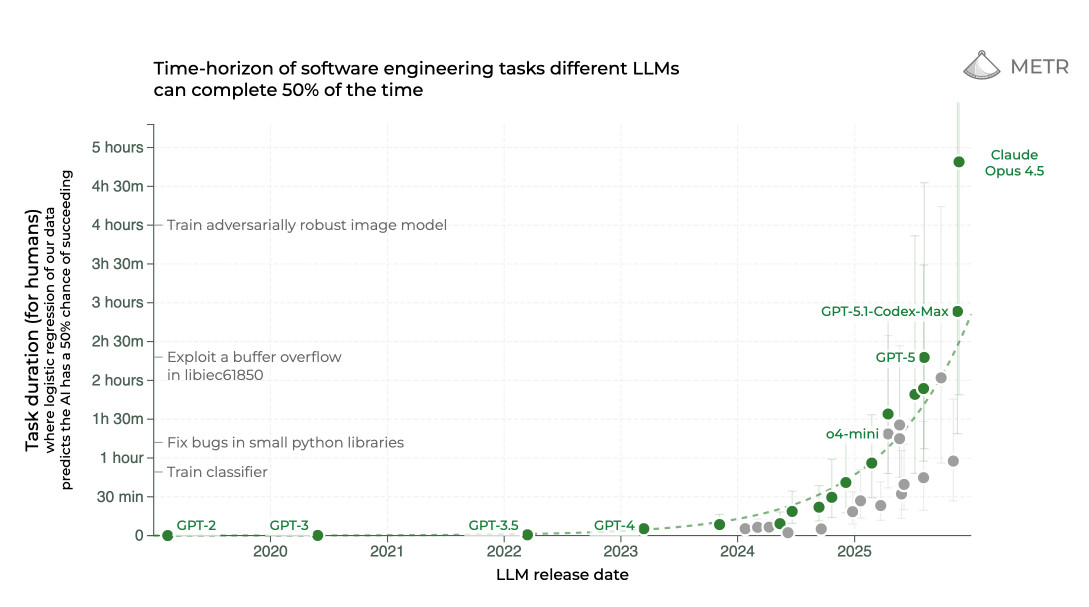
This is the third in my annual series reviewing everything that happened in the LLM space over the past 12 months. For previous years see Stuff we figured out about AI in 2023 and Things we learned about LLMs in 2024.
[... 8,273 words]JustHTML is a fascinating example of vibe engineering in action
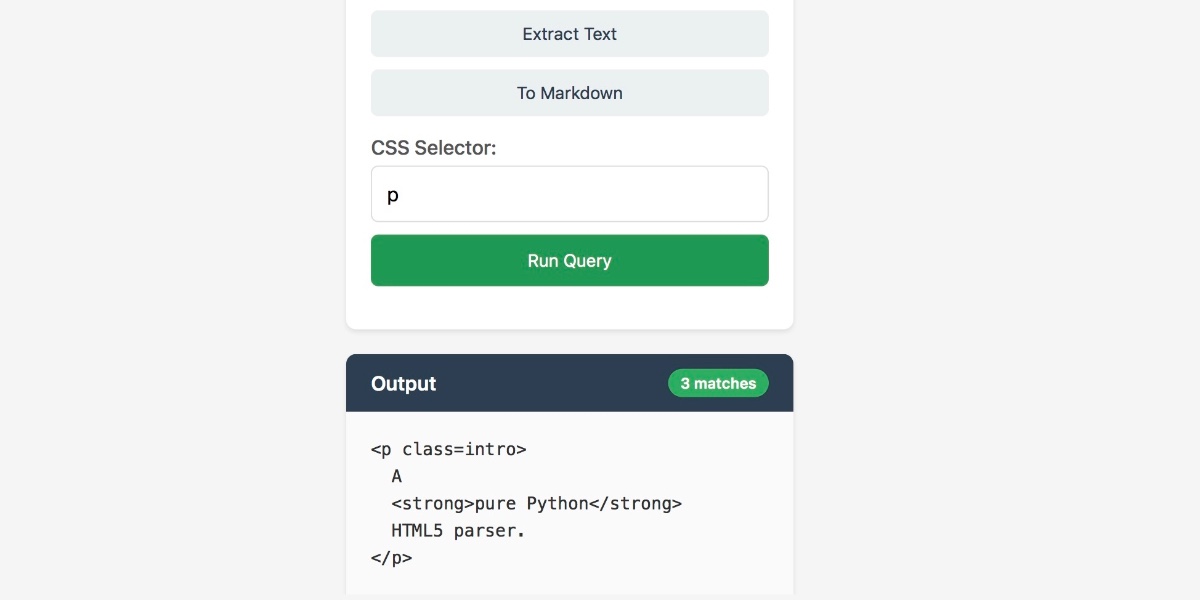
I recently came across JustHTML, a new Python library for parsing HTML released by Emil Stenström. It’s a very interesting piece of software, both as a useful library and as a case study in sophisticated AI-assisted programming.
[... 956 words]2010
twitter-text-conformance (via) This is a neat idea: Twitter have released open source libraries for parsing standard tweet syntax in Ruby and Java, but they’ve also released a set of YAML unit tests aimed at anyone who wants to implement the same parsing logic in other languages.
2003
Atom autodiscovery test suite
Mark Pilgrim has released the Atom autodiscovery test suite, comprising 148 tests:
[... 130 words]