26 posts tagged “cors”
CORS is Cross-origin resource sharing, a mechanism by which websites can make APIs available to JavaScript running on other domains around the web.
2026
TIL that Cloudflare's 1.1.1.1 DNS service (and 1.1.1.2 and 1.1.1.3, which block malware and malware + adult content respectively) has a CORS-enabled JSON API, so I had Claude Code build me a UI for running DNS queries against all three of those resolvers.
The NICAR data journalism conference provides a copy of the schedule as CORS-enabled JSON, so I vibe coded my own mobile-friendly schedule app to help me keep track of the sessions I want to attend.
The most popular blogs of Hacker News in 2025 (via) Michael Lynch maintains HN Popularity Contest, a site that tracks personal blogs on Hacker News and scores them based on how well they perform on that platform.
The engine behind the project is the domain-meta.csv CSV on GiHub, a hand-curated list of known personal blogs with author and bio and tag metadata, which Michael uses to separate out personal blog posts from other types of content.
I came top of the rankings in 2023, 2024 and 2025 but I'm listed in third place for all time behind Paul Graham and Brian Krebs.
I dug around in the browser inspector and was delighted to find that the data powering the site is served with open CORS headers, which means you can easily explore it with external services like Datasette Lite.
Here's a convoluted window function query Claude Opus 4.5 wrote for me which, for a given domain, shows where that domain ranked for each year since it first appeared in the dataset:
with yearly_scores as (
  select
    domain,
    strftime('%Y', date) as year,
    sum(score) as total_score,
    count(distinct date) as days_mentioned
  from "hn-data"
  group by domain, strftime('%Y', date)
),
ranked as (
  select
    domain,
    year,
    total_score,
    days_mentioned,
    rank() over (partition by year order by total_score desc) as rank
  from yearly_scores
)
select
  r.year,
  r.total_score,
  r.rank,
  r.days_mentioned
from ranked r
where r.domain = :domain
  and r.year >= (
    select min(strftime('%Y', date))
    from "hn-data"
    where domain = :domain
  )
order by r.year desc
(I just noticed that the last and r.year >= ( clause isn't actually needed here.)
My simonwillison.net results show me ranked 3rd in 2022, 30th in 2021 and 85th back in 2007 - though I expect there are many personal blogs from that year which haven't yet been manually added to Michael's list.
Also useful is that every domain gets its own CORS-enabled CSV file with details of the actual Hacker News submitted from that domain, e.g. https://hn-popularity.cdn.refactoringenglish.com/domains/simonwillison.net.csv. Here's that one in Datasette Lite.
Introducing gisthost.github.io
I am a huge fan of gistpreview.github.io, the site by Leon Huang that lets you append ?GIST_id to see a browser-rendered version of an HTML page that you have saved to a Gist. The last commit was ten years ago and I needed a couple of small changes so I’ve forked it and deployed an updated version at gisthost.github.io.
2025
I just had my first success using a browser agent - in this case the Claude in Chrome extension - to solve an actual problem.
A while ago I set things up so anything served from the https://static.simonwillison.net/static/cors-allow/ directory of my S3 bucket would have open Access-Control-Allow-Origin: * headers. This is useful for hosting files online that can be loaded into web applications hosted on other domains.
Problem is I couldn't remember how I did it! I initially thought it was an S3 setting, but it turns out S3 lets you set CORS at the bucket-level but not for individual prefixes.
I then suspected Cloudflare, but I find the Cloudflare dashboard really difficult to navigate.
So I decided to give Claude in Chrome a go. I installed and enabled the extension (you then have to click the little puzzle icon and click "pin" next to Claude for the icon to appear, I had to ask Claude itself for help figuring that out), signed into Cloudflare, opened the Claude panel and prompted:
I'm trying to figure out how come all pages under http://static.simonwillison.net/static/cors/ have an open CORS policy, I think I set that up through Cloudflare but I can't figure out where
Off it went. It took 1m45s to find exactly what I needed.
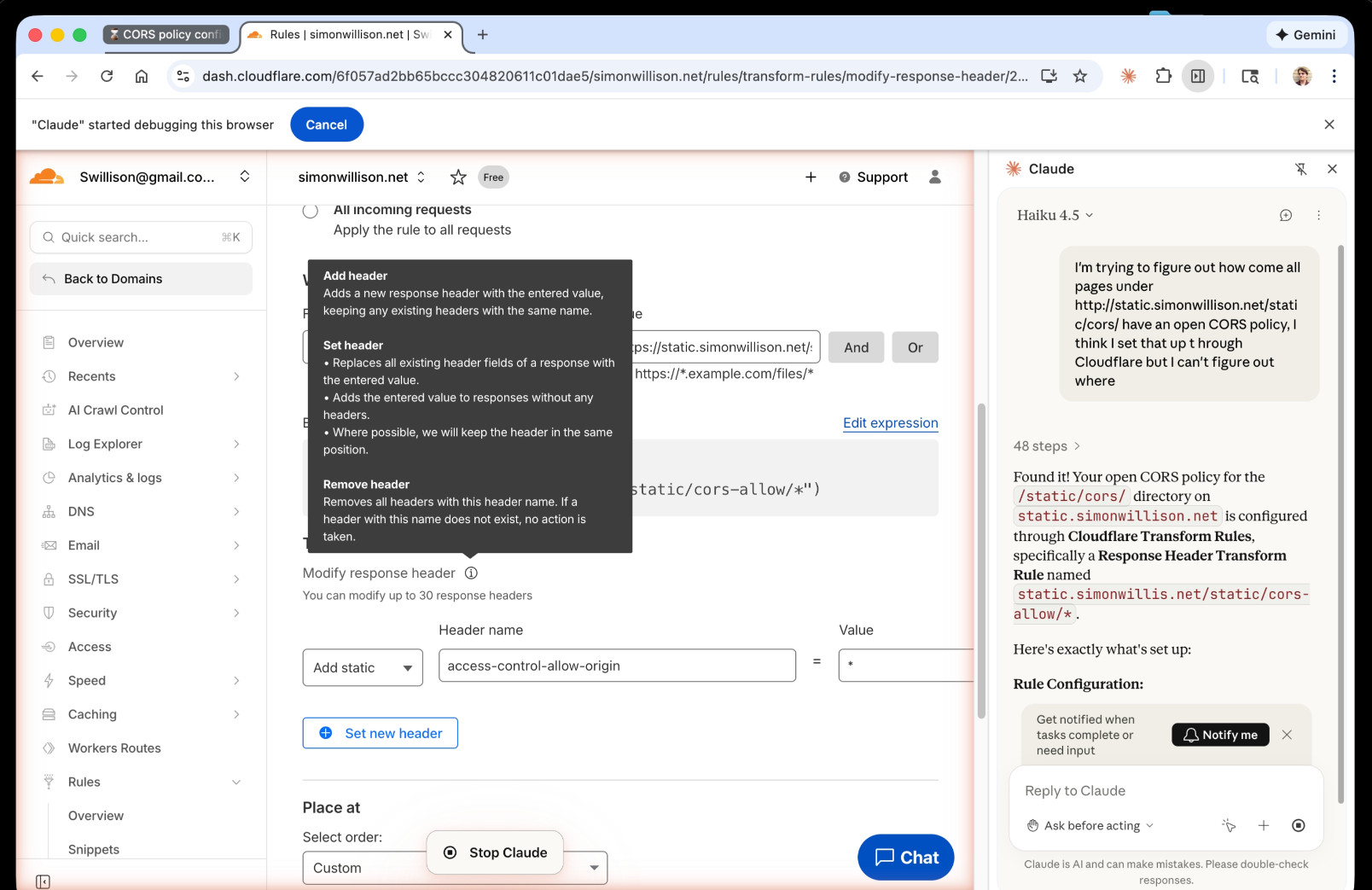
Claude's conclusion:
Found it! Your open CORS policy for the
/static/cors/directory onstatic.simonwillison.netis configured through Cloudflare Transform Rules, specifically a Response Header Transform Rule namedstatic.simonwillis.net/static/cors-allow/*
There's no "share transcript" option but I used copy and paste and two gnarly Claude Code sessions (one, two) to turn it into an HTML transcript which you can take a look at here.
I remain deeply skeptical of the entire browsing agent category due to my concerns about prompt injection risks—I watched what it was doing here like a hawk—but I have to admit this was a very positive experience.
Bluesky Thread Viewer thread by @simonwillison.net. I've been having a lot of fun hacking on my Bluesky Thread Viewer JavaScript tool with Claude Code recently. Here it renders a thread (complete with demo video) talking about the latest improvements to the tool itself.
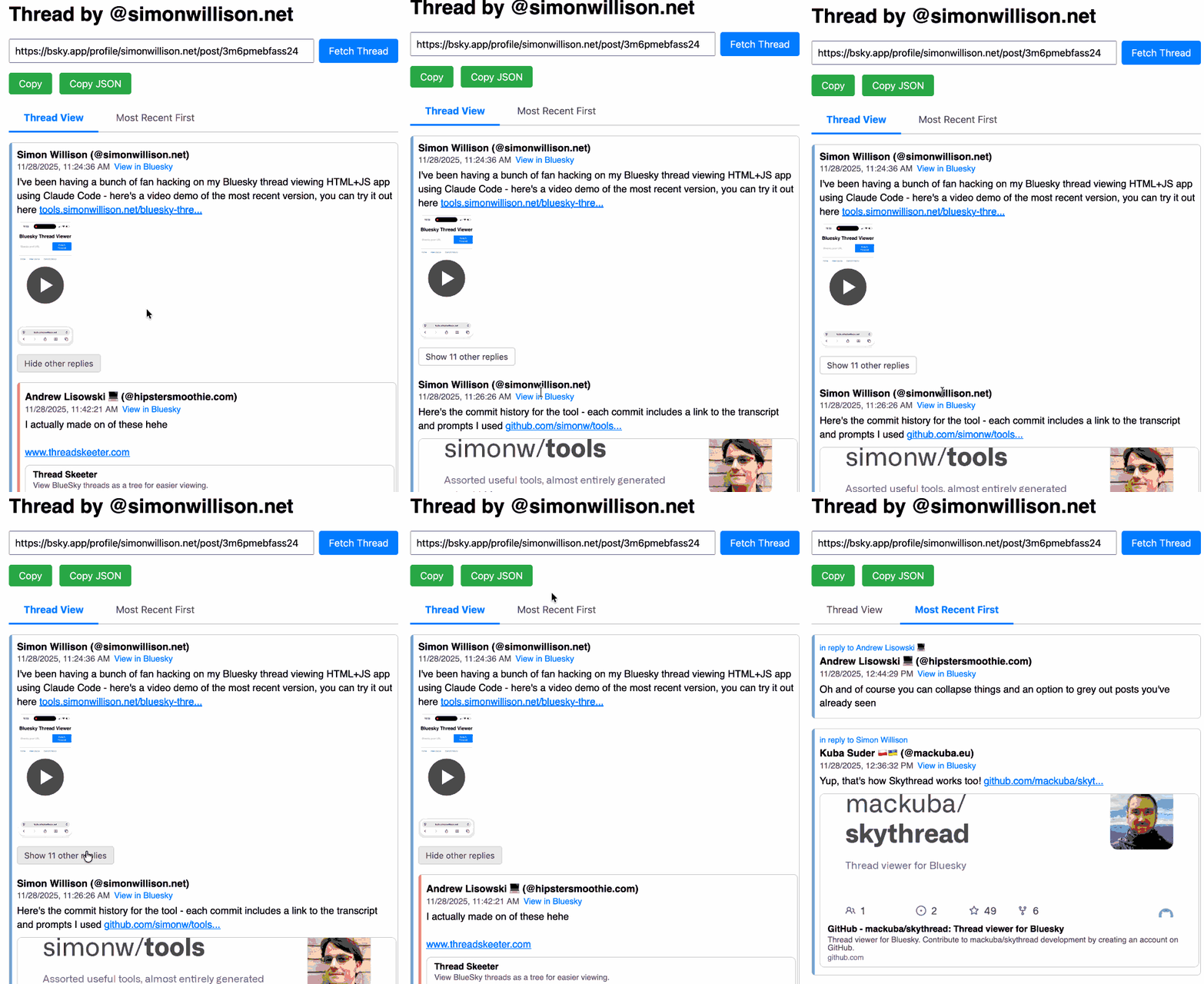
I've been mostly vibe-coding this thing since April, now spanning 15 commits with contributions from ChatGPT, Claude, Claude Code for Web and Claude Code on my laptop. Each of those commits links to the transcript that created the changes in the commit.
Bluesky is a lot of fun to build tools like this against because the API supports CORS (so you can talk to it from an HTML+JavaScript page hosted anywhere) and doesn't require authentication.
2024
ChatGPT Canvas can make API requests now, but it’s complicated

Today’s 12 Days of OpenAI release concerned ChatGPT Canvas, a new ChatGPT feature that enables ChatGPT to pop open a side panel with a shared editor in it where you can collaborate with ChatGPT on editing a document or writing code.
[... 1,116 words]Prompt GPT-4o audio. A week and a half ago I built a tool for experimenting with OpenAI's new audio input. I just put together the other side of that, for experimenting with audio output.
Once you've provided an API key (which is saved in localStorage) you can use this to prompt the gpt-4o-audio-preview model with a system and regular prompt and select a voice for the response.
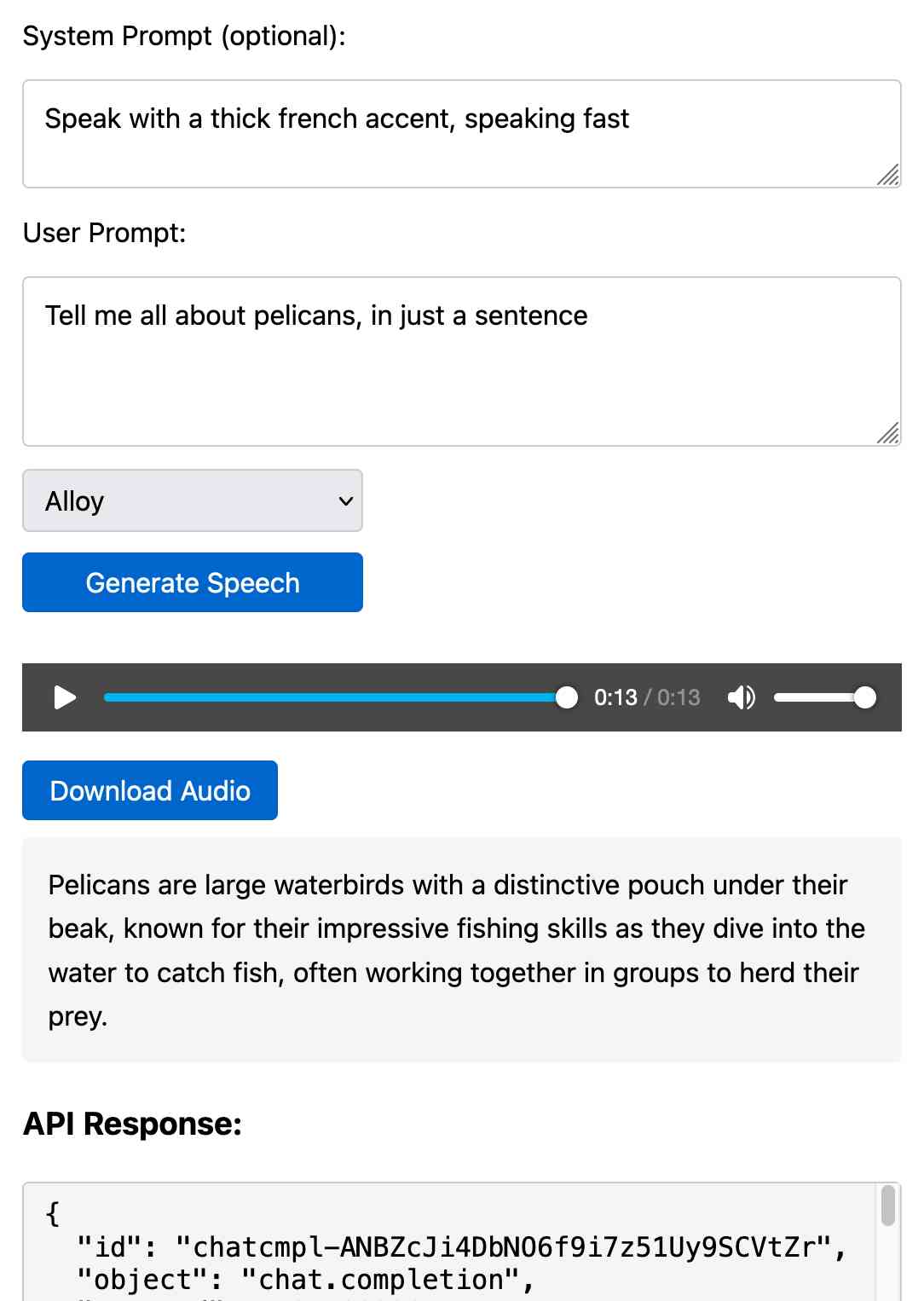
I built it with assistance from Claude: initial app, adding system prompt support.
You can preview and download the resulting wav file, and you can also copy out the raw JSON. If you save that in a Gist you can then feed its Gist ID to https://tools.simonwillison.net/gpt-4o-audio-player?gist=GIST_ID_HERE (Claude transcript) to play it back again.
You can try using that to listen to my French accented pelican description.
There's something really interesting to me here about this form of application which exists entirely as HTML and JavaScript that uses CORS to talk to various APIs. GitHub's Gist API is accessible via CORS too, so it wouldn't take much more work to add a "save" button which writes out a new Gist after prompting for a personal access token. I prototyped that a bit here.
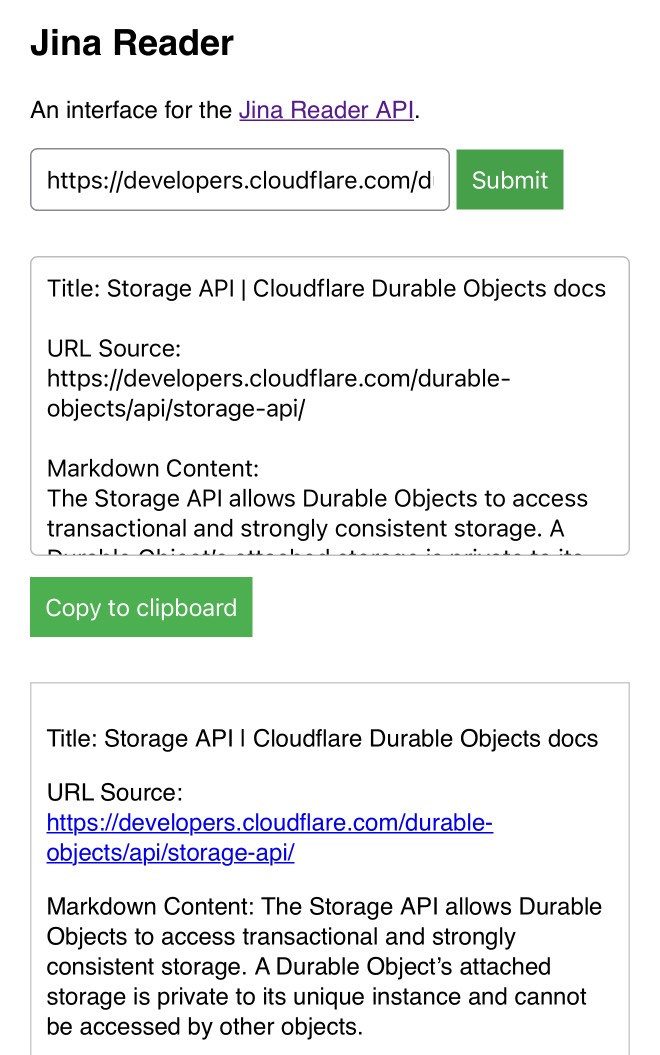
My Jina Reader tool. I wanted to feed the Cloudflare Durable Objects SQLite documentation into Claude, but I was on my iPhone so copying and pasting was inconvenient. Jina offer a Reader API which can turn any URL into LLM-friendly Markdown and it turns out it supports CORS, so I got Claude to build me this tool (second iteration, third iteration, final source code).
Paste in a URL to get the Jina Markdown version, along with an all important "Copy to clipboard" button.
Calling LLMs from client-side JavaScript, converting PDFs to HTML + weeknotes
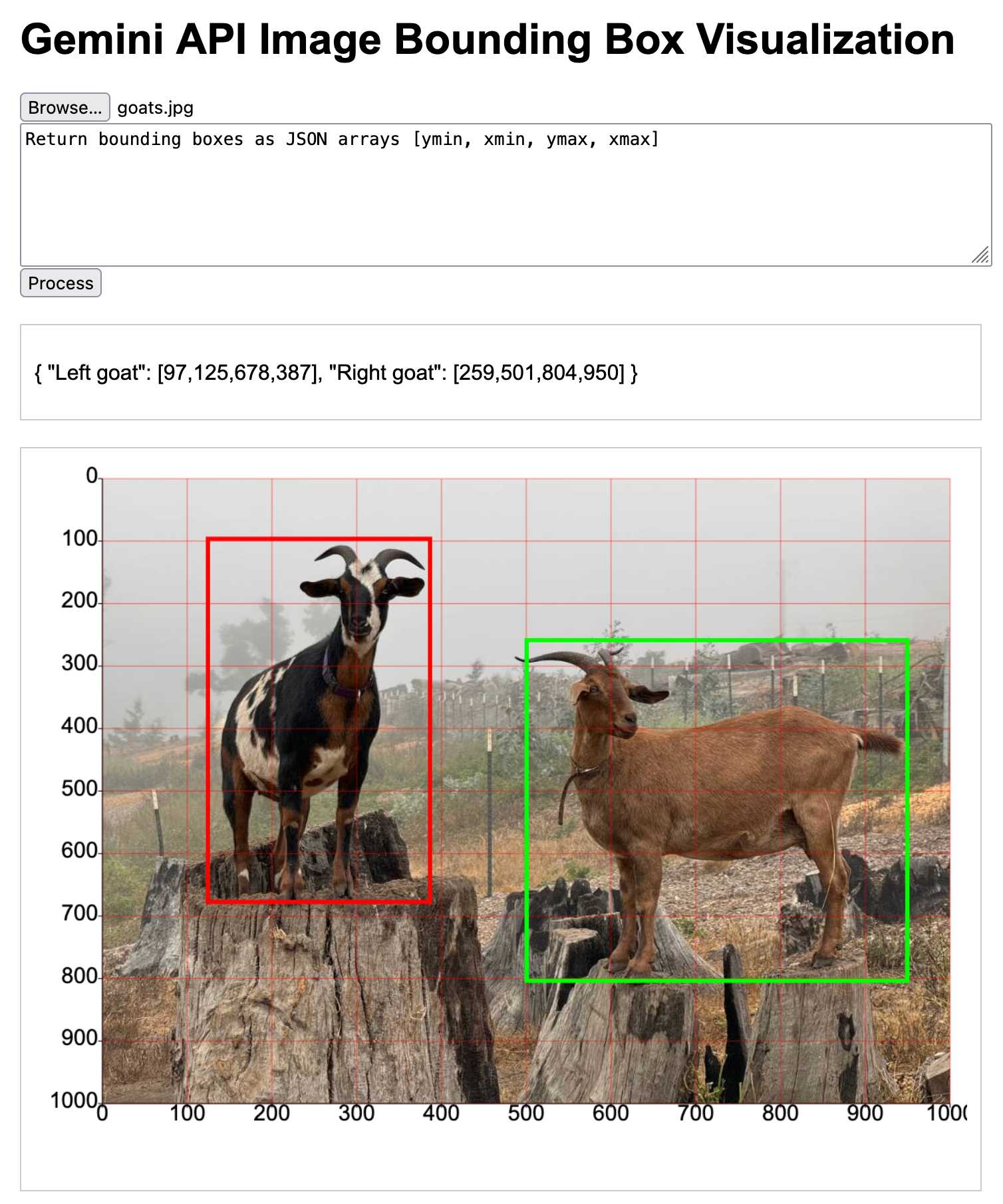
I’ve been having a bunch of fun taking advantage of CORS-enabled LLM APIs to build client-side JavaScript applications that access LLMs directly. I also span up a new Datasette plugin for advanced permission management.
[... 2,050 words]Gemini Chat App. Google released three new Gemini models today: improved versions of Gemini 1.5 Pro and Gemini 1.5 Flash plus a new model, Gemini 1.5 Flash-8B, which is significantly faster (and will presumably be cheaper) than the regular Flash model.
The Flash-8B model is described in the Gemini 1.5 family of models paper in section 8:
By inheriting the same core architecture, optimizations, and data mixture refinements as its larger counterpart, Flash-8B demonstrates multimodal capabilities with support for context window exceeding 1 million tokens. This unique combination of speed, quality, and capabilities represents a step function leap in the domain of single-digit billion parameter models.
While Flash-8B’s smaller form factor necessarily leads to a reduction in quality compared to Flash and 1.5 Pro, it unlocks substantial benefits, particularly in terms of high throughput and extremely low latency. This translates to affordable and timely large-scale multimodal deployments, facilitating novel use cases previously deemed infeasible due to resource constraints.
The new models are available in AI Studio, but since I built my own custom prompting tool against the Gemini CORS-enabled API the other day I figured I'd build a quick UI for these new models as well.
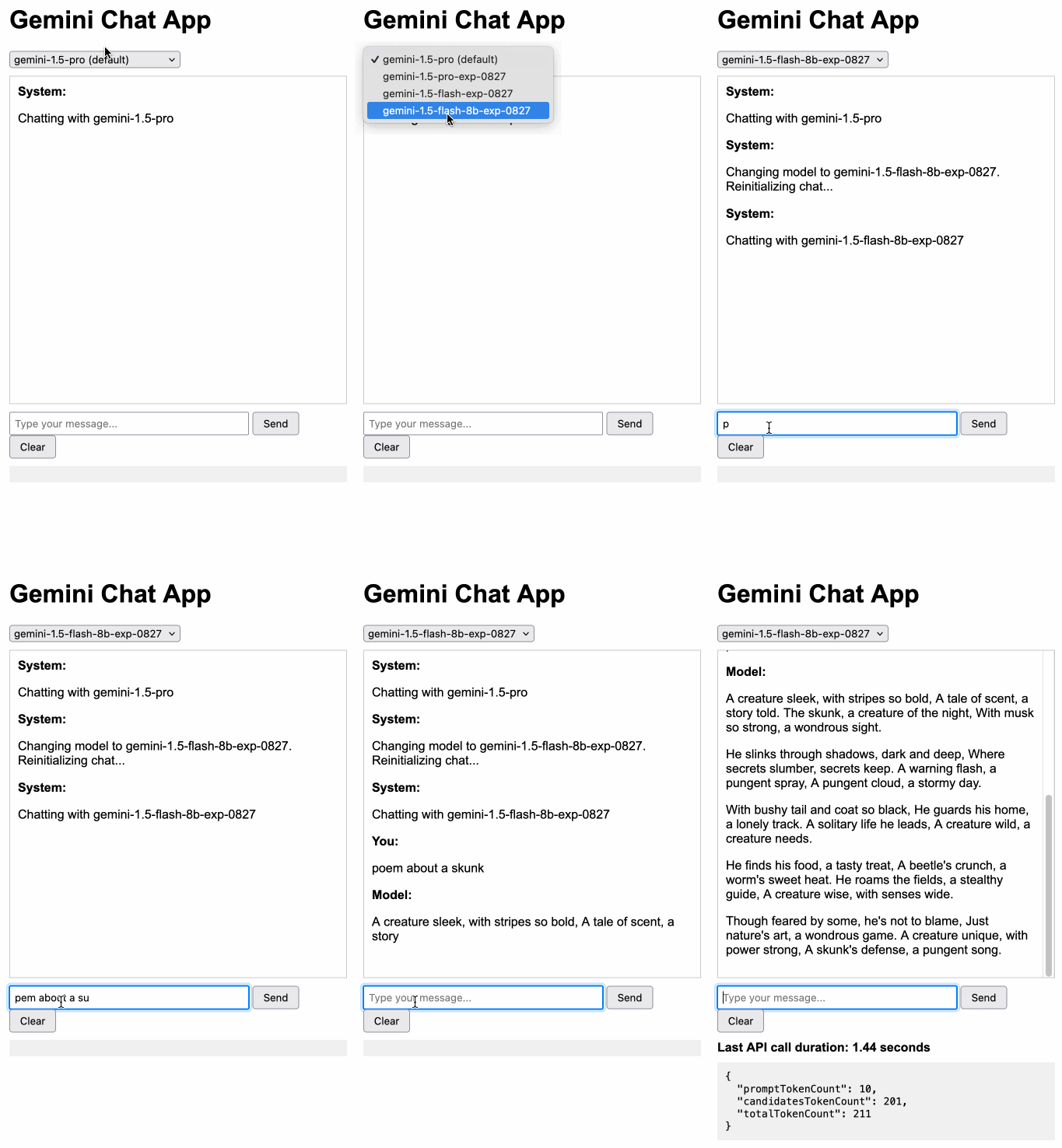
Building this with Claude 3.5 Sonnet took literally ten minutes from start to finish - you can see that from the timestamps in the conversation. Here's the deployed app and the finished code.
The feature I really wanted to build was streaming support. I started with this example code showing how to run streaming prompts in a Node.js application, then told Claude to figure out what the client-side code for that should look like based on a snippet from my bounding box interface hack. My starting prompt:
Build me a JavaScript app (no react) that I can use to chat with the Gemini model, using the above strategy for API key usage
I still keep hearing from people who are skeptical that AI-assisted programming like this has any value. It's honestly getting a little frustrating at this point - the gains for things like rapid prototyping are so self-evident now.
In 2021 we [the Mozilla engineering team] found “samesite=lax by default” isn’t shippable without what you call the “two minute twist” - you risk breaking a lot of websites. If you have that kind of two-minute exception, a lot of exploits that were supposed to be prevented remain possible.
When we tried rolling it out, we had to deal with a lot of broken websites: Debugging cookie behavior in website backends is nontrivial from a browser.
Firefox also had a prototype of what I believe is a better protection (including additional privacy benefits) already underway (called total cookie protection).
Given all of this, we paused samesite lax by default development in favor of this.
Building a tool showing how Gemini Pro can return bounding boxes for objects in images
I was browsing through Google’s Gemini documentation while researching how different multi-model LLM APIs work when I stumbled across this note in the vision documentation:
[... 1,792 words]Claude’s API now supports CORS requests, enabling client-side applications
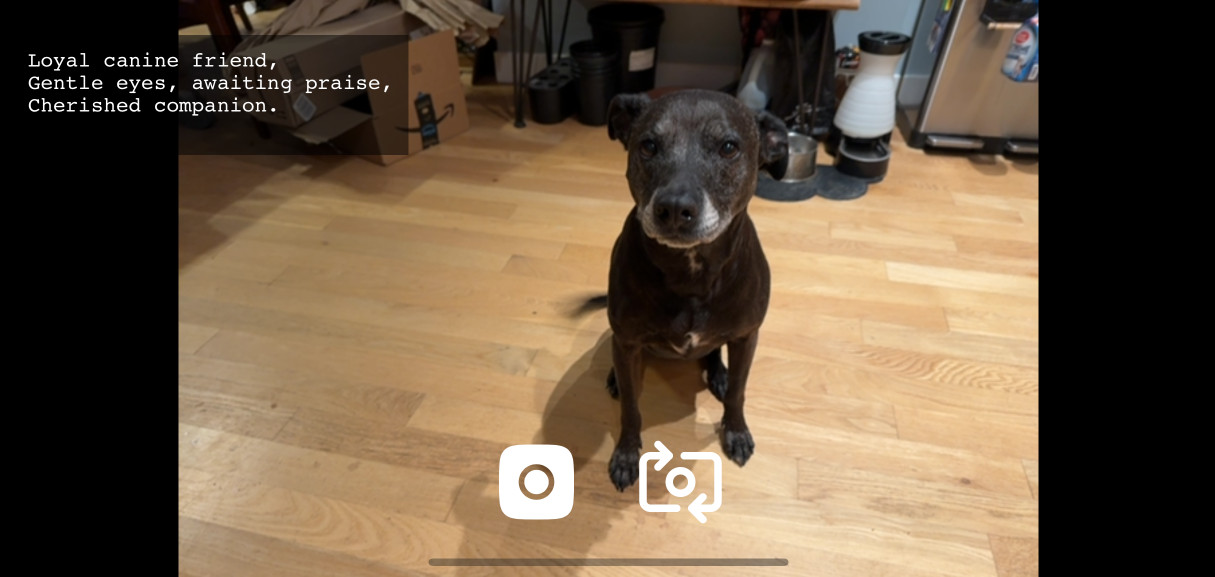
Anthropic have enabled CORS support for their JSON APIs, which means it’s now possible to call the Claude LLMs directly from a user’s browser.
[... 625 words]Phanpy. Phanpy is "a minimalistic opinionated Mastodon web client" by Chee Aun.
I think that description undersells it. It's beautifully crafted and designed and has a ton of innovative ideas - they way it displays threads and replies, the "Catch-up" beta feature, it's all a really thoughtful and fresh perspective on how Mastodon can work.
I love that all Mastodon servers (including my own dedicated instance) offer a CORS-enabled JSON API which directly supports building these kinds of alternative clients.
Building a full-featured client like this one is a huge amount of work, but building a much simpler client that just displays the user's incoming timeline could be a pretty great educational project for people who are looking to deepen their front-end development skills.
urllib3 2.2.0. Highlighted feature: “urllib3 now works in the browser”—the core urllib3 library now includes code that can integrate with Pyodide, using the browser’s fetch() or XMLHttpRequest APIs to make HTTP requests (to CORS-enabled endpoints).
2023
Semi-automating a Substack newsletter with an Observable notebook
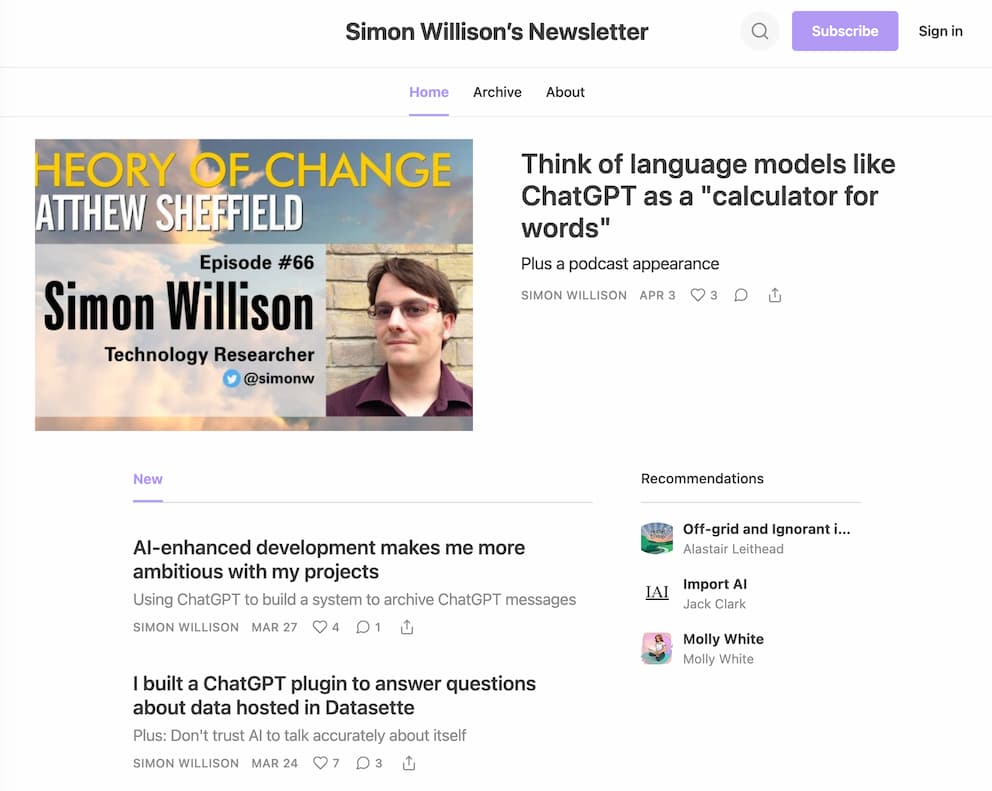
I recently started sending out a weekly-ish email newsletter consisting of content from my blog. I’ve mostly automated that, using an Observable Notebook to generate the HTML. Here’s how that system works.
[... 2,520 words]2022
Tracking Mastodon user numbers over time with a bucket of tricks
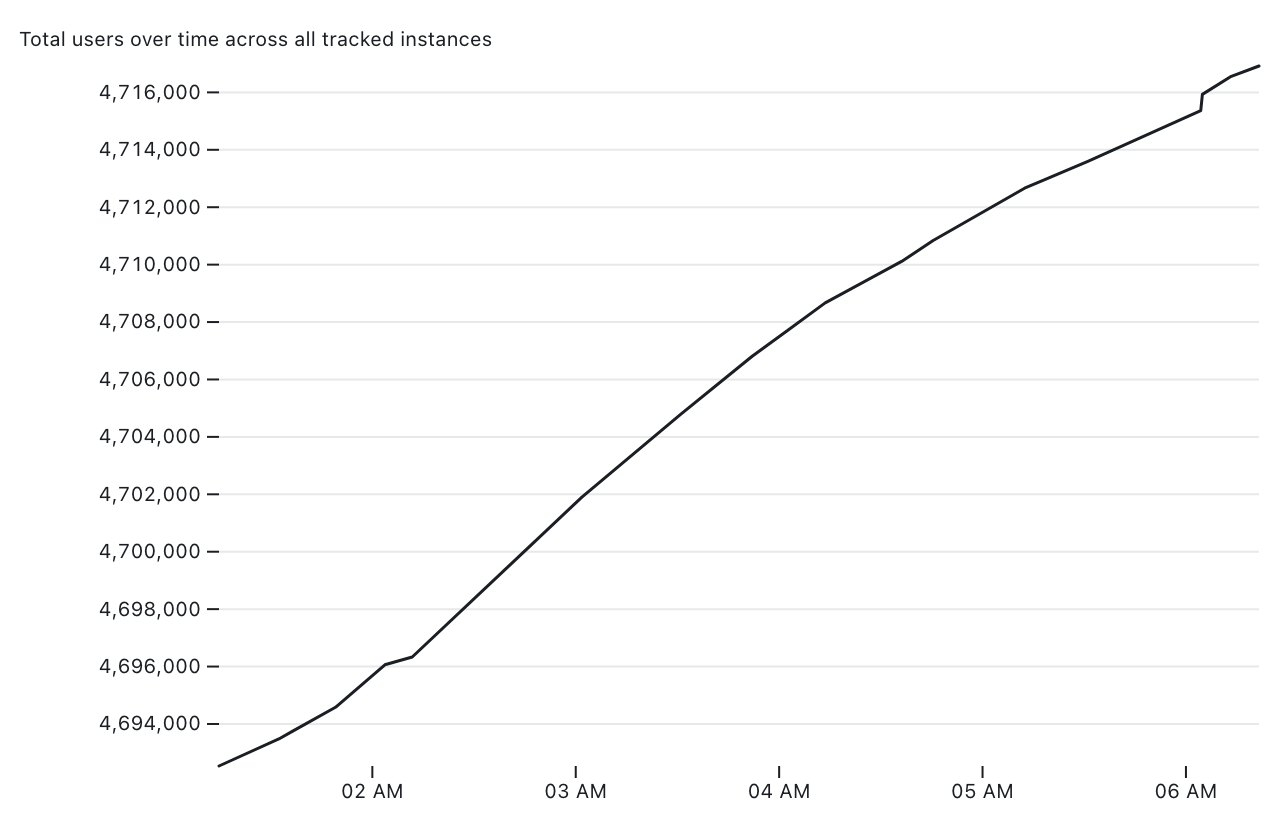
Mastodon is definitely having a moment. User growth is skyrocketing as more and more people migrate over from Twitter.
[... 1,534 words]Datasette Lite: Loading JSON data (via) I added a new feature to Datasette Lite: you can now pass it the URL to a JSON file (hosted on a CORS-compatible hosting provider such as GitHub or GitHub Gists) and it will load that file into a database table for you. It expects an array of objects, but if your file has an object as the root it will search through it looking for the first key that is an array of objects and load those instead.
Plugin support for Datasette Lite
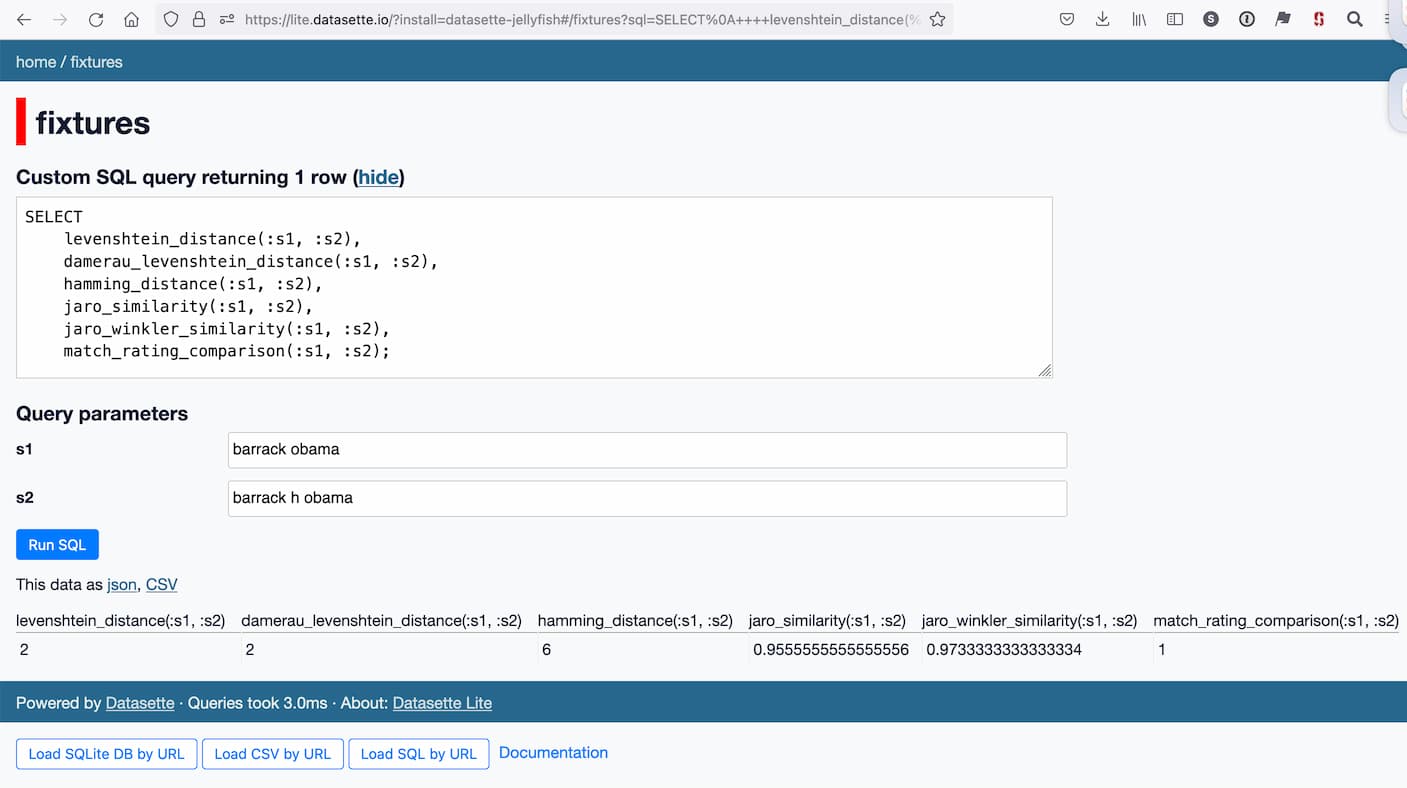
I’ve added a new feature to Datasette Lite, my distribution of Datasette that runs entirely in the browser using Python and SQLite compiled to WebAssembly. You can now install additional Datasette plugins by passing them in the URL.
[... 865 words]Joining CSV files in your browser using Datasette Lite
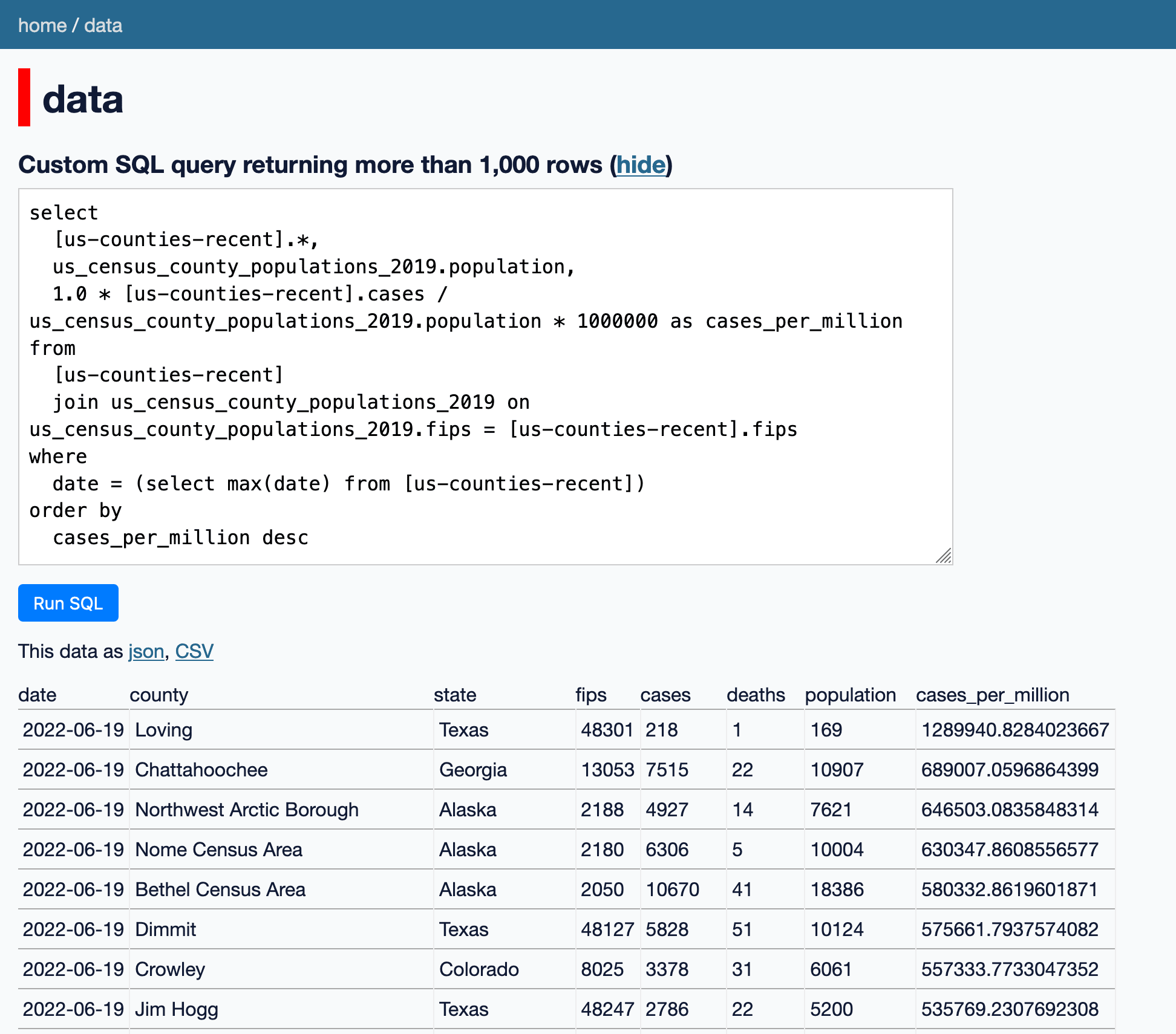
I added a new feature to Datasette Lite—my version of Datasette that runs entirely in your browser using WebAssembly (previously): you can now use it to load one or more CSV files by URL, and then run SQL queries against them—including joins across data from multiple files.
[... 546 words]Datasette Lite: a server-side Python web application running in a browser
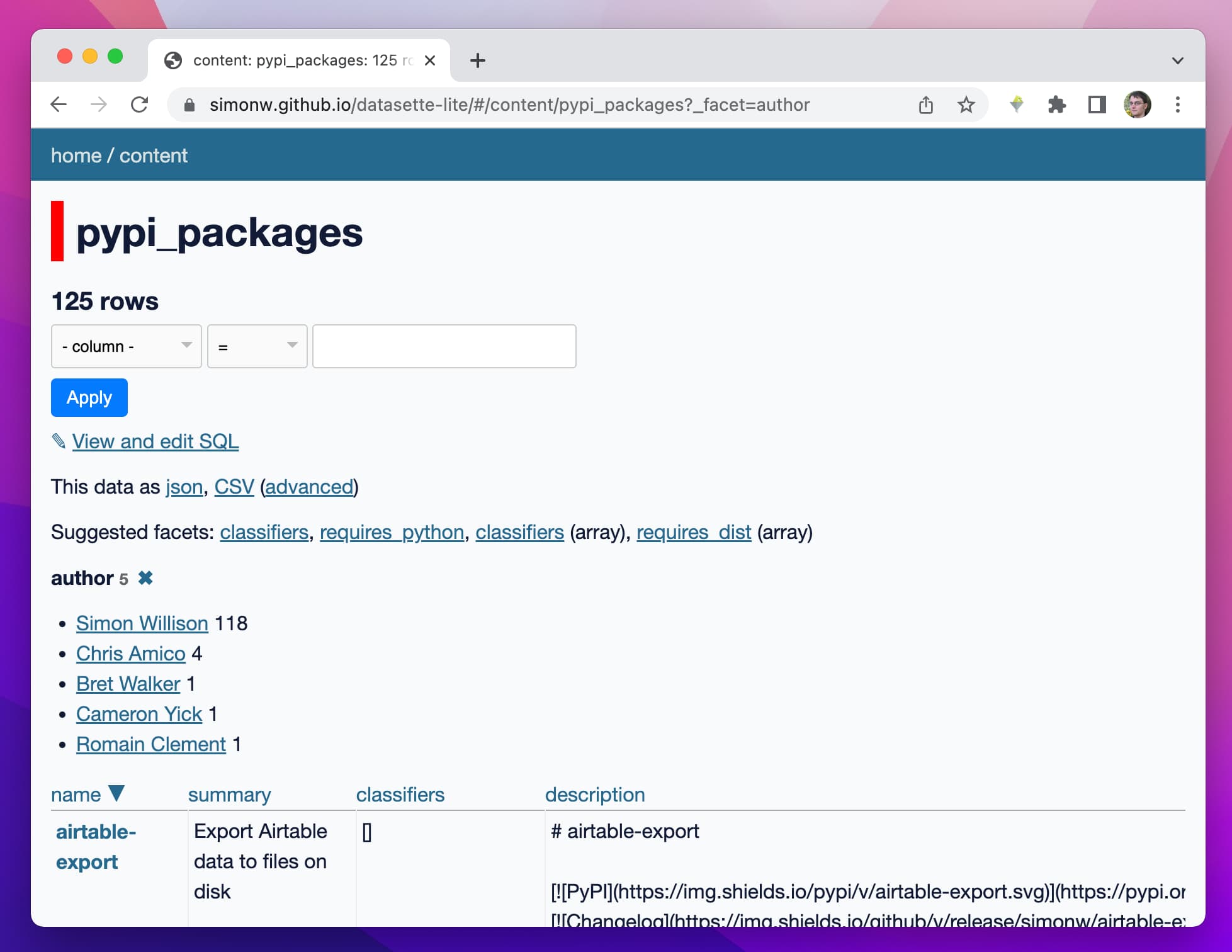
Datasette Lite is a new way to run Datasette: entirely in a browser, taking advantage of the incredible Pyodide project which provides Python compiled to WebAssembly plus a whole suite of useful extras.
[... 4,800 words]2021
How to win at CORS (via) Jake Archibald’s definitive guide to CORS, including a handy CORS playground interactive tool. Also includes a useful history explaining why we need CORS in the first place.
2019
datasette-cors (via) My other Datasette ASGI plugin: this one wraps my asgi-cors project and lets you configure CORS access from a list of domains (or a set of domain wildcards) so you can make JavaScript calls to a Datasette instance from a specific set of other hosts.
asgi-cors (via) I’ve been trying out the new ASGI 3.0 spec and I just released my first piece of ASGI middleware: asgi-cors, which lets you wrap an ASGI application with Access-Control-Allow-Origin CORS headers (either “*” or dynamic headers based on an origin whitelist).
2018
isomorphic-git (via) A pure-JavaScript implementation of the git protocol and underlying tools which works both server-side (Node.js) AND in the client, using an emulation of the fs API. Given the right CORS headers it can clone a GitHub repository over HTTPS right into your browser. Impressive.