52 posts tagged “pyodide”
2026
Cloudflare Python Workers are now generally available (via) After a two year preview, Cloudflare's support for running Python code in their server-side Workers platform is now stable: "Python is now a first-class, fully supported language on the Cloudflare Developer Platform".
A neat thing about this is how it works. Cloudflare are running Python compiled to WebAssembly via Pyodide in their V8-based workerd runtime.
This comes with some limitations, documented here - most notably both multiprocessing and threading are non-functional in the WebAssembly VM.
One particularly interesting detail of this is the local development environment story - their pywrangler development tool (confusingly packaged as workers-py on PyPI) runs a full local simulation of their stack, including executing code with Pyodide in WebAssembly in V8 in a 123MB workerd binary, which for me ended up in node_modules/@cloudflare/workerd-darwin-arm64/bin/workerd.
Python Workers represent a significant investment in the wider Python ecosystem by Cloudflare. The release announcement is credited to Gyeongjae Choi, Dominik Picheta, and Hood Chatham - Gyeongjae and Hood are both Pyodide core maintainers.
Julia Evan's, in Learning a few things about running SQLite:
Maybe one day I’ll learn to read a query plan.
Big same.... which inspired me to have Fable build this interactive explain tool, which runs SQLite in Python in Pyodide in Web Assembly in the browser and adds a layer of explanation to the results of both EXPLAIN and EXPLAIN QUERY PLAN.
Approach with caution, since I don't know enough about SQLite query plans to verify the results myself, but it seems cromulent enough to me.
I've been pondering if Datasette Lite - the Python Datasette application run entirely in the browser using Pyodide and WebAssembly - might be able to edit persistent SQLite files stored on the user's computer.
That's what OFPS (Origin Private File System) is for, so I had Claude Code for web build me this playground UI to try it out in different browsers.
Publishing WASM wheels to PyPI for use with Pyodide
The Pyodide 314.0 release announcement (via Hacker News) includes news I’ve been looking forward to for a long time:
[... 757 words]See Publishing WASM wheels to PyPI for use with Pyodide for details.
Running Python code in a sandbox with MicroPython and WASM
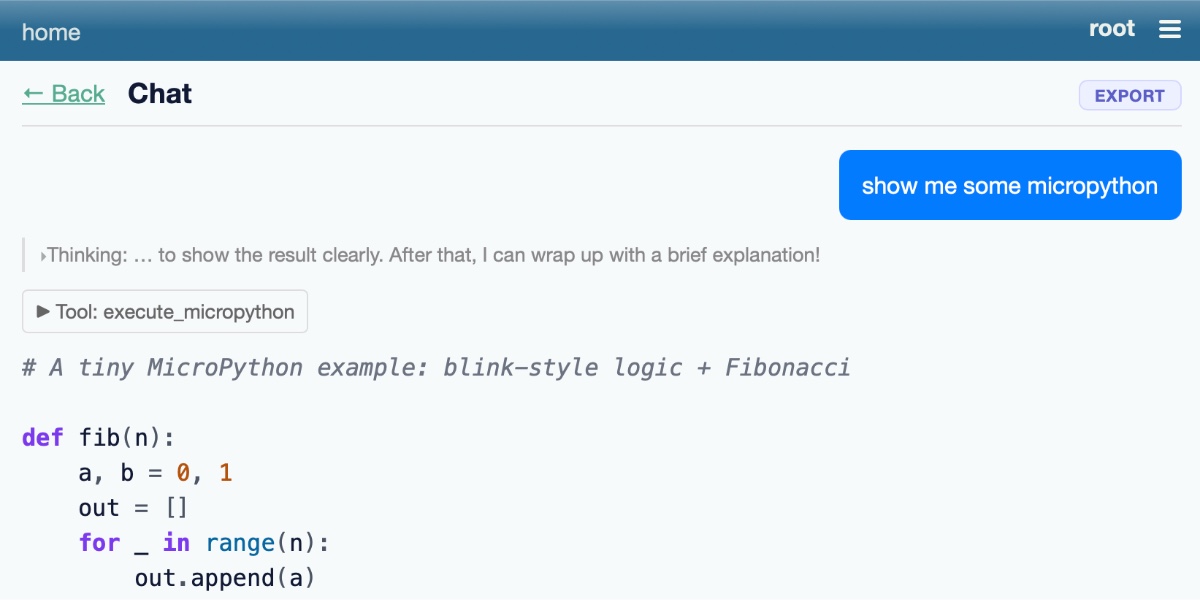
I’ve been experimenting with different approaches to running code in a sandbox for several years now, but my latest attempt feels like it might finally have all of the characteristics I’ve been looking for. I’ve released it as an alpha package called micropython-wasm, and I’m using it for a code execution sandbox plugin for Datasette Agent called datasette-agent-micropython.
[... 2,024 words]Datasette Lite is my version of Datasette that runs entirely in the browser using Pyodide in WebAssembly.
When I first built it four years ago I used Web Workers and code that intercepts navigation operations and fetches the generated HTML by running the Python app.
This worked, but had the disadvantage that any JavaScript in <script> tags would not be executed - breaking some Datasette functionality and a whole lot of Datasette plugins.
This morning I set Claude Opus 4.8 the task (in Claude Code for web) of figuring out how to run Python ASGI apps in Pyodide using Service Workers instead, and it seems to work! Here's a basic ASGI FastCGI demo and here's a demo that runs Datasette 1.0a31.
I'm still getting my head around exactly how it works, but once I've done that I plan to upgrade Datasette Lite itself.
Bram Cohen wrote about his coherent vision for the future of version control using CRDTs, illustrated by 470 lines of Python.
I fed that Python (minus comments) into Claude and asked for an explanation, then had it use Pyodide to build me an interactive UI for seeing how the algorithms work.
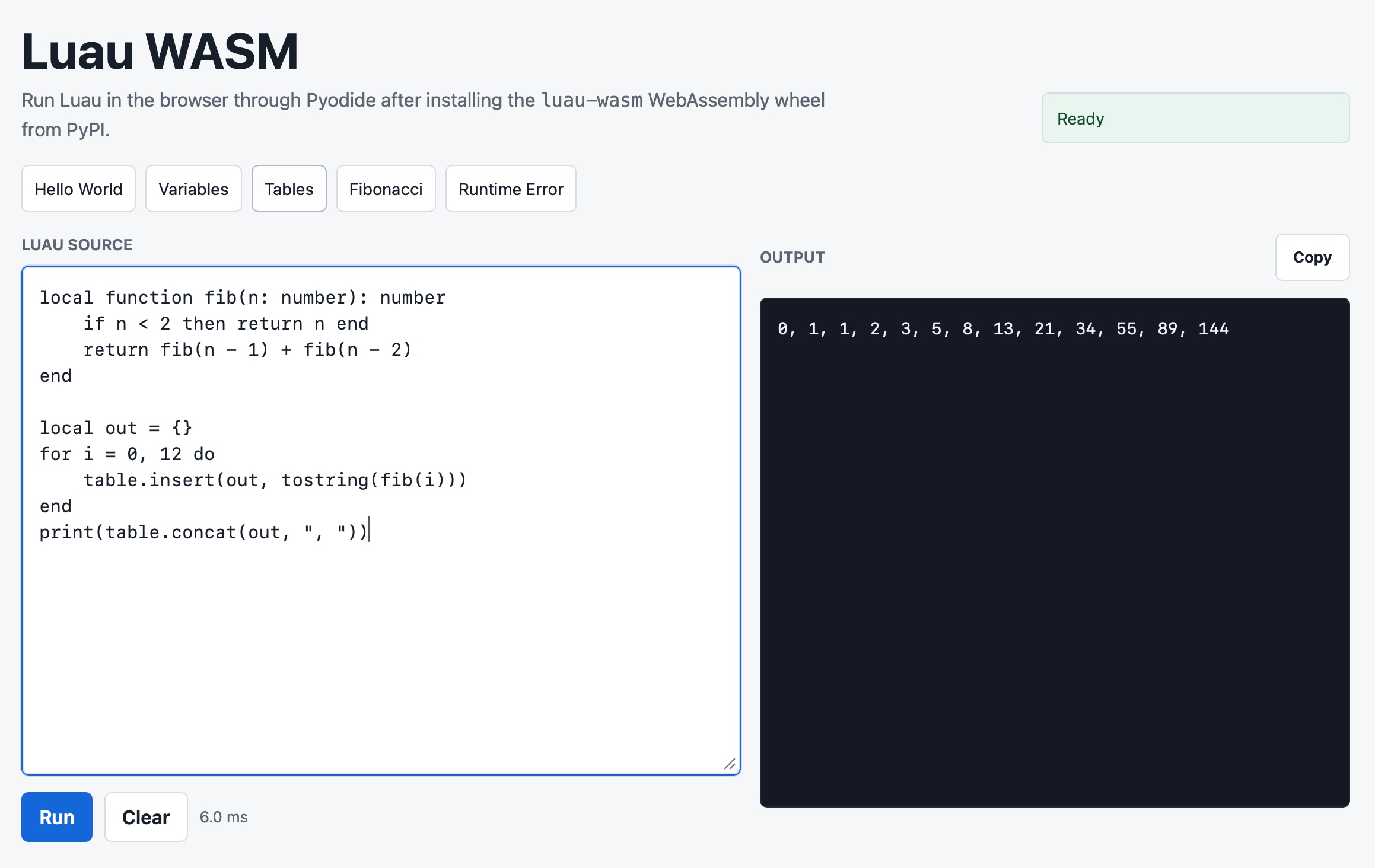
Luau is an MIT licensed "small, fast, and embeddable programming language based on Lua with a gradual type system", created by Roblox.
As part of my ongoing obsession with sandboxed runtimes I decided to see if I could get it working via WebAssembly in both Python and Pyodide.
cysqlite—a new sqlite driver
(via)
Charles Leifer has been maintaining pysqlite3 - a fork of the Python standard library's sqlite3 module that makes it much easier to run upgraded SQLite versions - since 2018.
He's been working on a ground-up Cython rewrite called cysqlite for almost as long, but it's finally at a stage where it's ready for people to try out.
The biggest change from the sqlite3 module involves transactions. Charles explains his discomfort with the sqlite3 implementation at length - that library provides two different variants neither of which exactly match the autocommit mechanism in SQLite itself.
I'm particularly excited about the support for custom virtual tables, a feature I'd love to see in sqlite3 itself.
cysqlite provides a Python extension compiled from C, which means it normally wouldn't be available in Pyodide. I set Claude Code on it (here's the prompt) and it built me cysqlite-0.1.4-cp311-cp311-emscripten_3_1_46_wasm32.whl, a 688KB wheel file with a WASM build of the library that can be loaded into Pyodide like this:
import micropip
await micropip.install(
    "https://simonw.github.io/research/cysqlite-wasm-wheel/cysqlite-0.1.4-cp311-cp311-emscripten_3_1_46_wasm32.whl"
)
import cysqlite
print(cysqlite.connect(":memory:").execute(
    "select sqlite_version()"
).fetchone())
(I also learned that wheels like this have to be built for the emscripten version used by that edition of Pyodide - my experimental wheel loads in Pyodide 0.25.1 but fails in 0.27.5 with a Wheel was built with Emscripten v3.1.46 but Pyodide was built with Emscripten v3.1.58 error.)
You can try my wheel in this new Pyodide REPL i had Claude build as a mobile-friendly alternative to Pyodide's own hosted console.
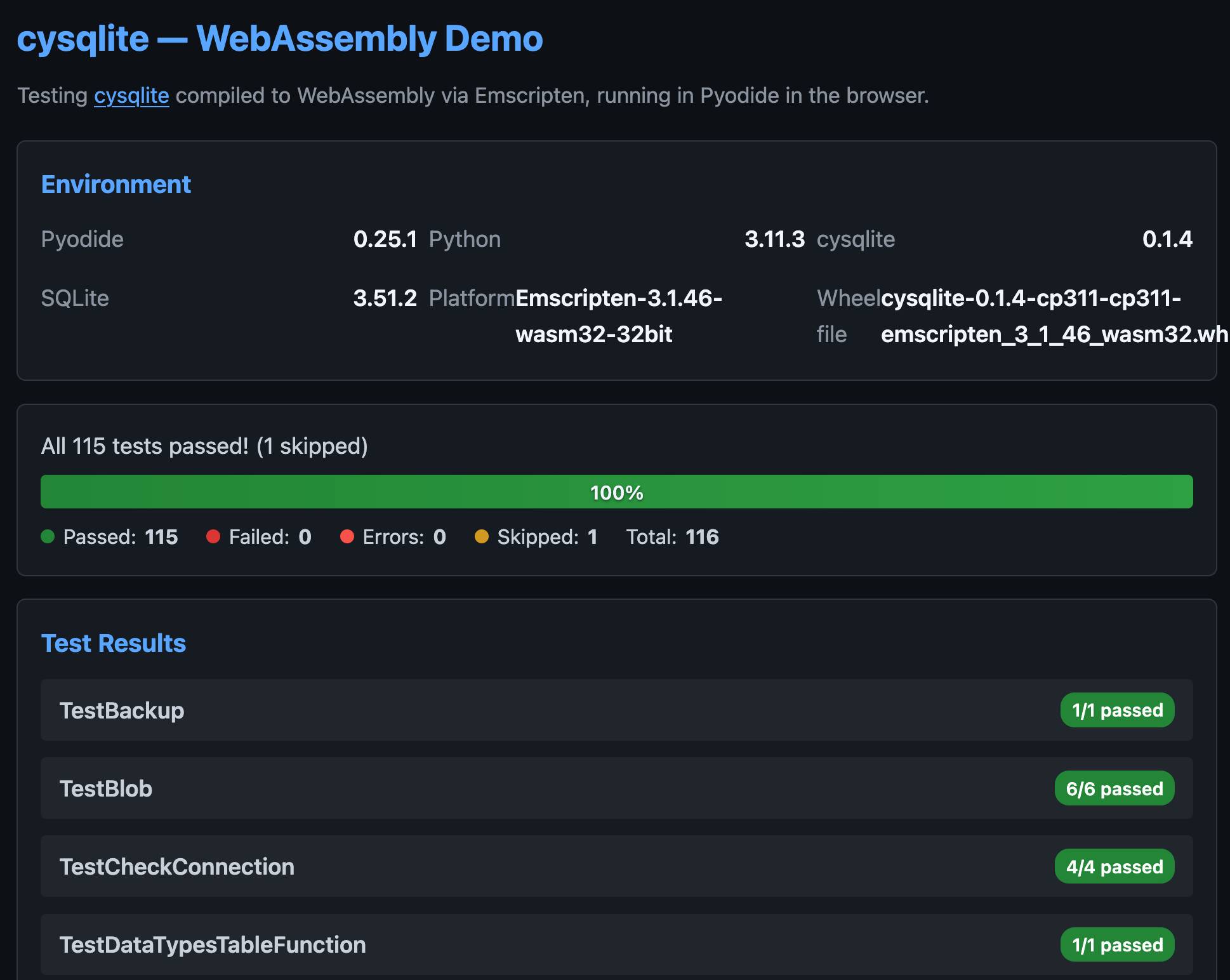
I also had Claude build this demo page that executes the original test suite in the browser and displays the results:
Running Pydantic’s Monty Rust sandboxed Python subset in WebAssembly
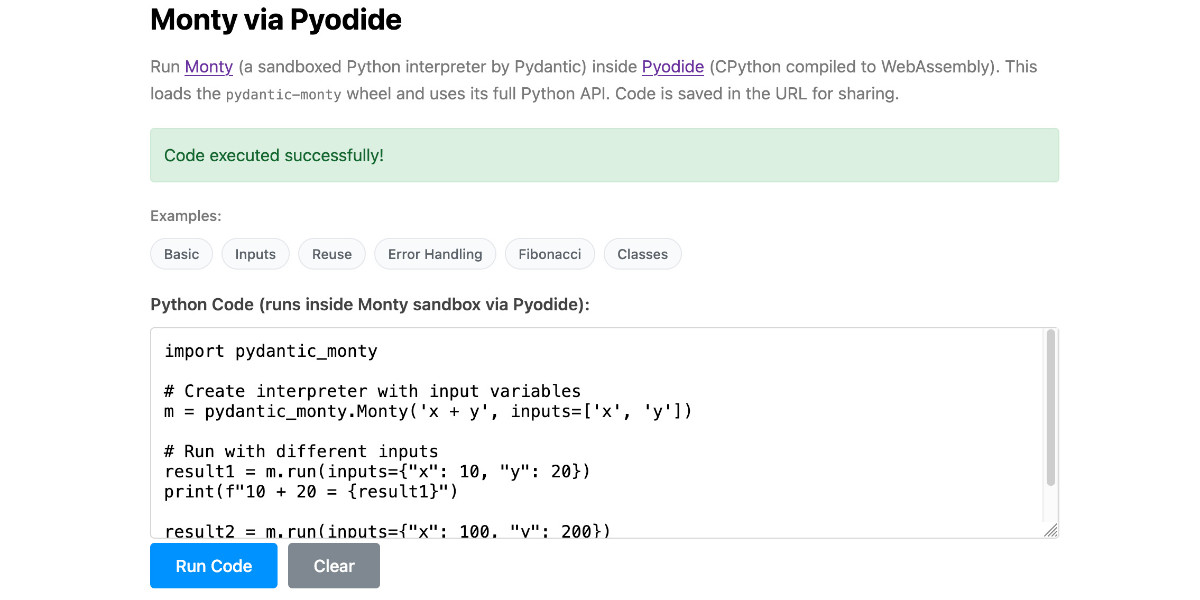
There’s a jargon-filled headline for you! Everyone’s building sandboxes for running untrusted code right now, and Pydantic’s latest attempt, Monty, provides a custom Python-like language (a subset of Python) in Rust and makes it available as both a Rust library and a Python package. I got it working in WebAssembly, providing a sandbox-in-a-sandbox.
[... 854 words]2025
MicroQuickJS. New project from programming legend Fabrice Bellard, of ffmpeg and QEMU and QuickJS and so much more fame:
MicroQuickJS (aka. MQuickJS) is a Javascript engine targetted at embedded systems. It compiles and runs Javascript programs with as low as 10 kB of RAM. The whole engine requires about 100 kB of ROM (ARM Thumb-2 code) including the C library. The speed is comparable to QuickJS.
It supports a subset of full JavaScript, though it looks like a rich and full-featured subset to me.
One of my ongoing interests is sandboxing: mechanisms for executing untrusted code - from end users or generated by LLMs - in an environment that restricts memory usage and applies a strict time limit and restricts file or network access. Could MicroQuickJS be useful in that context?
I fired up Claude Code for web (on my iPhone) and kicked off an asynchronous research project to see explore that question:
My full prompt is here. It started like this:
Clone https://github.com/bellard/mquickjs to /tmp
Investigate this code as the basis for a safe sandboxing environment for running untrusted code such that it cannot exhaust memory or CPU or access files or the network
First try building python bindings for this using FFI - write a script that builds these by checking out the code to /tmp and building against that, to avoid copying the C code in this repo permanently. Write and execute tests with pytest to exercise it as a sandbox
Then build a "real" Python extension not using FFI and experiment with that
Then try compiling the C to WebAssembly and exercising it via both node.js and Deno, with a similar suite of tests [...]
I later added to the interactive session:
Does it have a regex engine that might allow a resource exhaustion attack from an expensive regex?
(The answer was no - the regex engine calls the interrupt handler even during pathological expression backtracking, meaning that any configured time limit should still hold.)
Here's the full transcript and the final report.
Some key observations:
- MicroQuickJS is very well suited to the sandbox problem. It has robust near and time limits baked in, it doesn't expose any dangerous primitive like filesystem of network access and even has a regular expression engine that protects against exhaustion attacks (provided you configure a time limit).
- Claude span up and tested a Python library that calls a MicroQuickJS shared library (involving a little bit of extra C), a compiled a Python binding and a library that uses the original MicroQuickJS CLI tool. All of those approaches work well.
- Compiling to WebAssembly was a little harder. It got a version working in Node.js and Deno and Pyodide, but the Python libraries wasmer and wasmtime proved harder, apparently because "mquickjs uses setjmp/longjmp for error handling". It managed to get to a working wasmtime version with a gross hack.
I'm really excited about this. MicroQuickJS is tiny, full featured, looks robust and comes from excellent pedigree. I think this makes for a very solid new entrant in the quest for a robust sandbox.
Update: I had Claude Code build tools.simonwillison.net/microquickjs, an interactive web playground for trying out the WebAssembly build of MicroQuickJS, adapted from my previous QuickJS plaground. My QuickJS page loads 2.28 MB (675 KB transferred). The MicroQuickJS one loads 303 KB (120 KB transferred).
Here are the prompts I used for that.
Recreating the Apollo AI adoption rate chart with GPT-5, Python and Pyodide
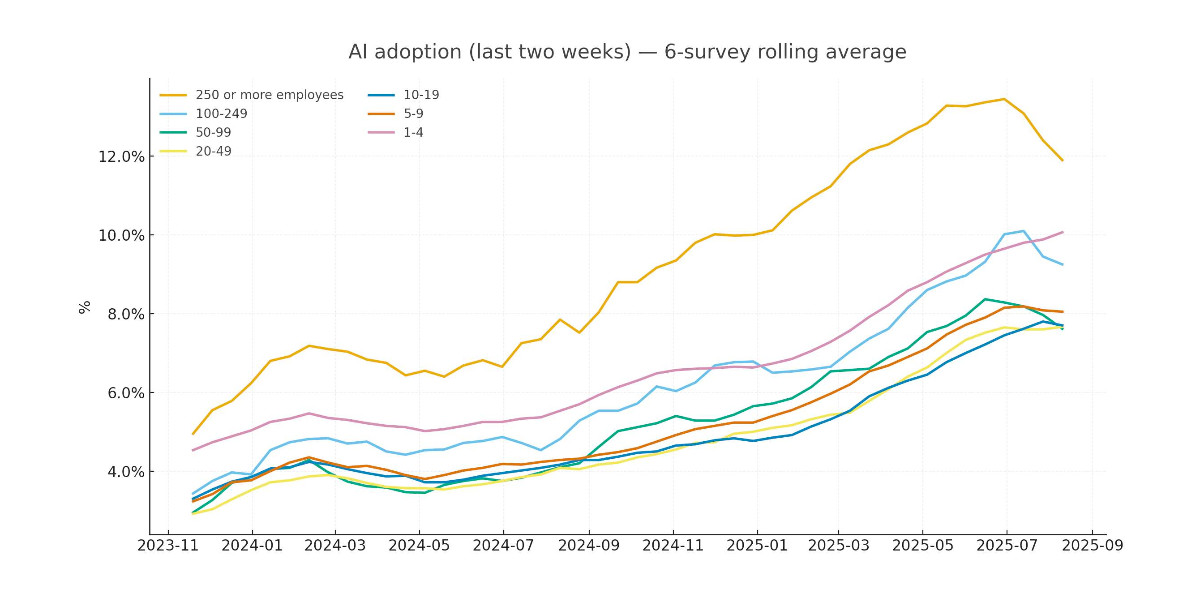
Apollo Global Management’s “Chief Economist” Dr. Torsten Sløk released this interesting chart which appears to show a slowdown in AI adoption rates among large (>250 employees) companies:
[... 2,673 words]If you want to create completely free software for other people to use, the absolute best delivery mechanism right now is static HTML and JavaScript served from a free web host with an established reputation.
Thanks to WebAssembly the set of potential software that can be served in this way is vast and, I think, under appreciated. Pyodide means we can ship client-side Python applications now!
This assumes that you would like your gift to the world to keep working for as long as possible, while granting you the freedom to lose interest and move onto other projects without needing to keep covering expenses far into the future.
Even the cheapest hosting plan requires you to monitor and update billing details every few years. Domains have to be renewed. Anything that runs server-side will inevitably need to be upgraded someday - and the longer you wait between upgrades the harder those become.
My top choice for this kind of thing in 2025 is GitHub, using GitHub Pages. It's free for public repositories and I haven't seen GitHub break a working URL that they have hosted in the 17+ years since they first launched.
A few years ago I'd have recommended Heroku on the basis that their free plan had stayed reliable for more than a decade, but Salesforce took that accumulated goodwill and incinerated it in 2022.
It almost goes without saying that you should release it under an open source license. The license alone is not enough to ensure regular human beings can make use of what you have built though: give people a link to something that works!
MCP Run Python (via) Pydantic AI's MCP server for running LLM-generated Python code in a sandbox. They ended up using a trick I explored two years ago: using a Deno process to run Pyodide in a WebAssembly sandbox.
Here's a bit of a wild trick: since Deno loads code on-demand from JSR, and uv run can install Python dependencies on demand via the --with option... here's a one-liner you can paste into a macOS shell (provided you have Deno and uv installed already) which will run the example from their README - calculating the number of days between two dates in the most complex way imaginable:
ANTHROPIC_API_KEY="sk-ant-..." \
uv run --with pydantic-ai python -c '
import asyncio
from pydantic_ai import Agent
from pydantic_ai.mcp import MCPServerStdio

server = MCPServerStdio(
    "deno",
    args=[
        "run",
        "-N",
        "-R=node_modules",
        "-W=node_modules",
        "--node-modules-dir=auto",
        "jsr:@pydantic/mcp-run-python",
        "stdio",
    ],
)
agent = Agent("claude-3-5-haiku-latest", mcp_servers=[server])

async def main():
    async with agent.run_mcp_servers():
        result = await agent.run("How many days between 2000-01-01 and 2025-03-18?")
    print(result.output)

asyncio.run(main())'
I ran that just now and got:
The number of days between January 1st, 2000 and March 18th, 2025 is 9,208 days.
I thoroughly enjoy how tools like uv and Deno enable throwing together shell one-liner demos like this one.
Here's an extended version of this example which adds pretty-printed logging of the messages exchanged with the LLM to illustrate exactly what happened. The most important piece is this tool call where Claude 3.5 Haiku asks for Python code to be executed my the MCP server:
ToolCallPart(
    tool_name='run_python_code',
    args={
        'python_code': (
            'from datetime import date\n'
            '\n'
            'date1 = date(2000, 1, 1)\n'
            'date2 = date(2025, 3, 18)\n'
            '\n'
            'days_between = (date2 - date1).days\n'
            'print(f"Number of days between {date1} and {date2}: {days_between}")'
        ),
    },
    tool_call_id='toolu_01TXXnQ5mC4ry42DrM1jPaza',
    part_kind='tool-call',
)
I also managed to run it against Mistral Small 3.1 (15GB) running locally using Ollama (I had to add "Use your python tool" to the prompt to get it to work):
ollama pull mistral-small3.1:24b

uv run --with devtools --with pydantic-ai python -c '
import asyncio
from devtools import pprint
from pydantic_ai import Agent, capture_run_messages
from pydantic_ai.models.openai import OpenAIModel
from pydantic_ai.providers.openai import OpenAIProvider
from pydantic_ai.mcp import MCPServerStdio

server = MCPServerStdio(
    "deno",
    args=[
        "run",
        "-N",
        "-R=node_modules",
        "-W=node_modules",
        "--node-modules-dir=auto",
        "jsr:@pydantic/mcp-run-python",
        "stdio",
    ],
)

agent = Agent(
    OpenAIModel(
        model_name="mistral-small3.1:latest",
        provider=OpenAIProvider(base_url="http://localhost:11434/v1"),
    ),
    mcp_servers=[server],
)

async def main():
    with capture_run_messages() as messages:
        async with agent.run_mcp_servers():
            result = await agent.run("How many days between 2000-01-01 and 2025-03-18? Use your python tool.")
    pprint(messages)
    print(result.output)

asyncio.run(main())'
Here's the full output including the debug logs.