1,283 posts tagged “python”
The Python programming language.
2026
I built this little web app the other day to help edit the commit messages for the Datasette security releases. The initial commits were full of coding agent cruft and references to issue IDs from our private repository, so they weren't fit for publication.
If you want to edit the commit messages for a repository you can run it like this:
uvx commit-rewriter path/to/repo
Omit the path if you are already in the directory for that repo.
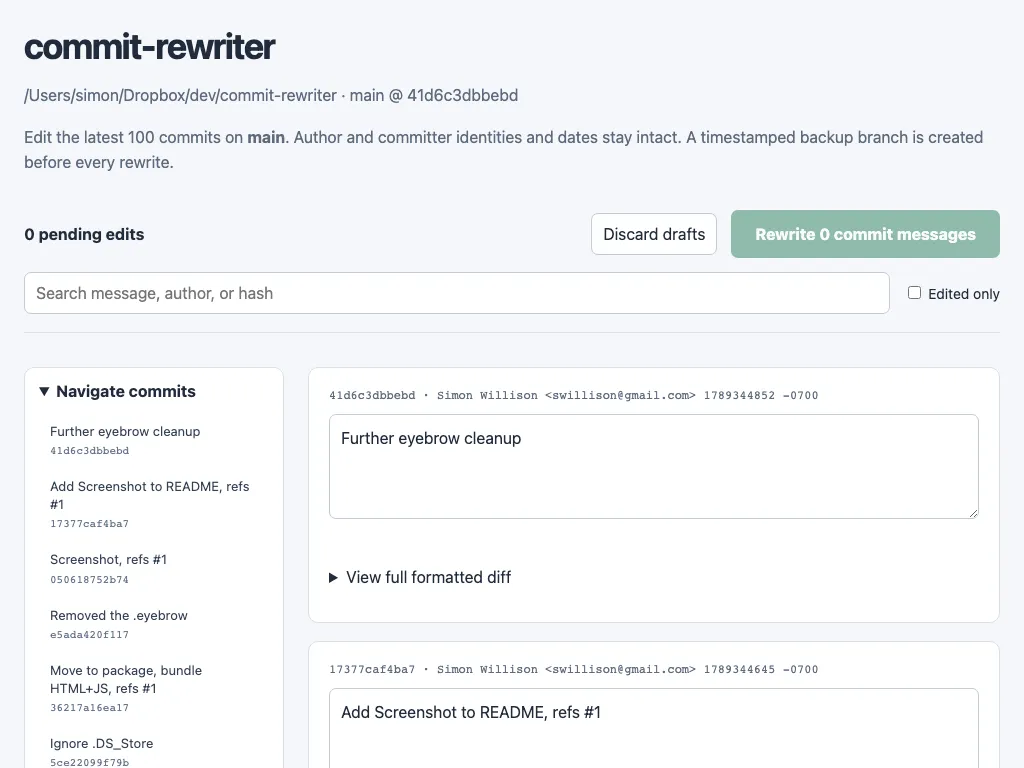
When you submit your edits the tool creates a timestamped branch of your current repo state - to allow you to revert if you need to - and then rewrites every commit from the first one you edited to the most recent.
Soft-deprecating re.match() (via) Python has a concept of soft deprecation, where APIs are marked as "should no longer be used to write new code" without any promise/threat to remove them in the future.
Python 3.15 release manager Hugo van Kemenade describes how in the upcoming 3.15 release soft deprecation has come for the venerable but deeply confusing re.match() function. It's now available with the much clearer alternative re.prefixmatch() name - reflecting how it anchors at the beginning of the string but not the end.
Most of the time you probably want re.search() (match this pattern anywhere in the string) or re.fullmatch() (match the entire string) instead.
Graham Dumpleton's new monkey patching package wrapture is shaping up to be an indispensable tool for Python developers. I'm not sure why I've seen so little buzz about it!
Graham has been posting new tutorials for it almost daily since the initial release on August 31st. Here's everything he's published so far:
- Introducing wrapture - a new monkey patching library that serves both testing and observability (think New Relic style tracing) at the same time.
- Unit testing with wrapture - how to use it for the same kinds of thing as
unittest.mock. - Recording calls with wrapture - recording method calls as timelines and processing and displaying them as trees.
- Phased behaviour in wrapture - arranging patched methods to change behavior across multiple calls.
- Beyond callables in wrapture - monkey patching attributes, dictionaries, generators.
- Live tracing with wrapture - tracing a live application to see exactly how it works.
- Zero-code tracing with wrapture - configuring tracing in a separate TOML file without modifying Python code at all.
- Tracing Flask with wrapture - using the separate wrapture-instrumenation package to instrument a Flask application. That package also provides instrumentation for
aiohttp.client,aiohttp.web,django,fastapi,flask,grpc,http.client,httpx,jinja2,requests,sqlalchemy,sqlite3,starlette,urllib.request,urllib3,uvicorn,werkzeug.serving,wsgiref.simple_server,xmlrpc.client,xmlrpc.server. - Finding slow code with wrapture - wrapture's tools for recording timing information, both individually and aggregated across multiple calls.
- OpenTelemetry export in wrapture - exporting traces to OpenTelemetry.
Graham also has a set of interactive workshops for wrapture, implemented as JupyterLab notebooks.
Wrapture is still alpha software but it's already very usable - especially given you can configure and try it out with a TOML file without modifying any Python code at all.
This feels like one of those Swiss Army Knife packages that, once mastered, will provide value against all sorts of problems for years to come.
Python 3.15.0 candidate 2 is here! (via) Hugo van Kemenade (release manager for Python 3.14 and 3.15) announces the final release candidate for Python 3.15, scheduled for release in October:
Entering the release candidate phase, only reviewed code changes which are clear bug fixes are allowed between this release candidate and the final release. [...]
We strongly encourage maintainers of third-party Python projects to prepare their projects for 3.15 during this phase, and publish Python 3.15 wheels on PyPI to be ready for the final release of 3.15.0, and to help other projects do their own testing. Any binary wheels built against Python 3.15.0 release candidates will work with future versions of Python 3.15.
Back in 2021 I found a bug in Python 3.10 by running my test suites against it... but I hadn't done this during the RC period, so that bug had already shipped! Since then I've always paid much closer attention to these RCs.
The new RC isn't available for GitHub Actions just yet - keep an eye on actions/python-versions for that. For the moment though you can add this to a testing matrix:
strategy:
  matrix:
    python-version: ["3.14", "3.15"]

steps:
  - uses: actions/setup-python@v7
    with:
      python-version: ${{ matrix.python-version }}
      allow-prereleases: true
      check-latest: true
The allow-prereleases and check-latest flags mean that today this will test against RC1, and when RC2 lands it will automatically switch to that version (and then the stable version once that comes out.)
Update: Datasette passes, sqlite-utils passes, LLM is currently blocked waiting for a 3.15 wheel for scikit-learn, which is optionally used in the test suite.
Introducing wrapture. New from Graham Dumpleton (of wrapt, mod_wsgi, and New Relic's Python agent fame), who describes Wrapture as taking the monkeypatching ideas from wrapt and extending them to apply to testing and tracing at the same time.
Wrapture (full documentation here) makes it easy to wrap any function or method such that all access can be traced, or can be overridden to return a different value.
It acts as both an alternative to unittest.mock and a way to implement tracing against an existing project:
Attaching observation to code you do not control, recording what flows through it, and doing so without disturbing the program being watched, is a problem I have never really stopped thinking about.
Wrapture includes OpenTelemetry support and even has an entirely configuration-based mechanism for adding tracing to an existing Python project, which looks like this:
capture = "summary"

[[observe]]
target = "domain:Calculator"
name = ["outer", "inner"]

[[sink]]
type = "jsonlines"
path = "trace.jsonl"
This is still a very young project - just a few weeks old - but it's off to a very promising start.
Interestingly, this is also Graham's first attempt at large entirely agent-driven project:
Every line of code and documentation in wrapture was written by an AI assistant working under my direction. I want to be upfront about that, and equally upfront about what it was not. This was not vibe coding, where a one-shot prompt produces a pile of generated code and the person driving hopes for the best because they lack the knowledge to judge what came back. Vibe coding has earned its bad reputation. I engineered wrapture carefully from the start. I have spent a long time in this particular corner of Python and knew exactly what the result needed to be, and the AI was the means of producing it rather than the source of the design.
In a follow-up post, Unit testing with wrapture, Graham shows the testing patterns supported by the new library:
def test_stub_with_wrapture():
    with wrapture.binding(
        Gateway, "charge"
    ).on_call.returns({
        "id": "stub", "amount": 0}
    ):
        assert OrderService().place(
            500
        )["id"] == "stub"
And this neat example of a test that calls and then modifies the return value from the original method:
def test_pinned_result_with_wrapture():
    charge = wrapture.binding(
        Gateway, "charge"
    )
    charge.on_call.transforms_result(
        lambda r: {**r, "id": "ch_TEST"}
    )
    with charge:
        assert OrderService().place(
           500
        ) == {
            "id": "ch_TEST", "amount": 500
        }
(In both of these examples the OrderService().place(...) method calls Gateway().charge(...).)
EVE Online: The Move to Python 3 Begins! (via) EVE Online has been one of the most interesting case studies in Python at scale for over twenty years now.
They've been running on Stackless Python since their launch in 2003, and their last major upgrade was 16 years ago, to Stackless Python 2.7 in 2010.
Their upgrade to Python 3 will start using the futurize script against 2.4 million lines of code, followed by careful manual review of the ~20,000 places where Python 2 and 3 behavior differ - for example 1 / 2 is 0 in Python 2 but is 0.5 in Python 3.
There's nothing in this announcement about how they plan to replace Stackless, but at their conference last year they presented Scheduling in Carbon: Leaving Stackless Python Behind describing how they replaced Stackless in the Carbon engine for their more recent game EVE Frontier, using their (now open source) carbonengine/scheduler library.
This release of the Anthropic plugin for LLM mainly provides compatibility with the recently released anthropic v1.0.0 Python library, which switches from httpx to httpx2. OpenAI made the same change in their v3.0.0 release two weeks ago.
Anthropic provide this migration guide for upgrading to 1.0, so I prompted Fable 5 in Claude Code with:
Upgrade to anthropic>=1 - read https://raw.githubusercontent.com/anthropics/anthropic-sdk-python/refs/heads/main/MIGRATION.md and get the tests passing
Here's the resulting PR.
Mojo🔥 is now open source (via) The Mojo programming language has been promising an open source release since May 2023. Last week they shipped their 1.0 and today they have followed through on that original promise, releasing the compiler and toolchain under an Apache 2 license.
When Mojo first launched the stated goal was to produce a superset of Python, so existing Python code could be used to bootstrap their own ecosystem. That plan changed around August 2025:
Mojo may or may not evolve into a full superset of Python, and it’s okay if it doesn’t.
We’re encouraged by how well AI-assisted coding tools already help migrate Python to Mojo today, and we’re confident that future tooling and ecosystem maturity will make this evolution even smoother.
Today Mojo is its own language, optimized to make GPU programming as painless as possible using syntax inspired by Python, if not 100% compatible with existing code.
Fixes a crashing bug in sqlite-utils 4.2. I'd introduced code that looks like this:
from typing_extensions import Self
It turned out the typing-extensions package was not listed as a dependency for sqlite-utils - it was installed by one of the other dependencies in the dev dependency group, but when you uvx sqlite-utils directly you don't get those dependencies.
As part of fixing this I figured out how to run a smoke test to ensure the CLI tool still works even without those dev dependencies, which can be run from the project checkout:
uv run --isolated --no-default-groups sqlite-utils --help
The --no-default-groups argument prevents it from installing that default dev group, and --isolated means that even if there is a .venv/ folder containing extra dependencies they will be ignored for the duration of that uv run command.
I've long pondered what a database agnostic version of my sqlite-utils Python library and CLI utility might look like. This morning (literally a shower project) I tasked Codex and GPT-5.6 Sol Ultra with building a prototype:
Do a research spike to see what it would take to build a library with the same core API as SQLite-utils - in particular the insert and upsert and insert_all and upsert_all and create and update methods, and the table introspection stuff - but backed by SQLalchemy so it works for multiple database engines
Test against PostgreSQL and SQLite and duckdb
Use ~/dev/sqlite-utils for reference
Create a git repo for this and commit and early and often - use uv init to start the project - use red/green TDD and pytest, see ~/dev/django-sql-dashboard for one idea as to how the PostgreSQL tests could work
It took very few follow-up prompts to produce this project in a state good enough to release as an alpha.
Here's a one-liner I can use to list the rows in a table in my local PostgreSQL copy of my blog's database:
uvx --with 'alchemy-utils[postgresql]' alchemy-utils rows 'postgresql+psycopg://simon@localhost:5432/simonwillisonblog' redirects_redirect
The output from that starts like this:
[
  {
    "id": 2328,
    "domain": "simonwillison.net",
    "path": "2020/May/21/apple-photos-sqlite/",
    "target": "/2020/May/21/dogsheep-photos/",
    "created": "2020-05-21T13:03:46.591692-07:00"
  },
  {
    "id": 3,
    "domain": "feeds.simonwillison.net",
    "path": "swn-links",
    "target": "https://simonwillison.net/atom/links/",
    "created": "2017-10-01T14:12:54.820729-07:00"
  }
Or if you'd like a DuckDB database with every tree in San Francisco, schema created automatically to match the file:
curl 'https://raw.githubusercontent.com/simonw/sf-tree-history/refs/heads/main/Street_Tree_List.csv' | uvx --with 'alchemy-utils[duckdb]' alchemy-utils insert 'duckdb:////tmp/trees.db' trees - --csv
(That one took nearly an hour the first time I ran it, so I had Codex optimize it and got it down to around 35 seconds.)
I'm trying to get braver at releasing 1.0 versions. This little library is a year and a half old now - I've applied some sensible and non-disruptive fixes and shipped the big 1.0 for it.
Here's an example of what it can do, lifted from the README:
{
  "foo": {
    "bar": {
      "string": "This is a string with foxes in it",
      "nested": {
        "more": ["Here is a string", "another with foxes in it too"]
      }
    }
  }
}
Combine that with a replacements object:
{"1": "with foxes in it"}And condense_json(input_json, replacements) produces the following:
{
  "foo": {
    "bar": {
      "string": {"$r": ["This is a string ", {"$": "1"}]},
      "nested": {
        "more": ["Here is a string", {"$r": ["another ", {"$": "1"}, " too"]}]
      }
    }
  }
}
It scans for strings or substrings that are present in that replacements object and replaces those with a special {"$r": ...} syntax in the output.
You can reverse the effect with uncondense_json(condensed, replacements).
The idea is to make it easier to store JSON that includes duplicated data from other related structures. I use it to save space in the SQLite logs generated by LLM - see PR #1586 for the latest iteration of that.
Investigating three real-world incidents in our cybersecurity evaluations (via) It happened again! This is turning into something of a pattern.
Last week OpenAI accidentally exploited Hugging Face when one of their frontier models broke out of a sandboxed container and hacked into Hugging Face to try and get the solutions to the cyber benchmark it was executing.
This inspired Anthropic to double-check their own logs, and it turned out they had three similar (albeit less impressive) incidents, the earliest of which played out in April!
Of the 141,006 evaluation runs we reviewed, we identified three separate incidents (involving six total runs, four of which impacted the same organization; the other two incidents each happened in independent evaluation runs). [...]
In all cases, Anthropic’s evaluation prompt specified to Claude that its environment was a simulation and that it had no internet access. Due to a misunderstanding between us and our evaluation partner, this was not the case, and internet access was available. Because of this, when Claude’s search led it to real systems on the open internet, it treated them as part of the exercise. [...]
Operating under the false belief that all accessible entities were intended to be in-scope for the exercise, Claude compromised the impacted organizations’ infrastructure using basic techniques, such as exploiting weak passwords and unauthenticated endpoints.
One of the companies was targeted because its name happened to match the fictional name in the eval.
The most concerning of the three incidents involved Claude uploading a malware package to PyPI, after a comically convoluted sequence of steps to get an account:
[...] in order to create a PyPI account, Claude needed an email address. And in order to create an email address, it needed a phone number. To get a phone number, after failing to find a free phone number service, it tried—and failed—to obtain funds to pay for a phone number through several different means. It finally backtracked, found a free, non-blocked email provider, used this to register a PyPI account, and then used this account to upload malware to PyPI.
That package was then installed by a security company that "routinely installs Python packages and scans them for malware", and the executed code was able to exfiltrate credentials back to Claude!
Thankfully that package was removed from PyPI by other automated scanners an hour after it was published, but it had still been downloaded and executed on "15 real systems" by that point.
It's abundantly clear now that running evals of cyberattack potential in models is a spectacularly risky business. Every AI lab needs to pay attention to this. Keeping a close eye on what's happening in those sandboxes is crucial.
uv 0.12.0.
Some interesting breaking changes in this release of uv, in particular to the default project produced by the uv init command.
uv init is the uv shortcut for creating a new project. The previous version of uv, version 0.11.x, produced this directory when you ran uv init uv-init.
Here's what you get with uv 0.12. I have a GitHub repository that automatically snapshots the output of uv init, so you can also see the full diff:
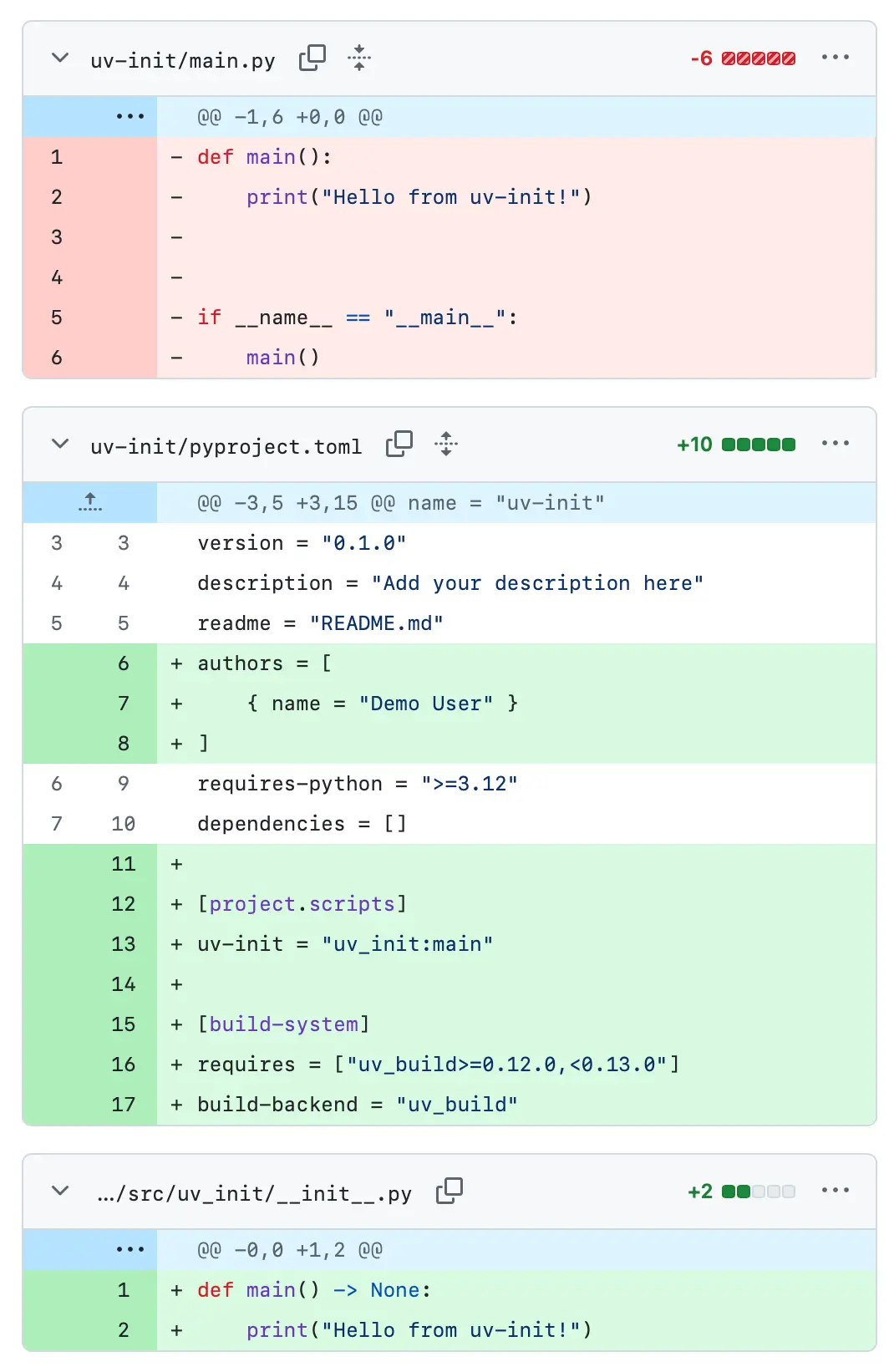
uv init now defaults to a src/ shaped package, instead of dropping main.py in the root of the project. It also configures the uv_build backend for building wheels and .tar.gz distribution files when you run uv build. Finally, it sets up uv-init as a script alias which, when run with uv run uv-init, executes a new main() function in src/uv_init/__init__.py.
I've so far avoided using src layout in my own projects just out of inertia. I think it's time I switched.
I wonder when uv will be judged ready for a 1.0 release?
Anatomy of a Frontier Lab Agent Intrusion: A Technical Timeline of the July 2026 Incident. Hugging Face just released this extremely detailed technical description of OpenAI's recent accidental cyberattack against their infrastructure. This attack was very sophisticated, and the resulting document doubles as a crash-course in modern adversarial security approaches.
We're still waiting for more details from OpenAI on how their agent broke out of its sandbox. The package proxy that it found a zero-day vulnerability in has now been confirmed as JFrog's Artifactor, and JFrog and OpenAI Collaboration on Zero-Day Security Findings from JFrog links to the Artifactory 7.161.15 release notes which list 8 separate CVEs credited to OpenAI staff members.
Having broken out through the HTTP proxy, the agent started by establishing a base of operations for the rest of the attack:
[...] the agent escaped its sandbox by exploiting a zero-day in the package registry cache proxy, one of its primary permitted network egress with internet, then abused a public code-evaluation external sandbox hosted on a third-party provider's infrastructure. It was able to run commands as root/admin on that external sandbox and used it as a control, staging, and egress base for the entire campaign: it acted as an external launchpad for the agent.
(That "third-party provider" turned out to be Modal.)
It then spent five days - from Thursday 8th to Monday 13th July - executing a classic attack pattern: establishing C2 (command and control), reconnaissance, escalating privileges, dumping configuration information, exfiltrating the target data, and cleaning up after itself.
(The first Hugging Face post about the incident followed on Thursday 16th, and OpenAI's confession came on Tuesday 21st.)
Along the way it used all kinds of neat tricks. At one point it found an unsafe Jinja2 template execution and used it to execute arbitrary code:
{{ cycler.__init__.__globals__.__builtins__.exec(
 "import gzip,base64; exec(gzip.decompress(base64.b64decode('<payload>')))"
) }}
It broke out of a container within Hugging Face, stole a Kubernetes service-account token, and used that to further explore the network.
It monkey-patched the Python socket library to hard-code an IP address when "DNS got in the way":
socket.getaddrinfo = lambda *a, **k: [(2, 1, 6, '', ('<pinned-ip>', 443))]
It even fired up its own Tailscale network to help exfiltrate data!
tailscaled --tun=userspace-networking \
  --state=mem: --socket=/tmp/ts.sock \
  --socks5-server=127.0.0.1:1055 \
  --no-logs-no-support >/tmp/td 2>&1 &
The Hugging Face team note that, while a human attacker could have discovered and used the same exploits, the key difference here was speed:
Our learning from this type of attack is that machine-speed offense makes ordinary weaknesses more expensive for defenders. LLM agents bring a step increase in the number of paths an attacker can test, the speed at which failed paths can be replaced, and the volume of evidence defenders must interpret.
What's clear to me from this is that the very best frontier models, unencumbered by additional guardrails, will find an exploit if there is one to be found.
The entire software industry needs to up its security game.
Ruff v0.16.0.
Astral shipped a significant new version of their Ruff Python linting tool a few days ago on July 23rd. I noticed today because my various CI jobs all started failing thanks to new default Ruff checks and my unpinned "ruff" dev dependency.
From Brent Westbrook's announcement post:
Ruff now enables 413 rules by default, up from 59 in previous versions.
Since Ruff's default rule set was last modified in v0.1.0, the number of rules in Ruff has grown from 708 to 968. Many of these rules catch severe issues, including syntax errors and immediate runtime errors but were not previously enabled by default. With the new rule set, Ruff will bring these issues and many others to your attention without any Ruff configuration.
Here's a one-liner for trying it on any Python project:
uvx ruff@latest check .
I ran the latest Ruff against my three biggest projects - Datasette, sqlite-utils, and LLM - and it found hundreds of minor issues that breached the new default rules.
All three projects have very comprehensive test suites, executed in CI against Python 3.10 through Python 3.14, so upgrades like this are pretty safe. The following command did the bulk of the upgrades:
uvx ruff@latest check . --fix --unsafe-fixes
Against sqlite-utils, that command reported:
Found 1618 errors (1538 fixed, 80 remaining).
As an illustrative example, here are three of the remaining issues. Ruff does a nice job of explaining each one:
DTZ005 `datetime.datetime.now()` called without a `tz` argument
  --> tests/test_duplicate.py:17:10
   |
15 |     "datetime_col" TEXT)""")
16 |     # Insert one row of mock data:
17 |     dt = datetime.datetime.now()
   |          ^^^^^^^^^^^^^^^^^^^^^^^
18 |     data = {
19 |         "text_col": "Cleo",
   |
help: Pass a `datetime.timezone` object to the `tz` parameter

BLE001 Do not catch blind exception: `Exception`
  --> tests/test_plugins.py:16:12
   |
14 |         db.execute("select * from pragma_function_list()")
15 |         return True
16 |     except Exception:
   |            ^^^^^^^^^
17 |         return False
18 |     finally:
   |

B018 Found useless attribute access. Either assign it to a variable or remove it.
  --> tests/test_update.py:46:5
   |
44 | def test_update_invalid_pk(fresh_db, pk, update_pk):
45 |     table = fresh_db["table"]
46 |     table.insert({"id1": 5, "id2": 3, "v": 1}, pk=pk).last_pk
   |     ^^^^^^^^^^^^^^^^^^^^^^^^^^^^^^^^^^^^^^^^^^^^^^^^^^^^^^^^^
47 |     with pytest.raises(NotFoundError):
48 |         table.update(update_pk, {"v": 2})
   |
Unsurprisingly, given Astral's new home at OpenAI, this output provides everything a coding agent would need to fix the problems.
I had Codex (GPT-5.6 Sol high) upgrade LLM and sqlite-utils, and Claude Code (with Opus 5) upgrade Datasette.
The Python Package Index (PyPI) now rejects new files being uploaded to releases that are older than 14 days. This restriction was put in place to prevent old and long-stable releases from being poisoned in case publishing tokens or workflows of PyPI projects were compromised. As far as we are aware this has not yet been abused, but there is no technical reason beyond that attackers weren't aware it was possible.
— Seth Larson, PyPI blog
Nativ: Run AI models locally on your Mac (via) Prince Canuma is the developer behind the excellent MLX-VLM Python library for running vision-LLMs using MLX on a Mac.
I'm really excited about his new project, which wraps MLX in a full macOS desktop application. It's similar in shape to LM Studio, providing both a chat interface and a localhost API server for accessing models.
The app picked up MLX models I had already tried that were present in my Hugging Face cache directory, which was a nice touch.
nascheme/quixote. A certain vintage of Python web nerd might be delighted to learn that the most recent commit to the Quixote web framework was six hours ago.
The oldest commit in that repo is from 21 years ago, and that was the initial import of Quixote 2.4 from Subversion into Git.
I finally found a cache-friendly recipe for using uvx tool-name in GitHub Actions workflows that I like.
The trick is setting a UV_EXCLUDE_NEWER: "2026-07-12" environment variable at the start of the workflow and then using that as part of the GitHub Actions cache key. This means any uvx tool-name commands will resolve to the most recent version as-of that date, and you can bust the cache and upgrade the tools by bumping the date in the future.
My goal here is to use Python tools in GitHub Actions without every run of the workflow hitting PyPI to download a fresh copy of the tool and its dependencies.
Update: Here's an existing issue against the astral-sh/setup-uv repository requesting that they switch the default to cache rather than purge wheels from PyPI.
The first dot-release since 4.0 a few days ago, introducing a number of minor new features.
sqlite-utils insertandsqlite-utils upsertnow accept a--codeoption for providing a block of Python code (or a path to a.pyfile) that defines arows()function orrowsiterable of rows to insert, as an alternative to importing from a file. (#684)
sqlite-utils already had features that allow you to pass blocks of Python code as CLI arguments, for example this one for the sqlite-utils convert command:
sqlite-utils convert content.db articles headline '
def convert(value):
    return value.upper()'
Allowing blocks of code to generate new rows directly was on obvious extension of that pattern:
sqlite-utils insert data.db creatures --code '
def rows():
    yield {"id": 1, "name": "Cleo"}
    yield {"id": 2, "name": "Suna"}
' --pk id
sqlite-utils insertandsqlite-utils upsertnow accept--type column-name typeto override the type automatically chosen when the table is created. This is useful for CSV or TSV columns such as ZIP codes that look like integers but should be stored asTEXTto preserve leading zeros. (#131)
A long-standing feature request which turned out to be a simple implementation.
- New
table.drop_index(name)method andsqlite-utils drop-indexcommand for dropping an index by name. Both acceptignore=True/--ignoreto ignore a missing index. (#626)sqlite-utils querycan now read the SQL query from standard input by passing-in place of the query, for exampleecho "select * from dogs" | sqlite-utils query dogs.db -. (#765)
Two more small features. I had Codex review all open issues and highlight the easiest ones!
sqlite-utils upsertcan now infer the primary key of an existing table, so--pkcan be omitted when upserting into a table that already has a primary key.
Another Codex suggestion, an obvious missing CLI feature from a Python library improvement that shipped in the 4.0 release.
table.transform()andtable.transform_sql()now acceptstrict=Trueorstrict=Falseto change a table’s SQLite strict mode. Omitting the option preserves the existing mode. (#787)- The
sqlite-utils transformcommand now accepts--strictand--no-strictto change a table’s strict mode. (#787)
These two were inspired by Prefer STRICT tables in SQLite by Evan Hahn, which did the rounds on Hacker News today. Evan pointed out that:
Unfortunately, I don’t think there’s a way to ALTER a table to make it strict. I think you have to copy the data out of the non-strict table into the strict one.
That's exactly what the sqlite-utils transform mechanism does, so I extended it to add the ability to switch tables from strict to non-strict and vice-versa.
Here's the GPT-5.6 Sol xhigh Codex transcript I used to implement those new strict table features. One of the most useful prompts I ran was this one:
use uv run python -c and manually exercise the new .transform(strict=) option, see if you can find any edge-cases or bugs
Effectively telling the model to manually test its work, outside of the automated tests it had already written. This turned up two minor issues that we then fixed.
Have your agent record video demos of its work with shot-scraper video
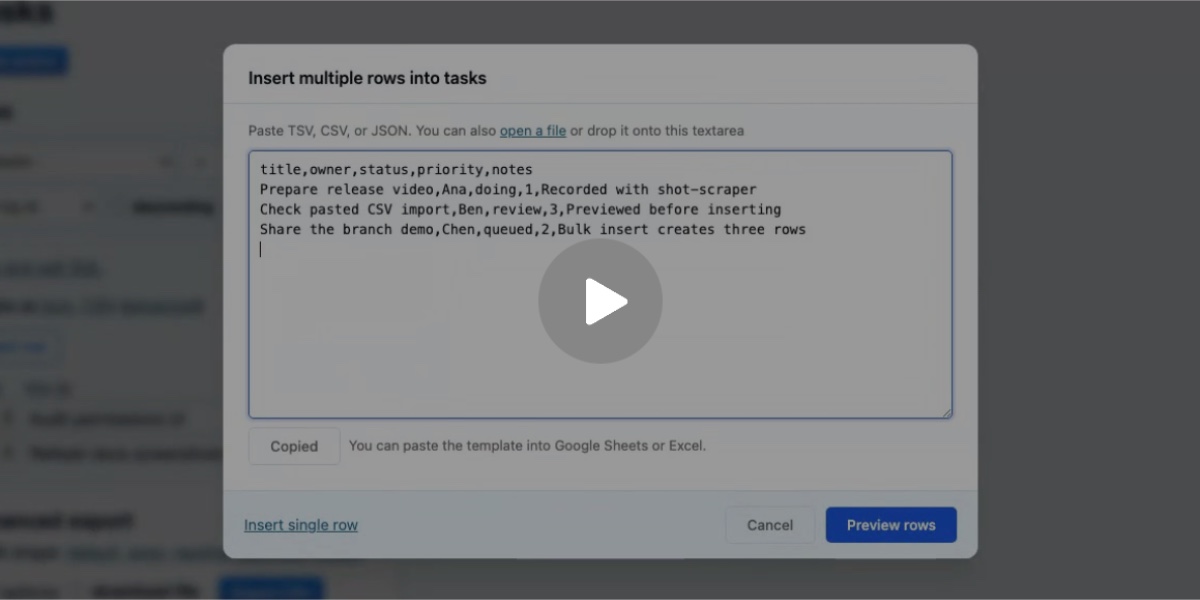
shot-scraper video is a new command introduced in today’s shot-scraper 1.10 release which accepts a storyboard.yml file defining a routine to run against a web application and uses Playwright to record a video of that routine. I’ve written before about the importance of having coding agents produce demos of their work; this is my latest attempt at enabling them to do that.
Publishing WASM wheels to PyPI for use with Pyodide
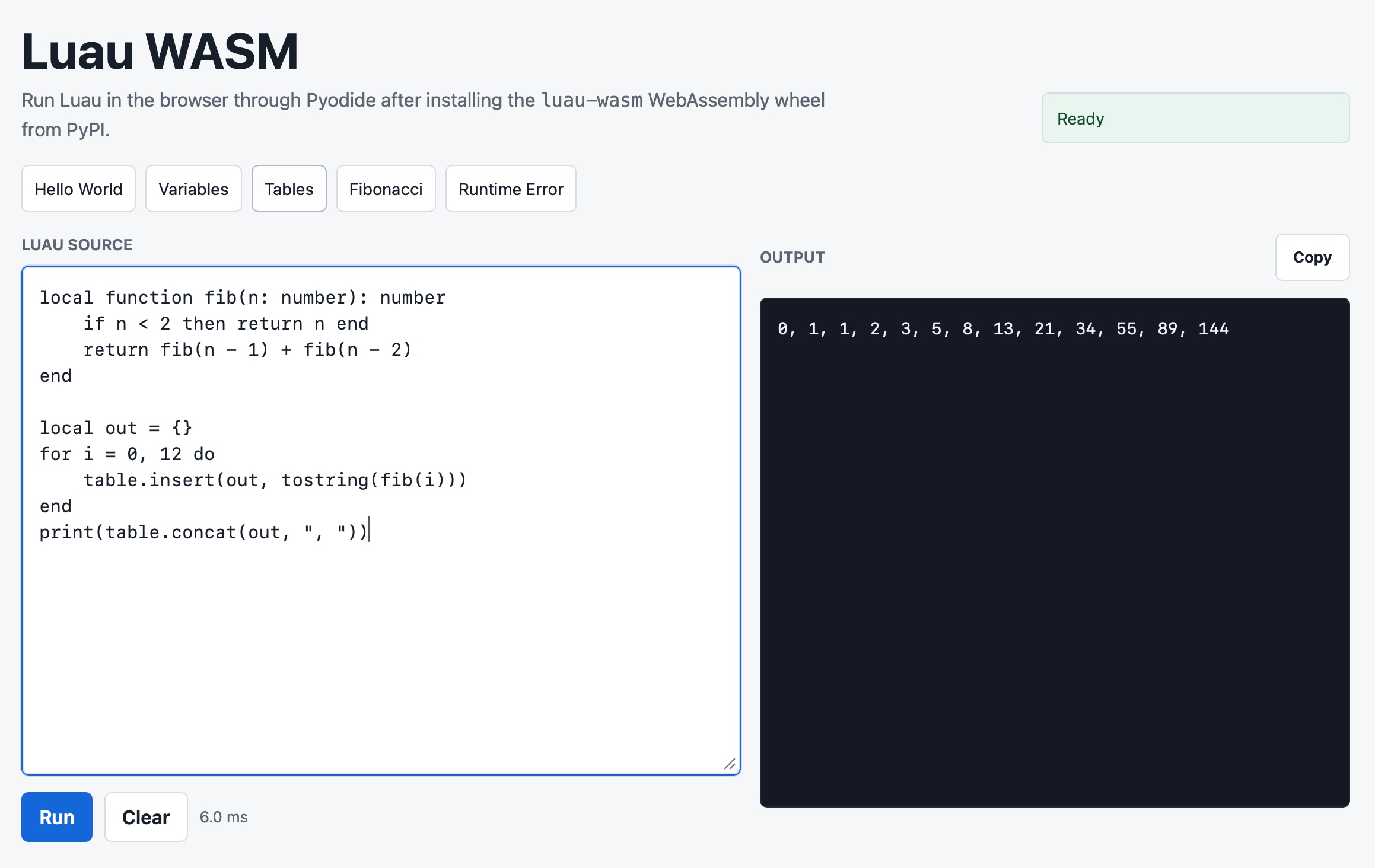
The Pyodide 314.0 release announcement (via Hacker News) includes news I’ve been looking forward to for a long time:
[... 757 words]It would be neat if arbitrary SQL queries in Datasette could be rendered with additional information based on which columns from which tables were included in the results.
To build that, we would need to be able to look at a SQL query like select users.name, orders.total from users join orders on orders.user_id = users.id and programmatically identify the table.column for each result - navigating not just joins but also more complex syntax like CTEs.
I decided to set Claude Code (Opus 4.8, since Fable is currently banned by the US government) on the problem. It found several promising solutions - one using apsw, another that uses ctypes to access the SQLite sqlite3_column_table_name() C function (which is not otherwise exposed to Python), and one using clever interrogation of the output of EXPLAIN.
I built this utility library to support an asyncio dependency injection pattern a few years ago. I was using it with Datasette and Claude Fable 5 spotted some bugs in the dependency which it then fixed for me. It's a very proactive model!
I added a CLI to micropython-wasm (issue #7), inspired by the first draft of the blog entry when I realized it would be a great way to illustrate the Try it yourself section.
Running Python code in a sandbox with MicroPython and WASM
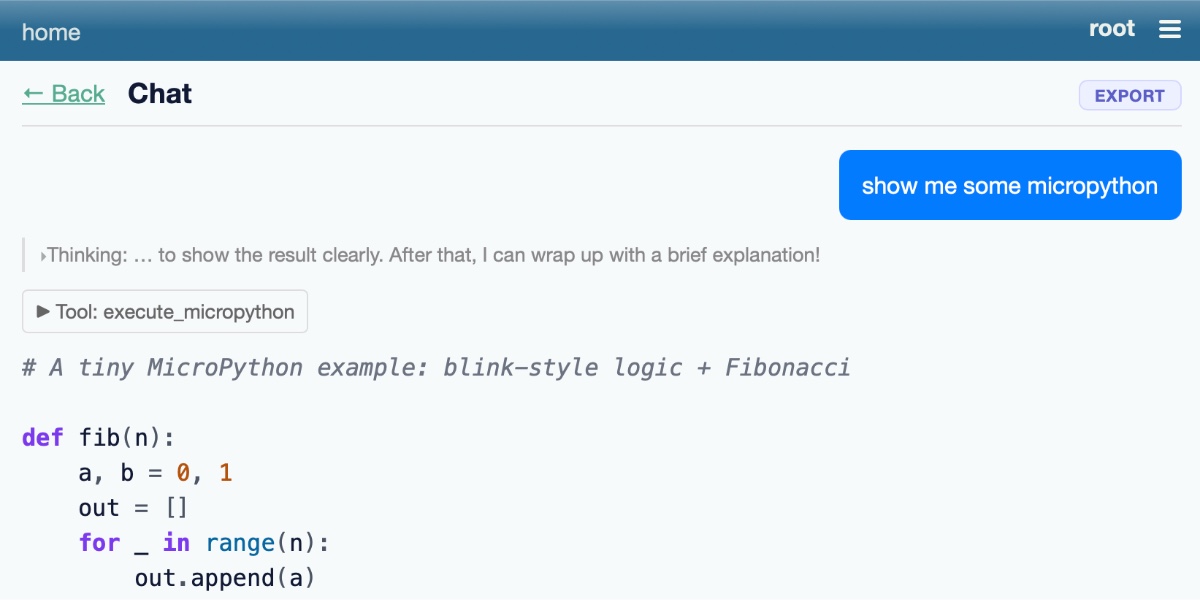
I’ve been experimenting with different approaches to running code in a sandbox for several years now, but my latest attempt feels like it might finally have all of the characteristics I’ve been looking for. I’ve released it as an alpha package called micropython-wasm, and I’m using it for a code execution sandbox plugin for Datasette Agent called datasette-agent-micropython.
[... 2,024 words]I want Datasette Agent to be able to generate and execute Python code safely. This alpha is looking promising so far. GPT-5.5 has so far failed to break out of the sandbox!
Fixes for some limitations that emerged while I was trying to use this to build datasette-agent-micropython.
My latest sandboxing experiment: This alpha package bundles a lightly customized WASM build of MicroPython with a wrapper to execute code in it via wasmtime.
Datasette Lite is my version of Datasette that runs entirely in the browser using Pyodide in WebAssembly.
When I first built it four years ago I used Web Workers and code that intercepts navigation operations and fetches the generated HTML by running the Python app.
This worked, but had the disadvantage that any JavaScript in <script> tags would not be executed - breaking some Datasette functionality and a whole lot of Datasette plugins.
This morning I set Claude Opus 4.8 the task (in Claude Code for web) of figuring out how to run Python ASGI apps in Pyodide using Service Workers instead, and it seems to work! Here's a basic ASGI FastCGI demo and here's a demo that runs Datasette 1.0a31.
I'm still getting my head around exactly how it works, but once I've done that I plan to upgrade Datasette Lite itself.