Monday, 4th May 2026
Salvatore Sanfilippo submitted a PR adding a new data type - arrays - to Redis.
The new commands are ARCOUNT, ARDEL, ARDELRANGE, ARGET, ARGETRANGE, ARGREP, ARINFO, ARINSERT, ARLASTITEMS, ARLEN, ARMGET, ARMSET, ARNEXT, AROP, ARRING, ARSCAN, ARSEEK, ARSET.
The implementation is currently available in a branch, so I had Claude Code for web build this interactive playground for trying out the new commands in a WASM-compiled build of a subset of Redis running in the browser.
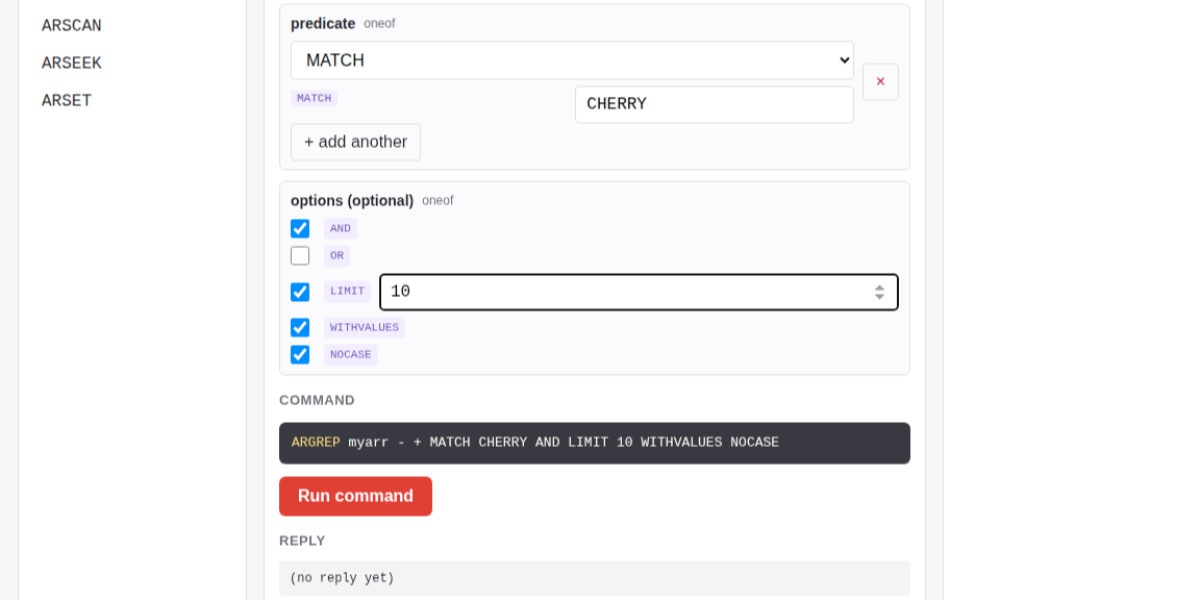
The most interesting new command is ARGREP which can run a server-side grep against a range of values in the array using the newly vendored TRE regex library.
Salvatore wrote more about the AI-assisted development process for the array type in Redis array type: short story of a long development.
If it's good enough for antirez to add to Redis I figured Ville Laurikari's TRE regular expression engine was worth exploring in a little more detail.
I had Claude Code build an experimental Python binding (it used ctypes) and try some malicious regular expression attacks against the library. TRE handles those much better than Python's standard library implementation, thanks mainly to the lack of support for backtracking.
I just sent out the April edition of my sponsors-only monthly newsletter. If you are a sponsor (or if you start a sponsorship now) you can access it here.
In this month's newsletter:
- Opus 4.7 and GPT-5.5, both with price increases
- Claude Mythos and LLM security research
- ChatGPT Images 2.0
- More model releases
- Other highlights from my blog
- What I'm using, April 2026 edition
Here's a copy of the March newsletter as a preview of what you'll get. Pay $10/month to stay a month ahead of the free copy!
[...] Between 2000 and 2024, farmers sold in total a Colorado-sized chunk of land all on their own, 77 times all land on data center property in 2028, and grew more food than ever on what was left. None of this caused any problems for US food access.
And then, in the middle of all this, a farmer in Loudoun County sells a few acres of mediocre hay field to a hyperscaler for ten times its agricultural value, and the response is that we’re running out of farmland.
— Andy Masley, pushing back against the "land use" argument against data center construction
Granite 4.1 3B SVG Pelican Gallery. IBM released their Granite 4.1 family of LLMs a few days ago. They're Apache 2.0 licensed and come in 3B, 8B and 30B sizes.
Granite 4.1 LLMs: How They’re Built by Granite team member Yousaf Shah describes the training process in detail.
Unsloth released the unsloth/granite-4.1-3b-GGUF collection of GGUF encoded quantized variants of the 3B model - 21 different model files ranging in size from 1.2GB to 6.34GB.
All 21 of those Unsloth files add up to 51.3GB, which inspired me to finally try an experiment I've been wanting to run for ages: prompting "Generate an SVG of a pelican riding a bicycle" against different sized quantized variants of the same model to see what the results would look like.
Honestly, the results are less interesting than I expected. There's no distinguishable pattern relating quality to size - they're all pretty terrible!
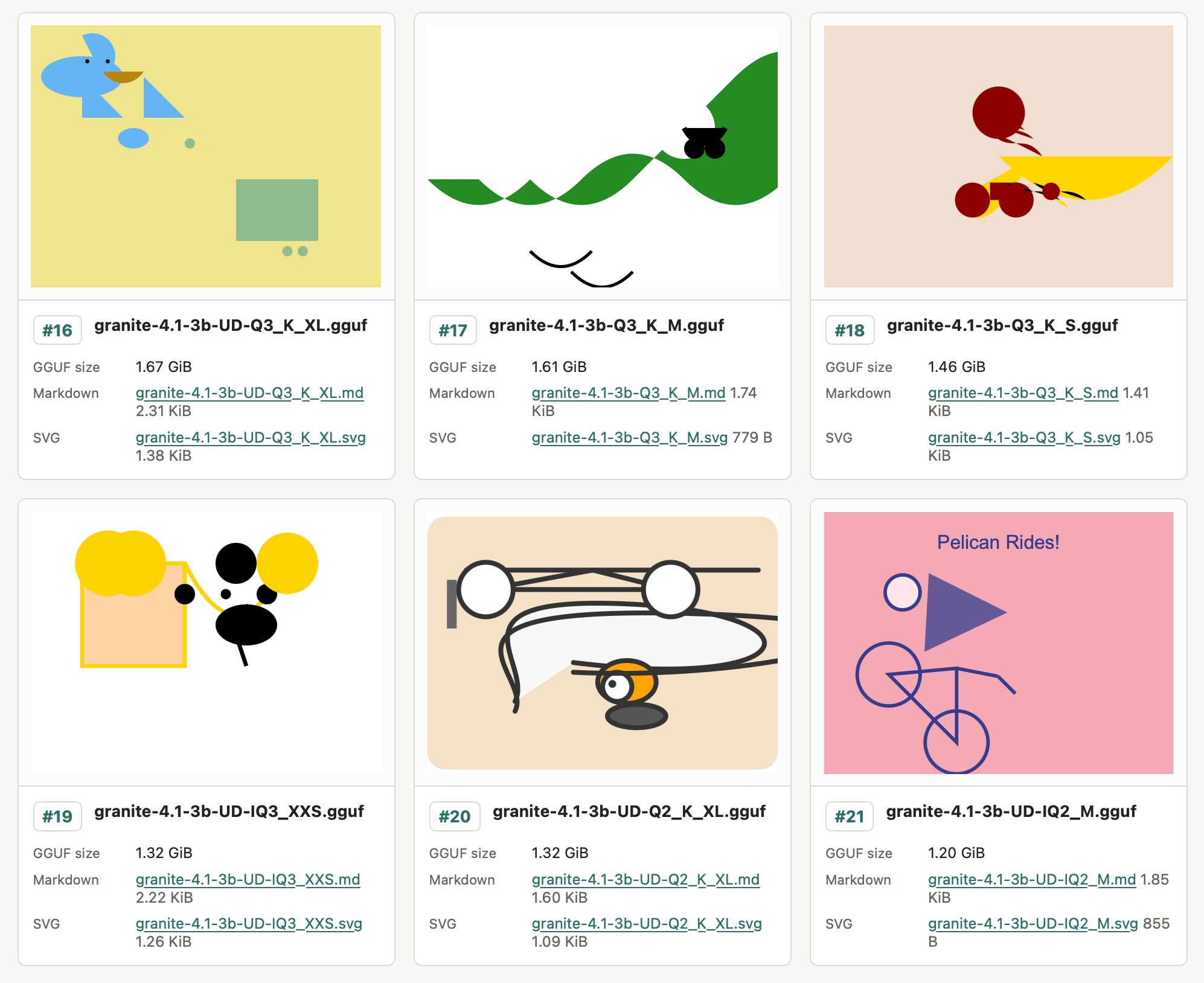
I'll likely try this again in the future with a model that's better at drawing pelicans.