39 posts tagged “agentic-engineering”
Using coding agents for professional software development. I've written a lot more about this under my broader tag ai-assisted-programming.
2026
I like publishing transcripts of local Claude Code sessions using my claude-code-transcripts tool but I'm often paranoid that one of my API keys or similar secrets might inadvertently be revealed in the detailed log files.
I built this new Python scanning tool to help reassure me. You can feed it secrets and have it scan for them in a specified directory:
uvx scan-for-secrets $OPENAI_API_KEY -d logs-to-publish/
If you leave off the -d it defaults to the current directory.
It doesn't just scan for the literal secrets - it also scans for common encodings of those secrets e.g. backslash or JSON escaping, as described in the README.
If you have a set of secrets you always want to protect you can list commands to echo them in a ~/.scan-for-secrets.conf.sh file. Mine looks like this:
llm keys get openai
llm keys get anthropic
llm keys get gemini
llm keys get mistral
awk -F= '/aws_secret_access_key/{print $2}' ~/.aws/credentials | xargs
I built this tool using README-driven-development: I carefully constructed the README describing exactly how the tool should work, then dumped it into Claude Code and told it to build the actual tool (using red/green TDD, naturally.)
A fun thing about recording a podcast with a professional like Lenny Rachitsky is that his team know how to slice the resulting video up into TikTok-sized short form vertical videos. Here's one he shared on Twitter today which ended up attracting over 1.1m views!
That was 48 seconds. Our full conversation lasted 1 hour 40 minutes.
Highlights from my conversation about agentic engineering on Lenny’s Podcast
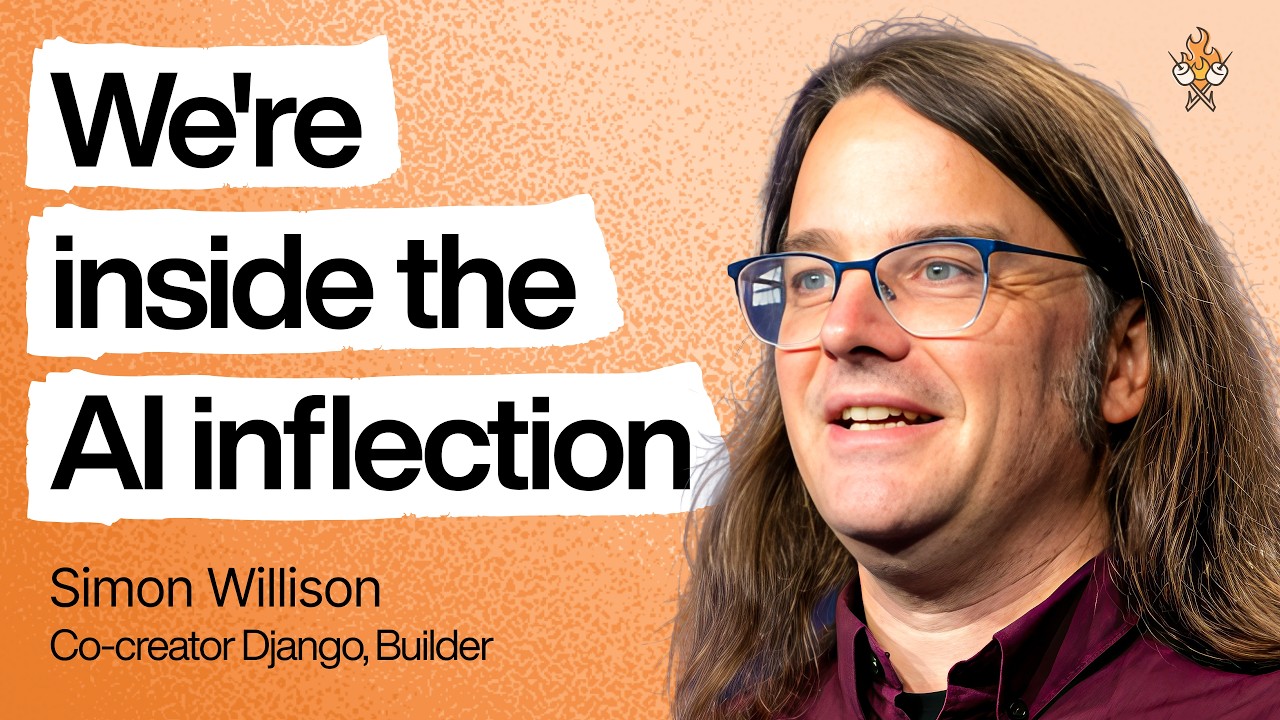
I was a guest on Lenny Rachitsky’s podcast, in a new episode titled An AI state of the union: We’ve passed the inflection point, dark factories are coming, and automation timelines. It’s available on YouTube, Spotify, and Apple Podcasts. Here are my highlights from our conversation, with relevant links.
[... 3,558 words]I want to argue that AI models will write good code because of economic incentives. Good code is cheaper to generate and maintain. Competition is high between the AI models right now, and the ones that win will help developers ship reliable features fastest, which requires simple, maintainable code. Good code will prevail, not only because we want it to (though we do!), but because economic forces demand it. Markets will not reward slop in coding, in the long-term.
— Soohoon Choi, Slop Is Not Necessarily The Future
The thing about agentic coding is that agents grind problems into dust. Give an agent a problem and a while loop and - long term - it’ll solve that problem even if it means burning a trillion tokens and re-writing down to the silicon. [...]
But we want AI agents to solve coding problems quickly and in a way that is maintainable and adaptive and composable (benefiting from improvements elsewhere), and where every addition makes the whole stack better.
So at the bottom is really great libraries that encapsulate hard problems, with great interfaces that make the “right” way the easy way for developers building apps with them. Architecture!
While I’m vibing (I call it vibing now, not coding and not vibe coding) while I’m vibing, I am looking at lines of code less than ever before, and thinking about architecture more than ever before.
— Matt Webb, An appreciation for (technical) architecture
We Rewrote JSONata with AI in a Day, Saved $500K/Year. Bit of a hyperbolic framing but this looks like another case study of vibe porting, this time spinning up a new custom Go implementation of the JSONata JSON expression language - similar in focus to jq, and heavily associated with the Node-RED platform.
As with other vibe-porting projects the key enabling factor was JSONata's existing test suite, which helped build the first working Go version in 7 hours and $400 of token spend.
The Reco team then used a shadow deployment for a week to run the new and old versions in parallel to confirm the new implementation exactly matched the behavior of the old one.
Thoughts on slowing the fuck down. Mario Zechner created the Pi agent framework used by OpenClaw, giving considerable credibility to his opinions on current trends in agentic engineering. He's not impressed:
We have basically given up all discipline and agency for a sort of addiction, where your highest goal is to produce the largest amount of code in the shortest amount of time. Consequences be damned.
Agents and humans both make mistakes, but agent mistakes accumulate much faster:
A human is a bottleneck. A human cannot shit out 20,000 lines of code in a few hours. Even if the human creates such booboos at high frequency, there's only so many booboos the human can introduce in a codebase per day. [...]
With an orchestrated army of agents, there is no bottleneck, no human pain. These tiny little harmless booboos suddenly compound at a rate that's unsustainable. You have removed yourself from the loop, so you don't even know that all the innocent booboos have formed a monster of a codebase. You only feel the pain when it's too late. [...]
You have zero fucking idea what's going on because you delegated all your agency to your agents. You let them run free, and they are merchants of complexity.
I think Mario is exactly right about this. Agents let us move so much faster, but this speed also means that changes which we would normally have considered over the course of weeks are landing in a matter of hours.
It's so easy to let the codebase evolve outside of our abilities to reason clearly about it. Cognitive debt is real.
Mario recommends slowing down:
Give yourself time to think about what you're actually building and why. Give yourself an opportunity to say, fuck no, we don't need this. Set yourself limits on how much code you let the clanker generate per day, in line with your ability to actually review the code.
Anything that defines the gestalt of your system, that is architecture, API, and so on, write it by hand. [...]
I'm not convinced writing by hand is the best way to address this, but it's absolutely the case that we need the discipline to find a new balance of speed v.s. mental thoroughness now that typing out the code is no longer anywhere close to being the bottleneck on writing software.
Experimenting with Starlette 1.0 with Claude skills
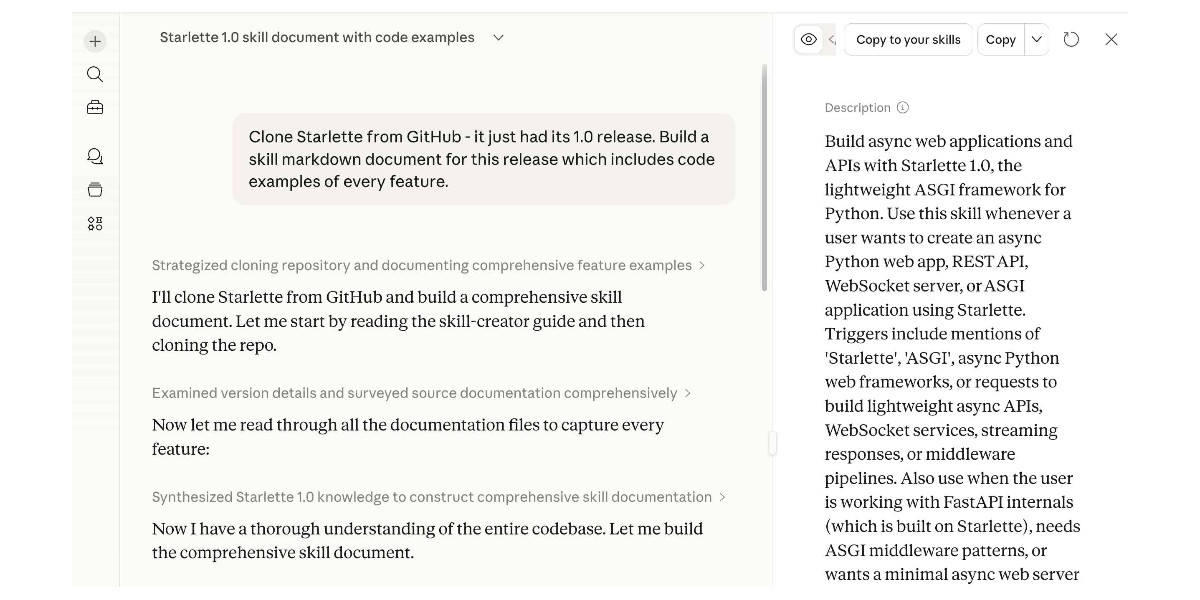
Starlette 1.0 is out! This is a really big deal. I think Starlette may be the Python framework with the most usage compared to its relatively low brand recognition because Starlette is the foundation of FastAPI, which has attracted a huge amount of buzz that seems to have overshadowed Starlette itself.
[... 1,194 words]Using Git with coding agents
Git is a key tool for working with coding agents. Keeping code in version control lets us record how that code changes over time and investigate and reverse any mistakes. All of the coding agents are fluent in using Git's features, both basic and advanced.
This fluency means we can be more ambitious about how we use Git ourselves. We don't need to memorize how to do things with Git, but staying aware of what's possible means we can take advantage of the full suite of Git's abilities.
Git essentials
Each Git project lives in a repository - a folder on disk that can track changes made to the files within it. Those changes are recorded in commits - timestamped bundles of changes to one or more files accompanied by a commit message describing those changes and an author recording who made them. [... 1,396 words]
Subagents
LLMs are restricted by their context limit - how many tokens they can fit in their working memory at any given time. These values have not increased much over the past two years even as the LLMs themselves have seen dramatic improvements in their abilities - they generally top out at around 1,000,000, and benchmarks frequently report better quality results below 200,000.
Carefully managing the context such that it fits within those limits is critical to getting great results out of a model.
Subagents provide a simple but effective way to handle larger tasks without burning through too much of the coding agent’s valuable top-level context. [... 926 words]
Use subagents and custom agents in Codex (via) Subagents were announced in general availability today for OpenAI Codex, after several weeks of preview behind a feature flag.
They're very similar to the Claude Code implementation, with default subagents for "explorer", "worker" and "default". It's unclear to me what the difference between "worker" and "default" is but based on their CSV example I think "worker" is intended for running large numbers of small tasks in parallel.
Codex also lets you define custom agents as TOML files in ~/.codex/agents/. These can have custom instructions and be assigned to use specific models - including gpt-5.3-codex-spark if you want some raw speed. They can then be referenced by name, as demonstrated by this example prompt from the documentation:
Investigate why the settings modal fails to save. Have browser_debugger reproduce it, code_mapper trace the responsible code path, and ui_fixer implement the smallest fix once the failure mode is clear.
The subagents pattern is widely supported in coding agents now. Here's documentation across a number of different platforms:
- OpenAI Codex subagents
- Claude Code subagents
- Gemini CLI subagents (experimental)
- Mistral Vibe subagents
- OpenCode agents
- Subagents in Visual Studio Code
- Cursor Subagents
Update: I added a chapter on Subagents to my Agentic Engineering Patterns guide.
How coding agents work
As with any tool, understanding how coding agents work under the hood can help you make better decisions about how to apply them.
A coding agent is a piece of software that acts as a harness for an LLM, extending that LLM with additional capabilities that are powered by invisible prompts and implemented as callable tools.
Large Language Models
At the heart of any coding agent is a Large Language Model, or LLM. These have names like GPT-5.4 or Claude Opus 4.6 or Gemini 3.1 Pro or Qwen3.5-35B-A3B. [... 1,187 words]
What is agentic engineering?
I use the term agentic engineering to describe the practice of developing software with the assistance of coding agents.
What are coding agents? They're agents that can both write and execute code. Popular examples include Claude Code, OpenAI Codex, and Gemini CLI.
What's an agent? Clearly defining that term is a challenge that has frustrated AI researchers since at least the 1990s but the definition I've come to accept, at least in the field of Large Language Models (LLMs) like GPT-5 and Gemini and Claude, is this one: [... 617 words]
My fireside chat about agentic engineering at the Pragmatic Summit
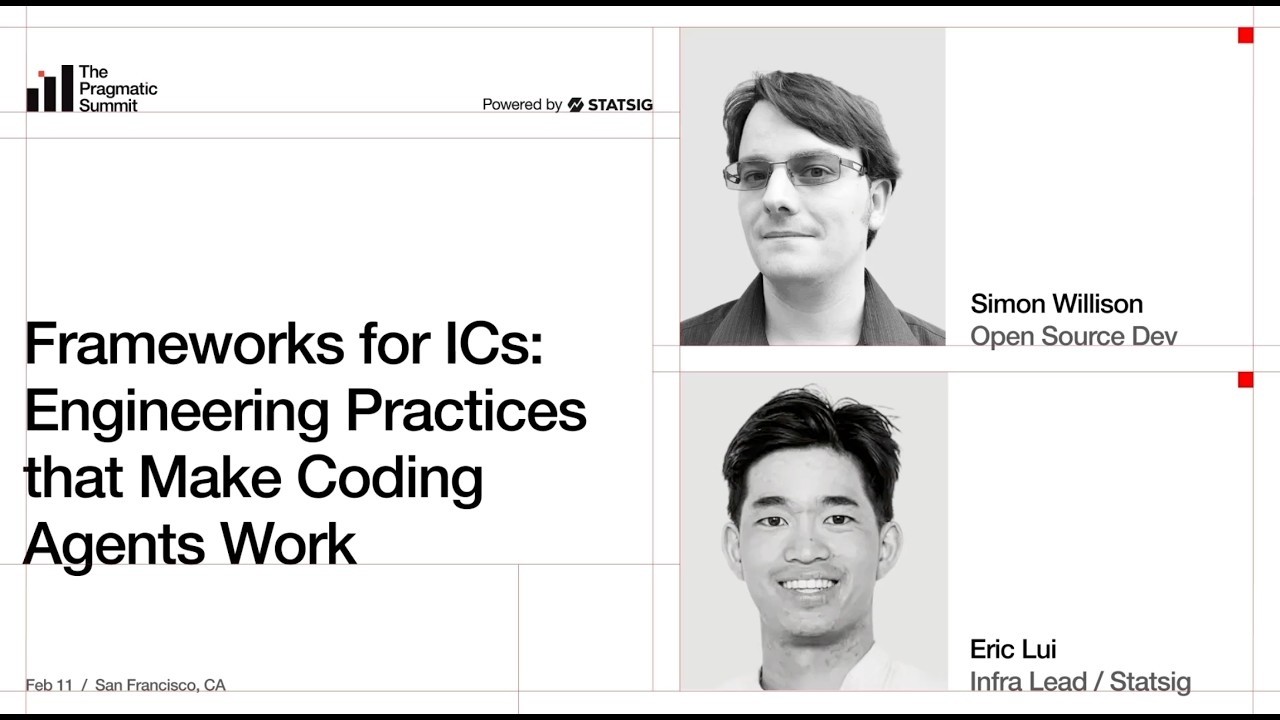
I was a speaker last month at the Pragmatic Summit in San Francisco, where I participated in a fireside chat session about Agentic Engineering hosted by Eric Lui from Statsig.
[... 3,350 words]Shopify/liquid: Performance: 53% faster parse+render, 61% fewer allocations (via) PR from Shopify CEO Tobias Lütke against Liquid, Shopify's open source Ruby template engine that was somewhat inspired by Django when Tobi first created it back in 2005.
Tobi found dozens of new performance micro-optimizations using a variant of autoresearch, Andrej Karpathy's new system for having a coding agent run hundreds of semi-autonomous experiments to find new effective techniques for training nanochat.
Tobi's implementation started two days ago with this autoresearch.md prompt file and an autoresearch.sh script for the agent to run to execute the test suite and report on benchmark scores.
The PR now lists 93 commits from around 120 automated experiments. The PR description lists what worked in detail - some examples:
- Replaced StringScanner tokenizer with
String#byteindex. Single-bytebyteindexsearching is ~40% faster than regex-basedskip_until. This alone reduced parse time by ~12%.- Pure-byte
parse_tag_token. Eliminated the costlyStringScanner#string=reset that was called for every{% %}token (878 times). Manual byte scanning for tag name + markup extraction is faster than resetting and re-scanning via StringScanner. [...]- Cached small integer
to_s. Pre-computed frozen strings for 0-999 avoid 267Integer#to_sallocations per render.
This all added up to a 53% improvement on benchmarks - truly impressive for a codebase that's been tweaked by hundreds of contributors over 20 years.
I think this illustrates a number of interesting ideas:
- Having a robust test suite - in this case 974 unit tests - is a massive unlock for working with coding agents. This kind of research effort would not be possible without first having a tried and tested suite of tests.
- The autoresearch pattern - where an agent brainstorms a multitude of potential improvements and then experiments with them one at a time - is really effective.
- If you provide an agent with a benchmarking script "make it faster" becomes an actionable goal.
- CEOs can code again! Tobi has always been more hands-on than most, but this is a much more significant contribution than anyone would expect from the leader of a company with 7,500+ employees. I've seen this pattern play out a lot over the past few months: coding agents make it feasible for people in high-interruption roles to productively work with code again.
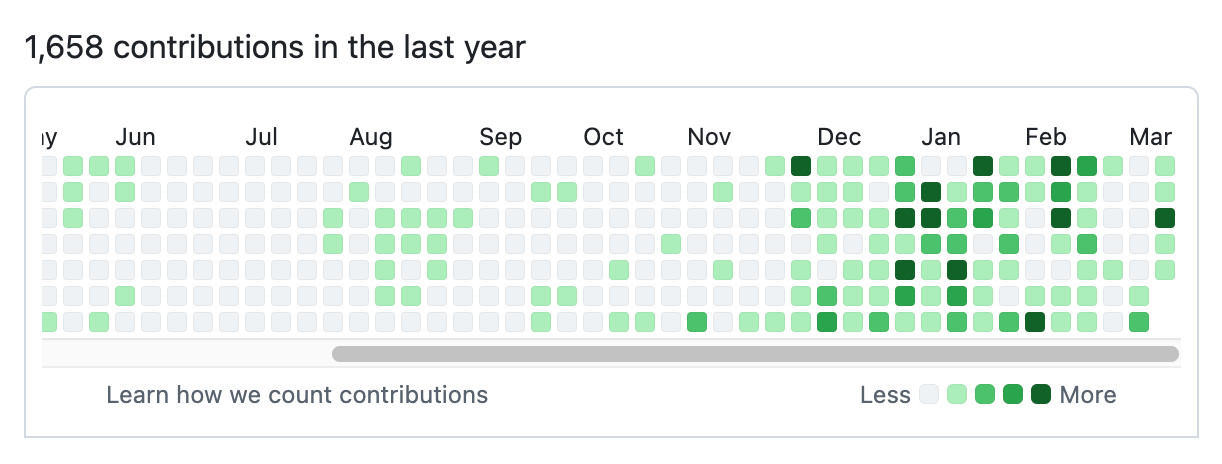
Here's Tobi's GitHub contribution graph for the past year, showing a significant uptick following that November 2025 inflection point when coding agents got really good.
He used Pi as the coding agent and released a new pi-autoresearch plugin in collaboration with David Cortés, which maintains state in an autoresearch.jsonl file like this one.
AI should help us produce better code
Many developers worry that outsourcing their code to AI tools will result in a drop in quality, producing bad code that's churned out fast enough that decision makers are willing to overlook its flaws.
If adopting coding agents demonstrably reduces the quality of the code and features you are producing, you should address that problem directly: figure out which aspects of your process are hurting the quality of your output and fix them.
Shipping worse code with agents is a choice. We can choose to ship code that is better instead. [... 838 words]
Perhaps not Boring Technology after all
A recurring concern I’ve seen regarding LLMs for programming is that they will push our technology choices towards the tools that are best represented in their training data, making it harder for new, better tools to break through the noise.
[... 391 words]Agentic manual testing
The defining characteristic of a coding agent is that it can execute the code that it writes. This is what makes coding agents so much more useful than LLMs that simply spit out code without any way to verify it.
Never assume that code generated by an LLM works until that code has been executed.
Coding agents have the ability to confirm that the code they have produced works as intended, or iterate further on that code until it does. [... 1,231 words]
Anti-patterns: things to avoid
There are some behaviors that are anti-patterns in our weird new world of agentic engineering.
Inflicting unreviewed code on collaborators
This anti-pattern is common and deeply frustrating.
Don't file pull requests with code you haven't reviewed yourself. [... 331 words]
GIF optimization tool using WebAssembly and Gifsicle
I like to include animated GIF demos in my online writing, often recorded using LICEcap. There's an example in the Interactive explanations chapter.
These GIFs can be pretty big. I've tried a few tools for optimizing GIF file size and my favorite is Gifsicle by Eddie Kohler. It compresses GIFs by identifying regions of frames that have not changed and storing only the differences, and can optionally reduce the GIF color palette or apply visible lossy compression for greater size reductions.
Gifsicle is written in C and the default interface is a command line tool. I wanted a web interface so I could access it in my browser and visually preview and compare the different settings. [... 1,603 words]
Interactive explanations
When we lose track of how code written by our agents works we take on cognitive debt.
For a lot of things this doesn't matter: if the code fetches some data from a database and outputs it as JSON the implementation details are likely simple enough that we don't need to care. We can try out the new feature and make a very solid guess at how it works, then glance over the code to be sure.
Often though the details really do matter. If the core of our application becomes a black box that we don't fully understand we can no longer confidently reason about it, which makes planning new features harder and eventually slows our progress in the same way that accumulated technical debt does. [... 672 words]
An AI agent coding skeptic tries AI agent coding, in excessive detail. Another in the genre of "OK, coding agents got good in November" posts, this one is by Max Woolf and is very much worth your time. He describes a sequence of coding agent projects, each more ambitious than the last - starting with simple YouTube metadata scrapers and eventually evolving to this:
It would be arrogant to port Python's scikit-learn — the gold standard of data science and machine learning libraries — to Rust with all the features that implies.
But that's unironically a good idea so I decided to try and do it anyways. With the use of agents, I am now developing
rustlearn(extreme placeholder name), a Rust crate that implements not only the fast implementations of the standard machine learning algorithms such as logistic regression and k-means clustering, but also includes the fast implementations of the algorithms above: the same three step pipeline I describe above still works even with the more simple algorithms to beat scikit-learn's implementations.
Max also captures the frustration of trying to explain how good the models have got to an existing skeptical audience:
The real annoying thing about Opus 4.6/Codex 5.3 is that it’s impossible to publicly say “Opus 4.5 (and the models that came after it) are an order of magnitude better than coding LLMs released just months before it” without sounding like an AI hype booster clickbaiting, but it’s the counterintuitive truth to my personal frustration. I have been trying to break this damn model by giving it complex tasks that would take me months to do by myself despite my coding pedigree but Opus and Codex keep doing them correctly.
A throwaway remark in this post inspired me to ask Claude Code to build a Rust word cloud CLI tool, which it happily did.
Hoard things you know how to do
Many of my tips for working productively with coding agents are extensions of advice I've found useful in my career without them. Here's a great example of that: hoard things you know how to do.
A big part of the skill in building software is understanding what's possible and what isn't, and having at least a rough idea of how those things can be accomplished.
These questions can be broad or quite obscure. Can a web page run OCR operations in JavaScript alone? Can an iPhone app pair with a Bluetooth device even when the app isn't running? Can we process a 100GB JSON file in Python without loading the entire thing into memory first? [... 1,370 words]
It is hard to communicate how much programming has changed due to AI in the last 2 months: not gradually and over time in the "progress as usual" way, but specifically this last December. There are a number of asterisks but imo coding agents basically didn’t work before December and basically work since - the models have significantly higher quality, long-term coherence and tenacity and they can power through large and long tasks, well past enough that it is extremely disruptive to the default programming workflow. [...]
I vibe coded my dream macOS presentation app
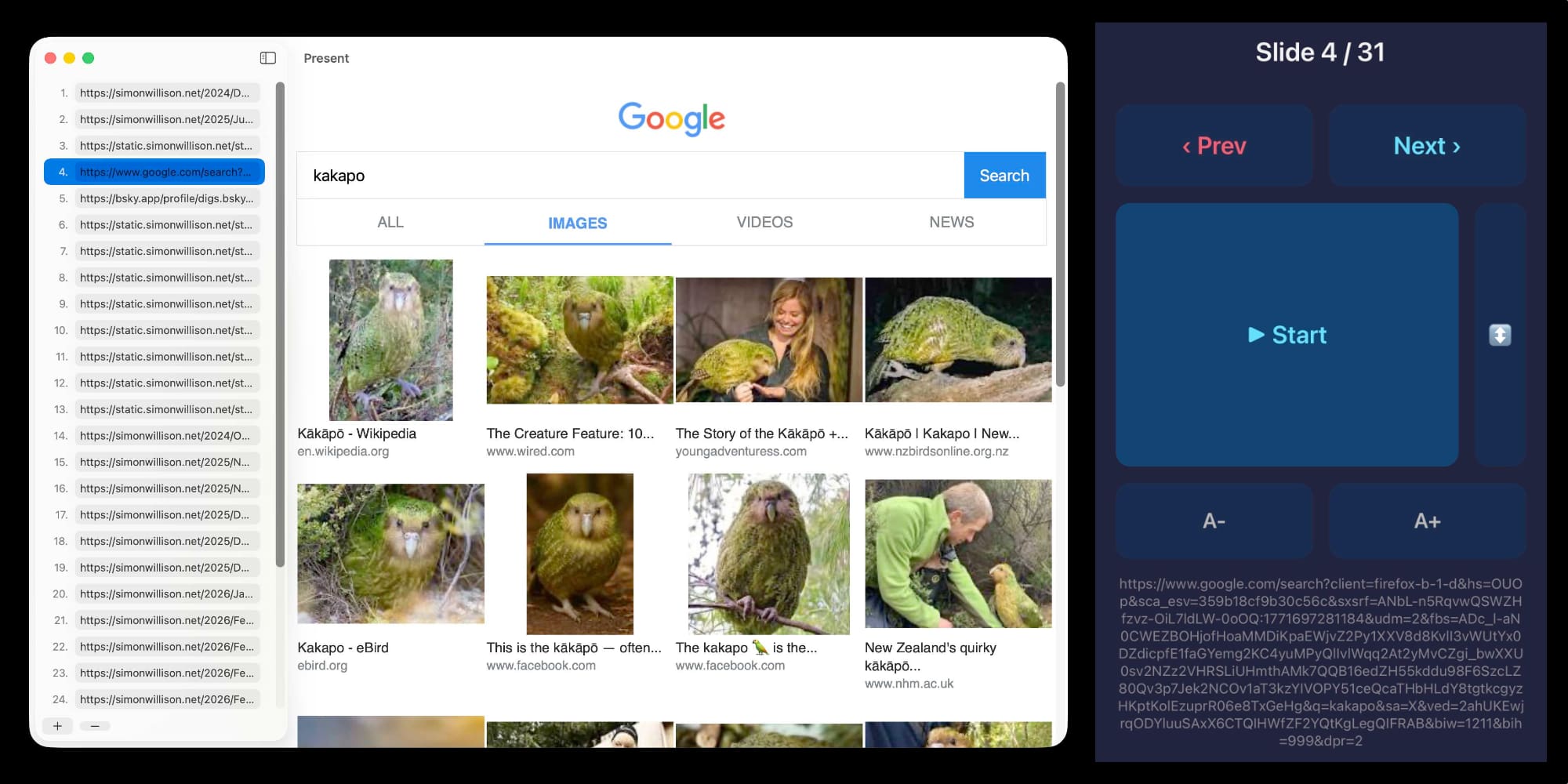
I gave a talk this weekend at Social Science FOO Camp in Mountain View. The event was a classic unconference format where anyone could present a talk without needing to propose it in advance. I grabbed a slot for a talk I titled “The State of LLMs, February 2026 edition”, subtitle “It’s all changed since November!”. I vibe coded a custom macOS app for the presentation the night before.
[... 1,613 words]It’s also reasonable for people who entered technology in the last couple of decades because it was good job, or because they enjoyed coding to look at this moment with a real feeling of loss. That feeling of loss though can be hard to understand emotionally for people my age who entered tech because we were addicted to feeling of agency it gave us. The web was objectively awful as a technology, and genuinely amazing, and nobody got into it because programming in Perl was somehow aesthetically delightful.
— Kellan Elliott-McCrea, Code has always been the easy part
Linear walkthroughs
Sometimes it's useful to have a coding agent give you a structured walkthrough of a codebase.
Maybe it's existing code you need to get up to speed on, maybe it's your own code that you've forgotten the details of, or maybe you vibe coded the whole thing and need to understand how it actually works.
Frontier models with the right agent harness can construct a detailed walkthrough to help you understand how code works. [... 524 words]
First run the tests
Automated tests are no longer optional when working with coding agents.
The old excuses for not writing them - that they're time consuming and expensive to constantly rewrite while a codebase is rapidly evolving - no longer hold when an agent can knock them into shape in just a few minutes.
They're also vital for ensuring AI-generated code does what it claims to do. If the code has never been executed it's pure luck if it actually works when deployed to production. [... 359 words]
Ladybird adopts Rust, with help from AI (via) Really interesting case-study from Andreas Kling on advanced, sophisticated use of coding agents for ambitious coding projects with critical code. After a few years hoping Swift's platform support outside of the Apple ecosystem would mature they switched tracks to Rust their memory-safe language of choice, starting with an AI-assisted port of a critical library:
Our first target was LibJS , Ladybird's JavaScript engine. The lexer, parser, AST, and bytecode generator are relatively self-contained and have extensive test coverage through test262, which made them a natural starting point.
I used Claude Code and Codex for the translation. This was human-directed, not autonomous code generation. I decided what to port, in what order, and what the Rust code should look like. It was hundreds of small prompts, steering the agents where things needed to go. [...]
The requirement from the start was byte-for-byte identical output from both pipelines. The result was about 25,000 lines of Rust, and the entire port took about two weeks. The same work would have taken me multiple months to do by hand. We’ve verified that every AST produced by the Rust parser is identical to the C++ one, and all bytecode generated by the Rust compiler is identical to the C++ compiler’s output. Zero regressions across the board.
Having an existing conformance testing suite of the quality of test262 is a huge unlock for projects of this magnitude, and the ability to compare output with an existing trusted implementation makes agentic engineering much more of a safe bet.
Writing about Agentic Engineering Patterns
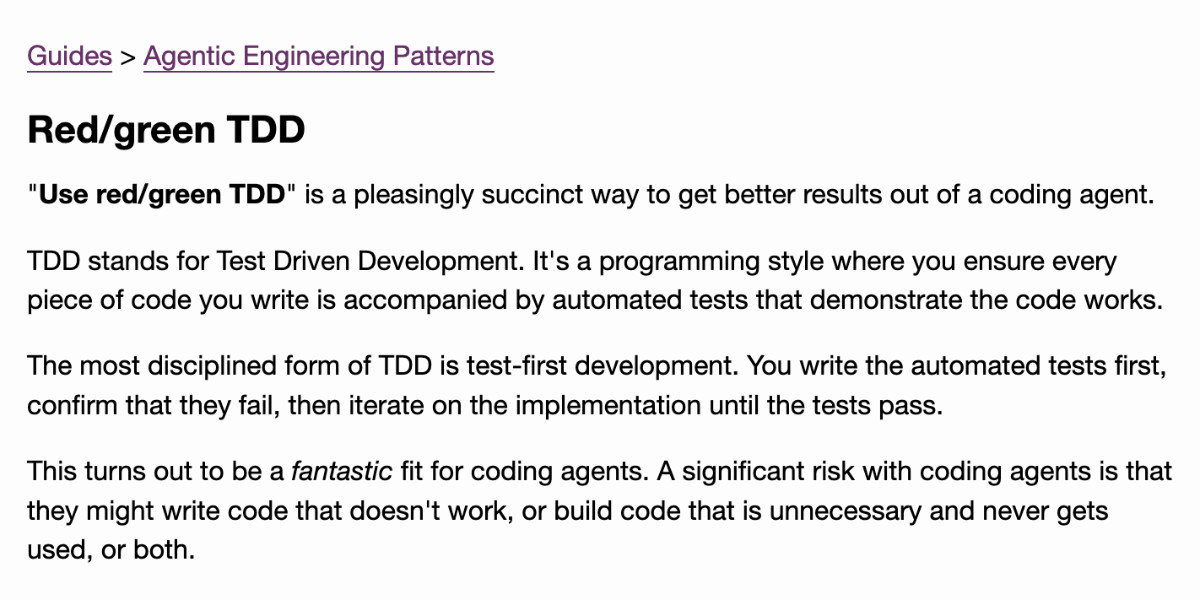
I’ve started a new project to collect and document Agentic Engineering Patterns—coding practices and patterns to help get the best results out of this new era of coding agent development we find ourselves entering.
[... 554 words]