589 posts tagged “django”
The Django web framework.
2026
OpenAI’s rogue agents were caught communicating via public wikis
Here we go again... Discovery of a new OpenAI agent message board by Sydney Von Arx, Cormac Slade Byrd, Spencer Kitts, and Thomas Larsen describes the latest accidental cyberattack by models being trained by OpenAI. This time it was agents engaged in some sort of web research benchmark, so they had (supposedly) controlled access to the Web. The agents figured out they could update public Wikis and spent weeks exchanging thousands of messages with each other to collaborate on the benchmark.
[... 1,366 words]If you do not understand the ticket, if you do not understand the solution, or if you do not understand the feedback on your PR, then your use of LLM is hurting Django as a whole. [...]
For a reviewer, it’s demoralizing to communicate with a facade of a human.
This is because contributing to open source, especially Django, is a communal endeavor. Removing your humanity from that experience makes that endeavor more difficult. If you use an LLM to contribute to Django, it needs to be as a complementary tool, not as your vehicle.
— Tim Schilling, Give Django your time and money, not your tokens
Shopify/liquid: Performance: 53% faster parse+render, 61% fewer allocations (via) PR from Shopify CEO Tobias Lütke against Liquid, Shopify's open source Ruby template engine that was somewhat inspired by Django when Tobi first created it back in 2005.
Tobi found dozens of new performance micro-optimizations using a variant of autoresearch, Andrej Karpathy's new system for having a coding agent run hundreds of semi-autonomous experiments to find new effective techniques for training nanochat.
Tobi's implementation started two days ago with this autoresearch.md prompt file and an autoresearch.sh script for the agent to run to execute the test suite and report on benchmark scores.
The PR now lists 93 commits from around 120 automated experiments. The PR description lists what worked in detail - some examples:
- Replaced StringScanner tokenizer with
String#byteindex. Single-bytebyteindexsearching is ~40% faster than regex-basedskip_until. This alone reduced parse time by ~12%.- Pure-byte
parse_tag_token. Eliminated the costlyStringScanner#string=reset that was called for every{% %}token (878 times). Manual byte scanning for tag name + markup extraction is faster than resetting and re-scanning via StringScanner. [...]- Cached small integer
to_s. Pre-computed frozen strings for 0-999 avoid 267Integer#to_sallocations per render.
This all added up to a 53% improvement on benchmarks - truly impressive for a codebase that's been tweaked by hundreds of contributors over 20 years.
I think this illustrates a number of interesting ideas:
- Having a robust test suite - in this case 974 unit tests - is a massive unlock for working with coding agents. This kind of research effort would not be possible without first having a tried and tested suite of tests.
- The autoresearch pattern - where an agent brainstorms a multitude of potential improvements and then experiments with them one at a time - is really effective.
- If you provide an agent with a benchmarking script "make it faster" becomes an actionable goal.
- CEOs can code again! Tobi has always been more hands-on than most, but this is a much more significant contribution than anyone would expect from the leader of a company with 7,500+ employees. I've seen this pattern play out a lot over the past few months: coding agents make it feasible for people in high-interruption roles to productively work with code again.
Here's Tobi's GitHub contribution graph for the past year, showing a significant uptick following that November 2025 inflection point when coding agents got really good.
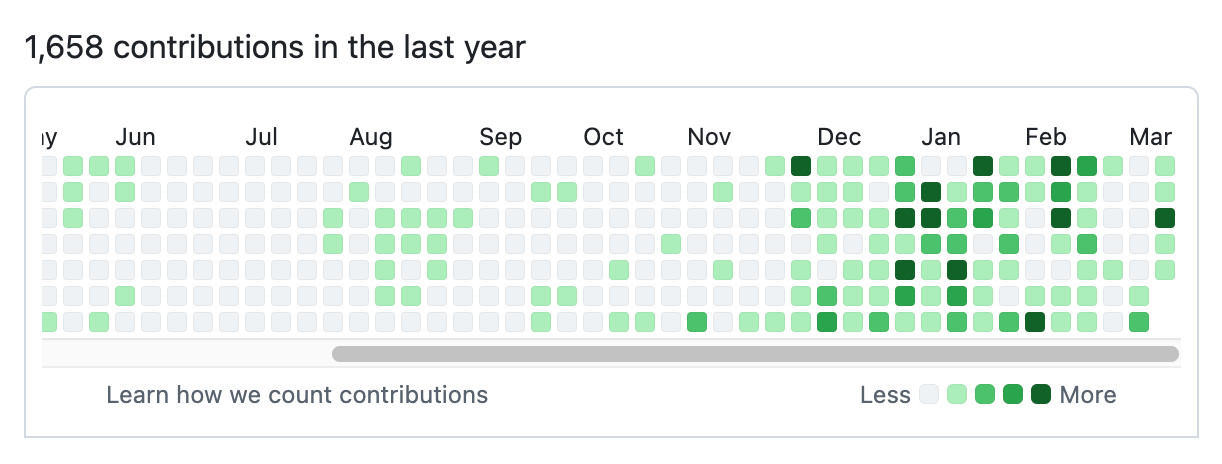
He used Pi as the coding agent and released a new pi-autoresearch plugin in collaboration with David Cortés, which maintains state in an autoresearch.jsonl file like this one.
SWE-bench February 2026 leaderboard update (via) SWE-bench is one of the benchmarks that the labs love to list in their model releases. The official leaderboard is infrequently updated but they just did a full run of it against the current generation of models, which is notable because it's always good to see benchmark results like this that weren't self-reported by the labs.
The fresh results are for their "Bash Only" benchmark, which runs their mini-swe-bench agent (~9,000 lines of Python, here are the prompts they use) against the SWE-bench dataset of coding problems - 2,294 real-world examples pulled from 12 open source repos: django/django (850), sympy/sympy (386), scikit-learn/scikit-learn (229), sphinx-doc/sphinx (187), matplotlib/matplotlib (184), pytest-dev/pytest (119), pydata/xarray (110), astropy/astropy (95), pylint-dev/pylint (57), psf/requests (44), mwaskom/seaborn (22), pallets/flask (11).
Correction: The Bash only benchmark runs against SWE-bench Verified, not original SWE-bench. Verified is a manually curated subset of 500 samples described here, funded by OpenAI. Here's SWE-bench Verified on Hugging Face - since it's just 2.1MB of Parquet it's easy to browse using Datasette Lite, which cuts those numbers down to django/django (231), sympy/sympy (75), sphinx-doc/sphinx (44), matplotlib/matplotlib (34), scikit-learn/scikit-learn (32), astropy/astropy (22), pydata/xarray (22), pytest-dev/pytest (19), pylint-dev/pylint (10), psf/requests (8), mwaskom/seaborn (2), pallets/flask (1).
Here's how the top ten models performed:
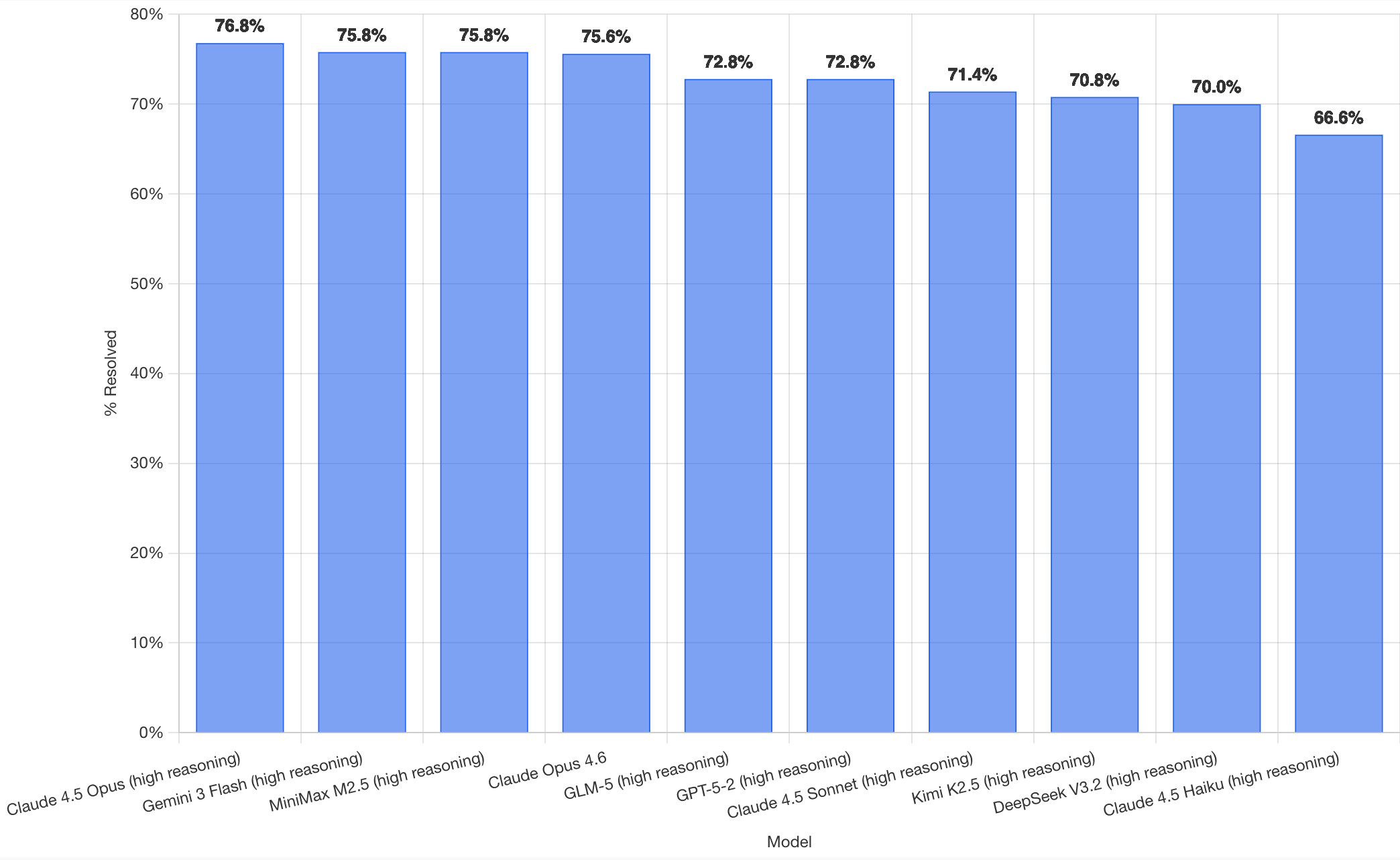
It's interesting to see Claude Opus 4.5 beat Opus 4.6, though only by about a percentage point. 4.5 Opus is top, then Gemini 3 Flash, then MiniMax M2.5 - a 229B model released last week by Chinese lab MiniMax. GLM-5, Kimi K2.5 and DeepSeek V3.2 are three more Chinese models that make the top ten as well.
OpenAI's GPT-5.2 is their highest performing model at position 6, but it's worth noting that their best coding model, GPT-5.3-Codex, is not represented - maybe because it's not yet available in the OpenAI API.
This benchmark uses the same system prompt for every model, which is important for a fair comparison but does mean that the quality of the different harnesses or optimized prompts is not being measured here.
The chart above is a screenshot from the SWE-bench website, but their charts don't include the actual percentage values visible on the bars. I successfully used Claude for Chrome to add these - transcript here. My prompt sequence included:
Use claude in chrome to open https://www.swebench.com/
Click on "Compare results" and then select "Select top 10"
See those bar charts? I want them to display the percentage on each bar so I can take a better screenshot, modify the page like that
I'm impressed at how well this worked - Claude injected custom JavaScript into the page to draw additional labels on top of the existing chart.
![Screenshot of a Claude AI conversation showing browser automation. A thinking step reads "Pivoted strategy to avoid recursion issues with chart labeling >" followed by the message "Good, the chart is back. Now let me carefully add the labels using an inline plugin on the chart instance to avoid the recursion issue." A collapsed "Browser_evaluate" section shows a browser_evaluate tool call with JavaScript code using Chart.js canvas context to draw percentage labels on bars: meta.data.forEach((bar, index) => { const value = dataset.data[index]; if (value !== undefined && value !== null) { ctx.save(); ctx.textAlign = 'center'; ctx.textBaseline = 'bottom'; ctx.fillStyle = '#333'; ctx.font = 'bold 12px sans-serif'; ctx.fillText(value.toFixed(1) + '%', bar.x, bar.y - 5); A pending step reads "Let me take a screenshot to see if it worked." followed by a completed "Done" step, and the message "Let me take a screenshot to check the result."](https://static.simonwillison.net/static/2026/claude-chrome-draw-on-chart.jpg)
Update: If you look at the transcript Claude claims to have switched to Playwright, which is confusing because I didn't think I had that configured.
Adding dynamic features to an aggressively cached website
My blog uses aggressive caching: it sits behind Cloudflare with a 15 minute cache header, which guarantees it can survive even the largest traffic spike to any given page. I’ve recently added a couple of dynamic features that work in spite of that full-page caching. Here’s how those work.
[... 1,145 words]2025
Django 6.0 released. Django 6.0 includes a flurry of neat features, but the two that most caught my eye are background workers and template partials.
Background workers started out as DEP (Django Enhancement Proposal) 14, proposed and shepherded by Jake Howard. Jake prototyped the feature in django-tasks and wrote this extensive background on the feature when it landed in core just in time for the 6.0 feature freeze back in September.
Kevin Wetzels published a useful first look at Django's background tasks based on the earlier RC, including notes on building a custom database-backed worker implementation.
Template Partials were implemented as a Google Summer of Code project by Farhan Ali Raza. I really like the design of this. Here's an example from the documentation showing the neat inline attribute which lets you both use and define a partial at the same time:
{# Define and render immediately. #}
{% partialdef user-info inline %}
    <div id="user-info-{{ user.username }}">
        <h3>{{ user.name }}</h3>
        <p>{{ user.bio }}</p>
    </div>
{% endpartialdef %}

{# Other page content here. #}

{# Reuse later elsewhere in the template. #}
<section class="featured-authors">
    <h2>Featured Authors</h2>
    {% for user in featured %}
        {% partial user-info %}
    {% endfor %}
</section>
You can also render just a named partial from a template directly in Python code like this:
return render(request, "authors.html#user-info", {"user": user})
I'm looking forward to trying this out in combination with HTMX.
I asked Claude Code to dig around in my blog's source code looking for places that could benefit from a template partial. Here's the resulting commit that uses them to de-duplicate the display of dates and tags from pages that list multiple types of content, such as my tag pages.
YouTube embeds fail with a 153 error. I just fixed this bug on my blog. I was getting an annoying "Error 153: Video player configuration error" on some of the YouTube video embeds (like this one) on this site. After some digging it turns out the culprit was this HTTP header, which Django's SecurityMiddleware was sending by default:
Referrer-Policy: same-origin
YouTube's embedded player terms documentation explains why this broke:
API Clients that use the YouTube embedded player (including the YouTube IFrame Player API) must provide identification through the
HTTP Refererrequest header. In some environments, the browser will automatically setHTTP Referer, and API Clients need only ensure they are not setting theReferrer-Policyin a way that suppresses theReferervalue. YouTube recommends usingstrict-origin-when-cross-originReferrer-Policy, which is already the default in many browsers.
The fix, which I outsourced to GitHub Copilot agent since I was on my phone, was to add this to my settings.py:
SECURE_REFERRER_POLICY = "strict-origin-when-cross-origin"
This explainer on the Chrome blog describes what the header means:
strict-origin-when-cross-originoffers more privacy. With this policy, only the origin is sent in the Referer header of cross-origin requests.This prevents leaks of private data that may be accessible from other parts of the full URL such as the path and query string.
Effectively it means that any time you follow a link from my site to somewhere else they'll see this in the incoming HTTP headers even if you followed the link from a page other than my homepage:
Referer: https://simonwillison.net/
The previous header, same-origin, is explained by MDN here:
Send the origin, path, and query string for same-origin requests. Don't send the
Refererheader for cross-origin requests.
This meant that previously traffic from my site wasn't sending any HTTP referer at all!
Highlights from my appearance on the Data Renegades podcast with CL Kao and Dori Wilson

I talked with CL Kao and Dori Wilson for an episode of their new Data Renegades podcast titled Data Journalism Unleashed with Simon Willison.
[... 2,964 words]How I automate my Substack newsletter with content from my blog

I sent out my weekly-ish Substack newsletter this morning and took the opportunity to record a YouTube video demonstrating my process and describing the different components that make it work. There’s a lot of digital duct tape involved, taking the content from Django+Heroku+PostgreSQL to GitHub Actions to SQLite+Datasette+Fly.io to JavaScript+Observable and finally to Substack.
[... 1,345 words]Talk Python: Celebrating Django’s 20th Birthday With Its Creators. I recorded this podcast episode recently to celebrate Django's 20th birthday with Adrian Holovaty, Will Vincent, Jeff Triplet, and Thibaud Colas.
We didn’t know that it was a web framework. We thought it was a tool for building local newspaper websites. [...]
Django’s original tagline was ‘Web development on journalism deadlines’. That’s always been my favorite description of the project.
Happy 20th birthday Django! Here’s my talk on Django Origins from Django’s 10th
Today is the 20th anniversary of the first commit to the public Django repository!
[... 8,994 words]Following the widespread availability of large language models (LLMs), the Django Security Team has received a growing number of security reports generated partially or entirely using such tools. Many of these contain inaccurate, misleading, or fictitious content. While AI tools can help draft or analyze reports, they must not replace human understanding and review.
If you use AI tools to help prepare a report, you must:
- Disclose which AI tools were used and specify what they were used for (analysis, writing the description, writing the exploit, etc).
- Verify that the issue describes a real, reproducible vulnerability that otherwise meets these reporting guidelines.
- Avoid fabricated code, placeholder text, or references to non-existent Django features.
Reports that appear to be unverified AI output will be closed without response. Repeated low-quality submissions may result in a ban from future reporting
— Django’s security policies, on AI-Assisted Reports
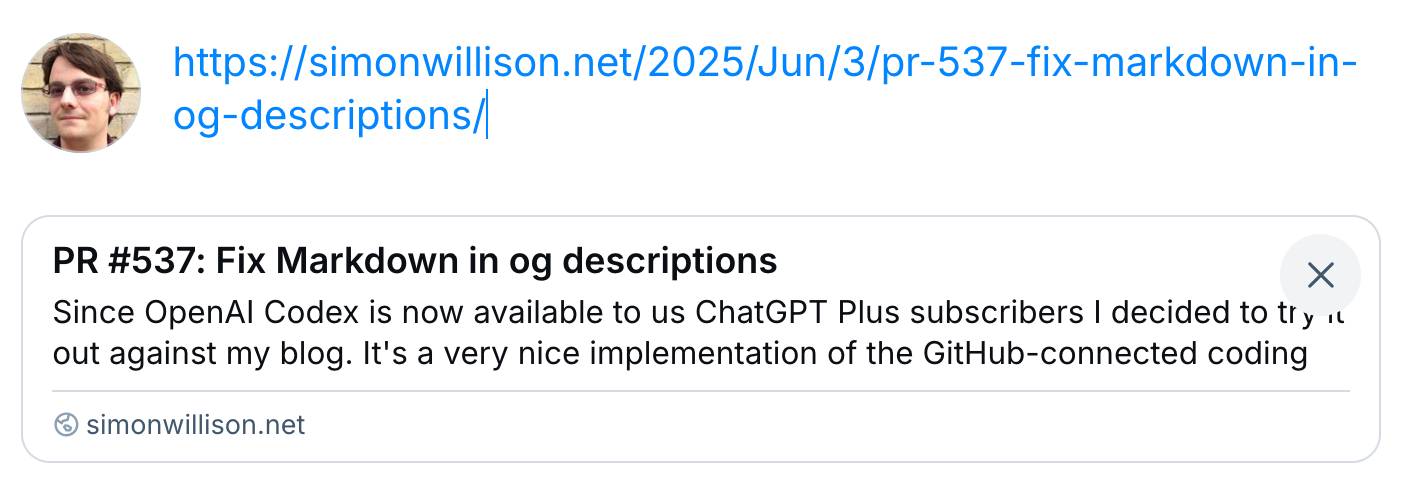
PR #537: Fix Markdown in og descriptions. Since OpenAI Codex is now available to us ChatGPT Plus subscribers I decided to try it out against my blog.
It's a very nice implementation of the GitHub-connected coding "agent" pattern, as also seen in Google's Jules and Microsoft's Copilot Coding Agent.
First I had to configure an environment for it. My Django blog uses PostgreSQL which isn't part of the default Codex container, so I had Claude Sonnet 4 help me come up with a startup recipe to get PostgreSQL working.
I attached my simonw/simonwillisonblog GitHub repo and used the following as the "setup script" for the environment:
# Install PostgreSQL
apt-get update && apt-get install -y postgresql postgresql-contrib

# Start PostgreSQL service
service postgresql start

# Create a test database and user
sudo -u postgres createdb simonwillisonblog
sudo -u postgres psql -c "CREATE USER testuser WITH PASSWORD 'testpass';"
sudo -u postgres psql -c "GRANT ALL PRIVILEGES ON DATABASE simonwillisonblog TO testuser;"
sudo -u postgres psql -c "ALTER USER testuser CREATEDB;"

pip install -r requirements.txt
I left "Agent internet access" off for reasons described previously.
Then I prompted Codex with the following (after one previous experimental task to check that it could run my tests):
Notes and blogmarks can both use Markdown.
They serve
meta property="og:description" content="tags on the page, but those tags include that raw Markdown which looks bad on social media previews.Fix it so they instead use just the text with markdown stripped - so probably render it to HTML and then strip the HTML tags.
Include passing tests.
Try to run the tests, the postgresql details are:
database = simonwillisonblog username = testuser password = testpass
Put those in the DATABASE_URL environment variable.
I left it to churn away for a few minutes (4m12s, to be precise) and it came back with a fix that edited two templates and added one more (passing) test. Here's that change in full.
And sure enough, the social media cards for my posts now look like this - no visible Markdown any more:
django-simple-deploy. Eric Matthes presented a lightning talk about this project at PyCon US this morning. "Django has a deploy command now". You can run it like this:
pip install django-simple-deploy[fly_io]
# Add django_simple_deploy to INSTALLED_APPS.
python manage.py deploy --automate-all
It's plugin-based (inspired by Datasette!) and the project has stable plugins for three hosting platforms: dsd-flyio, dsd-heroku and dsd-platformsh.
Currently in development: dsd-vps - a plugin that should work with any VPS provider, using Paramiko to connect to a newly created instance and run all of the commands needed to start serving a Django application.
Django: what’s new in 5.2. Adam Johnson provides extremely detailed unofficial annotated release notes for the latest Django.
I found his explanation and example of Form BoundField customization particularly useful - here's the new pattern for customizing the class= attribute on the label associated with a CharField:
from django import forms

class WideLabelBoundField(forms.BoundField):
    def label_tag(self, contents=None, attrs=None, label_suffix=None):
        if attrs is None:
            attrs = {}
        attrs["class"] = "wide"
        return super().label_tag(contents, attrs, label_suffix)

class NebulaForm(forms.Form):
    name = forms.CharField(
        max_length=100,
        label="Nebula Name",
        bound_field_class=WideLabelBoundField,
    )
I'd also missed the new HttpResponse.get_preferred_type() method for implementing HTTP content negotiation:
content_type = request.get_preferred_type(
    ["text/html", "application/json"]
)
Composite primary keys in Django. Django 5.2 is out today and a big new feature is composite primary keys, which can now be defined like this:
class Release(models.Model):
    pk = models.CompositePrimaryKey(
        "version", "name"
    )
    version = models.IntegerField()
    name = models.CharField(max_length=20)
They don't yet work with the Django admin or as targets for foreign keys.
Other smaller new features include:
- All ORM models are now automatically imported into
./manage.py shell- a feature borrowed from./manage.py shell_plusin django-extensions - Feeds from the Django syndication framework can now specify XSLT stylesheets
- response.text now returns the string representation of the body - I'm so happy about this, now I don't have to litter my Django tests with
response.content.decode("utf-8")any more - a new simple_block_tag helper making it much easier to create a custom Django template tag that further processes its own inner rendered content
- A bunch more in the full release notes
5.2 is also an LTS release, so it will receive security and data loss bug fixes up to April 2028.
suitenumerique/docs. New open source (MIT licensed) collaborative text editing web application, similar to Google Docs or Notion, notable because it's a joint effort funded by the French and German governments and "currently onboarding the Netherlands".
It's built using Django and React:
Docs is built on top of Django Rest Framework, Next.js, BlockNote.js, HocusPocus and Yjs.
Deployments currently require Kubernetes, PostgreSQL, memcached, an S3 bucket (or compatible) and an OIDC provider.
Smoke test your Django admin site.
Justin Duke demonstrates a neat pattern for running simple tests against your internal Django admin site: introspect every admin route via django.urls.get_resolver() and loop through them with @pytest.mark.parametrize to check they all return a 200 HTTP status code.
This catches simple mistakes with the admin configuration that trigger exceptions that might otherwise go undetected.
I rarely write automated tests against my own admin sites and often feel guilty about it. I wrote some notes on testing it with pytest-django fixtures a few years ago.
2024
My approach to running a link blog
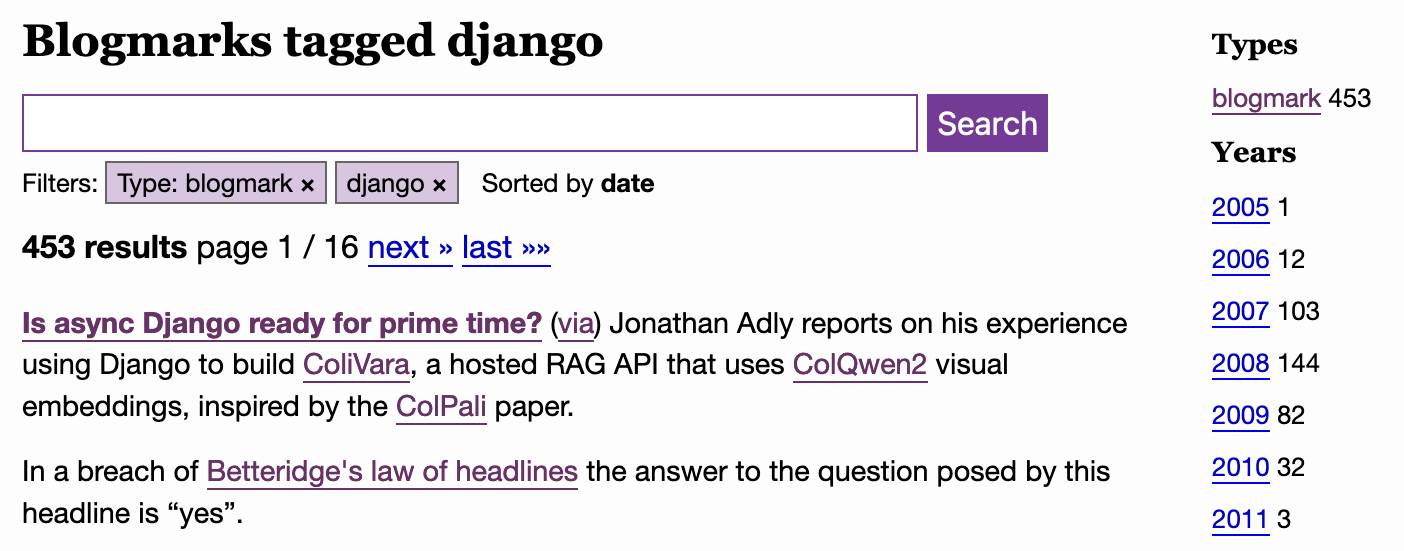
I started running a basic link blog on this domain back in November 2003—publishing links (which I called “blogmarks”) with a title, URL, short snippet of commentary and a “via” link where appropriate.
[... 1,510 words]Is async Django ready for prime time? (via) Jonathan Adly reports on his experience using Django to build ColiVara, a hosted RAG API that uses ColQwen2 visual embeddings, inspired by the ColPali paper.
In a breach of Betteridge's law of headlines the answer to the question posed by this headline is “yes”.
We believe async Django is ready for production. In theory, there should be no performance loss when using async Django instead of FastAPI for the same tasks.
The ColiVara application is itself open source, and you can see how it makes use of Django’s relatively new asynchronous ORM features in the api/views.py module.
I also picked up a useful trick from their Dockerfile: if you want uv in a container you can install it with this one-liner:
COPY --from=ghcr.io/astral-sh/uv:latest /uv /bin/uv
django-plugin-django-debug-toolbar (via) Tom Viner built a plugin for my DJP Django plugin system that configures the excellent django-debug-toolbar debugging tool.
You can see everything it sets up for you in this Python code: it configures installed apps, URL patterns and middleware and sets the INTERNAL_IPS and DEBUG settings.
Here are Tom's running notes as he created the plugin.
It feels like we’re at a bit of an inflection point for the Django community. [...] One of the places someone could have the most impact is by serving on the DSF Board. Like the community at large, the DSF is at a transition point: we’re outgrowing the “small nonprofit” status, and have the opportunity to really expand our ambition and reach. In all likelihood, the decisions the Board makes over the next year or two will define our direction and strategy for the next decade.
2025 DSF Board Nominations. The Django Software Foundation board elections are coming up. There are four positions open, seven directors total. Terms last two years, and the deadline for submitting a nomination is October 25th (the date of the election has not yet been decided).
Several community members have shared "DSF initiatives I'd like to see" documents to inspire people who may be considering running for the board:
- Sarah Boyce (current Django Fellow) wants a marketing strategy, better community docs, more automation and a refresh of the Django survey.
- Tim Schilling wants one big sponsor, more community recognition and a focus on working groups.
- Carlton Gibson wants an Executive Director, an updated website and better integration of the community into that website.
- Jacob Kaplan-Moss wants effectively all of the above.
There's also a useful FAQ on the Django forum by Thibaud Colas.
jefftriplett/django-startproject
(via)
Django's django-admin startproject and startapp commands include a --template option which can be used to specify an alternative template for generating the initial code.
Jeff Triplett actively maintains his own template for new projects, which includes the pattern that I personally prefer of keeping settings and URLs in a config/ folder. It also configures the development environment to run using Docker Compose.
The latest update adds support for Python 3.13, Django 5.1 and uv. It's neat how you can get started without even installing Django using uv run like this:
uv run --with=django django-admin startproject \
  --extension=ini,py,toml,yaml,yml \
  --template=https://github.com/jefftriplett/django-startproject/archive/main.zip \
  example_project
If we had $1,000,000…. Jacob Kaplan-Moss gave my favorite talk at DjangoCon this year, imagining what the Django Software Foundation could do if it quadrupled its annual income to $1 million and laying out a realistic path for getting there. Jacob suggests leaning more into large donors than increasing our small donor base:
It’s far easier for me to picture convincing eight or ten or fifteen large companies to make large donations than it is to picture increasing our small donor base tenfold. So I think a major donor strategy is probably the most realistic one for us.
So when I talk about major donors, who am I talking about? I’m talking about four major categories: large corporations, high net worth individuals (very wealthy people), grants from governments (e.g. the Sovereign Tech Fund run out of Germany), and private foundations (e.g. the Chan Zuckerberg Initiative, who’s given grants to the PSF in the past).
Also included: a TIL on Turning a conference talk into an annotated presentation. Jacob used my annotated presentation tool to OCR text from images of keynote slides, extracted a Whisper transcript from the YouTube livestream audio and then cleaned that up a little with LLM and Claude 3.5 Sonnet ("Split the content of this transcript up into paragraphs with logical breaks. Add newlines between each paragraph.") before editing and re-writing it all into the final post.
Django Commons. Django Commons is a really promising initiative started by Tim Schilling, aimed at the problem of keeping key Django community projects responsibly maintained on a long-term basis.
Django Commons is an organization dedicated to supporting the community's efforts to maintain packages. It seeks to improve the maintenance experience for all contributors; reducing the barrier to entry for new contributors and reducing overhead for existing maintainers.
I’ve stated recently that I’d love to see the Django Software Foundation take on this role - adopting projects and ensuring they are maintained long-term. Django Commons looks like it solves that exact problem, assuring the future of key projects beyond their initial creators.
So far the Commons has taken on responsibility for django-fsm-2, django-tasks-scheduler and, as-of this week, diango-typer.
Here’s Tim introducing the project back in May. Thoughtful governance has been baked in from the start:
Having multiple administrators makes the role more sustainable, lessens the impact of a person stepping away, and shortens response time for administrator requests. It’s important to me that the organization starts with multiple administrators so that collaboration and documentation are at the forefront of all decisions.
Thoughts on the Treasurer Role at Tech NonProfits. Will Vincent, Django Software Foundation treasurer from 2020-2022, explains what’s involved in the non-profit role with the highest level of responsibility and trust.
Building an automatically updating live blog in Django. Here's an extended write-up of how I implemented the live blog feature I used for my coverage of OpenAI DevDay yesterday. I built the first version using Claude while waiting for the keynote to start, then upgraded it during the lunch break with the help of GPT-4o to add sort options and incremental fetching of new updates.
Weeknotes: Three podcasts, two trips and a new plugin system
I fell behind a bit on my weeknotes. Here’s most of what I’ve been doing in September.
[... 693 words]Ensuring a block is overridden in a Django template (via) Neat Django trick by Tom Carrick: implement a Django template tag that raises a custom exception, then you can use this pattern in your templates:
{% block title %}{% ensure_overridden %}{% endblock %}
To ensure you don't accidentally extend a base template but forget to fill out a critical block.