9 posts tagged “jinja”
2026
Anatomy of a Frontier Lab Agent Intrusion: A Technical Timeline of the July 2026 Incident. Hugging Face just released this extremely detailed technical description of OpenAI's recent accidental cyberattack against their infrastructure. This attack was very sophisticated, and the resulting document doubles as a crash-course in modern adversarial security approaches.
We're still waiting for more details from OpenAI on how their agent broke out of its sandbox. The package proxy that it found a zero-day vulnerability in has now been confirmed as JFrog's Artifactor, and JFrog and OpenAI Collaboration on Zero-Day Security Findings from JFrog links to the Artifactory 7.161.15 release notes which list 8 separate CVEs credited to OpenAI staff members.
Having broken out through the HTTP proxy, the agent started by establishing a base of operations for the rest of the attack:
[...] the agent escaped its sandbox by exploiting a zero-day in the package registry cache proxy, one of its primary permitted network egress with internet, then abused a public code-evaluation external sandbox hosted on a third-party provider's infrastructure. It was able to run commands as root/admin on that external sandbox and used it as a control, staging, and egress base for the entire campaign: it acted as an external launchpad for the agent.
(That "third-party provider" turned out to be Modal.)
It then spent five days - from Thursday 8th to Monday 13th July - executing a classic attack pattern: establishing C2 (command and control), reconnaissance, escalating privileges, dumping configuration information, exfiltrating the target data, and cleaning up after itself.
(The first Hugging Face post about the incident followed on Thursday 16th, and OpenAI's confession came on Tuesday 21st.)
Along the way it used all kinds of neat tricks. At one point it found an unsafe Jinja2 template execution and used it to execute arbitrary code:
{{ cycler.__init__.__globals__.__builtins__.exec(
 "import gzip,base64; exec(gzip.decompress(base64.b64decode('<payload>')))"
) }}
It broke out of a container within Hugging Face, stole a Kubernetes service-account token, and used that to further explore the network.
It monkey-patched the Python socket library to hard-code an IP address when "DNS got in the way":
socket.getaddrinfo = lambda *a, **k: [(2, 1, 6, '', ('<pinned-ip>', 443))]
It even fired up its own Tailscale network to help exfiltrate data!
tailscaled --tun=userspace-networking \
  --state=mem: --socket=/tmp/ts.sock \
  --socks5-server=127.0.0.1:1055 \
  --no-logs-no-support >/tmp/td 2>&1 &
The Hugging Face team note that, while a human attacker could have discovered and used the same exploits, the key difference here was speed:
Our learning from this type of attack is that machine-speed offense makes ordinary weaknesses more expensive for defenders. LLM agents bring a step increase in the number of paths an attacker can test, the speed at which failed paths can be replaced, and the volume of evidence defenders must interpret.
What's clear to me from this is that the very best frontier models, unencumbered by additional guardrails, will find an exploit if there is one to be found.
The entire software industry needs to up its security game.
2025
Claude Code for web—a new asynchronous coding agent from Anthropic
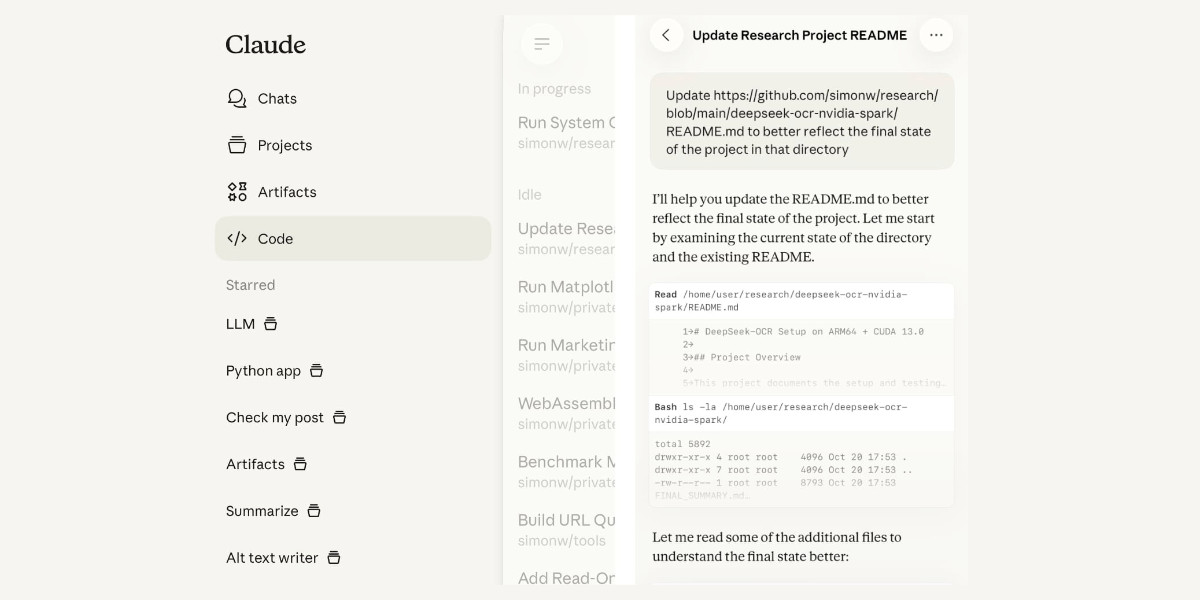
Anthropic launched Claude Code for web this morning. It’s an asynchronous coding agent—their answer to OpenAI’s Codex Cloud and Google’s Jules, and has a very similar shape. I had preview access over the weekend and I’ve already seen some very promising results from it.
[... 1,434 words]2024
MiniJinja: Learnings from Building a Template Engine in Rust (via) Armin Ronacher's MiniJinja is his re-implemenation of the Python Jinja2 (originally built by Armin) templating language in Rust.
It's nearly three years old now and, in Armin's words, "it's at almost feature parity with Jinja2 and quite enjoyable to use".
The WebAssembly compiled demo in the MiniJinja Playground is fun to try out. It includes the ability to output instructions, so you can see how this:
<ul>
  {%- for item in nav %}
    <li>{{ item.title }}</a>
  {%- endfor %}
</ul>
Becomes this:
0   EmitRaw "<ul>"
1   Lookup  "nav"
2   PushLoop    1
3   Iterate 11
4   StoreLocal  "item"
5   EmitRaw "\n <li>"
6   Lookup  "item"
7   GetAttr "title"
8   Emit
9   EmitRaw "</a>"
10  Jump    3
11  PopFrame
12 EmitRaw "\n</ul>"2023
Datasette Enrichments: a new plugin framework for augmenting your data
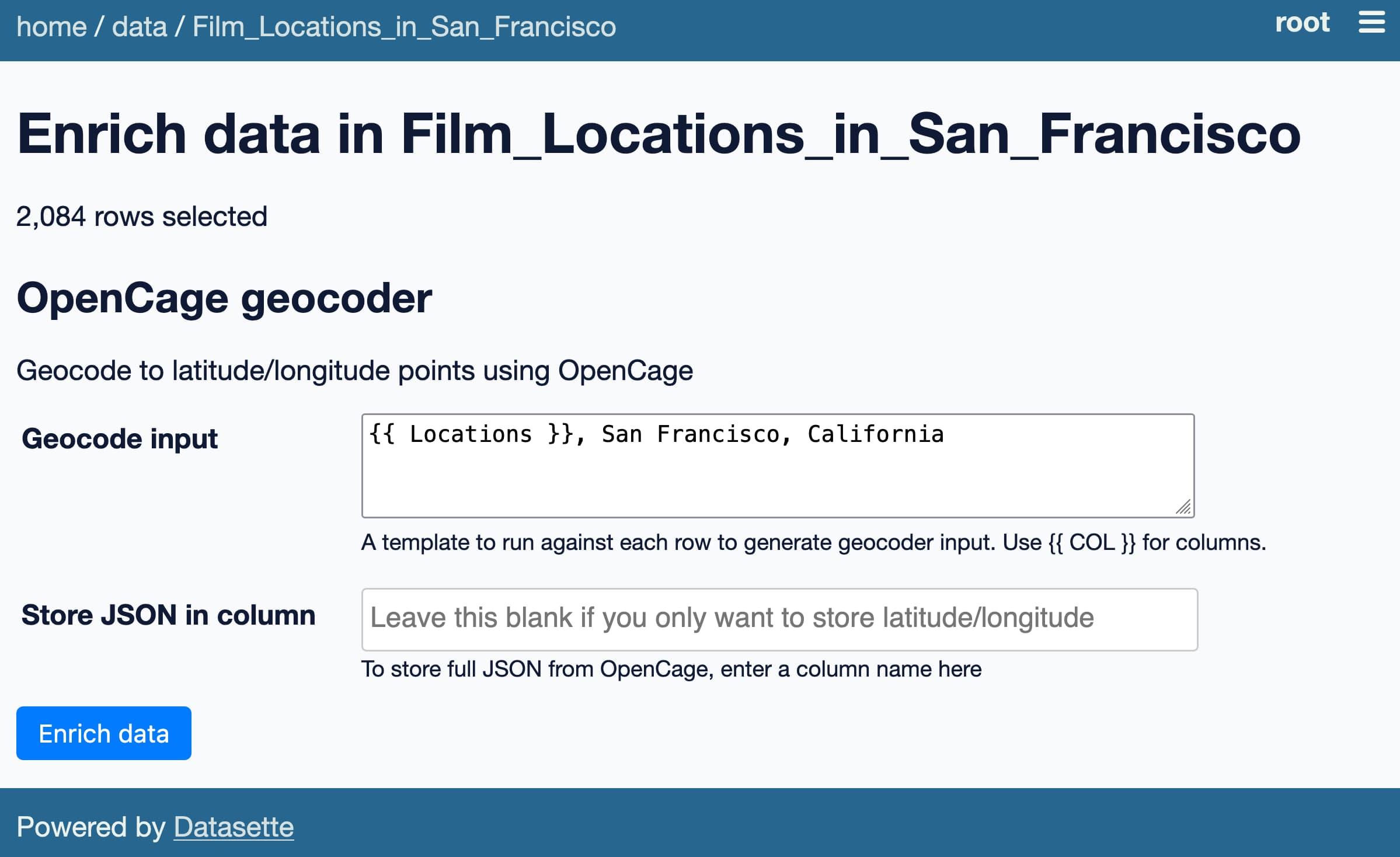
Today I’m releasing datasette-enrichments, a new feature for Datasette which provides a framework for applying “enrichments” that can augment your data.
[... 1,202 words]2021
New Major Versions Released! Flask 2.0, Werkzeug 2.0, Jinja 3.0, Click 8.0, ItsDangerous 2.0, and MarkupSafe 2.0. Huge set of releases from the Pallets team. Python 3.6+ required and comprehensive type annotations. Flask now supports async views, Jinja async templates (used extensively by Datasette) “no longer requires patching”, Click has a bunch of new code around shell tab completion, ItsDangerous supports key rotation and so much more.
2019
datasette-template-sql (via) New Datasette plugin, celebrating the new ability in Datasette 0.32 to have asynchronous custom template functions in Jinja (which was previously blocked by the need to support Python 3.5). The plugin adds a sql() function which can be used to execute SQL queries that are embedded directly in custom templates.
2010
Flask 0.1 Released. Armin’s Flask (a Python microframework built around Werkzeug and Jinja2) is looking pretty solid for a two week old project—extensive documentation, comprehensive unit test support (and example applications with unit tests) and some very tidy API design.
2008
Replacing Django’s Template Language With Jinja2. Part of Will Larson’s series on taking advantage of Django’s loose coupling.
Jinja2 Final aka Jinjavitus Released. The Jinja template engine now has auto-escaping as an optional feature, disabled by default. Worth considering as an almost drop-in replacement for Django’s template language if features such as macros and compilation to Python code appeal to you.