1,951 posts tagged “llms”
Large Language Models (LLMs) are the class of technology behind generative text AI systems like OpenAI's ChatGPT, Google's Gemini and Anthropic's Claude.
2024
Chrome Prompt Playground.
Google Chrome Canary is currently shipping an experimental on-device LLM, in the form of Gemini Nano. You can access it via the new window.ai API, after first enabling the "Prompt API for Gemini Nano" experiment in chrome://flags (and then waiting an indeterminate amount of time for the ~1.7GB model file to download - I eventually spotted it in ~/Library/Application Support/Google/Chrome Canary/OptGuideOnDeviceModel).
I got Claude 3.5 Sonnet to build me this playground interface for experimenting with the model. You can execute prompts, stream the responses and all previous prompts and responses are stored in localStorage.
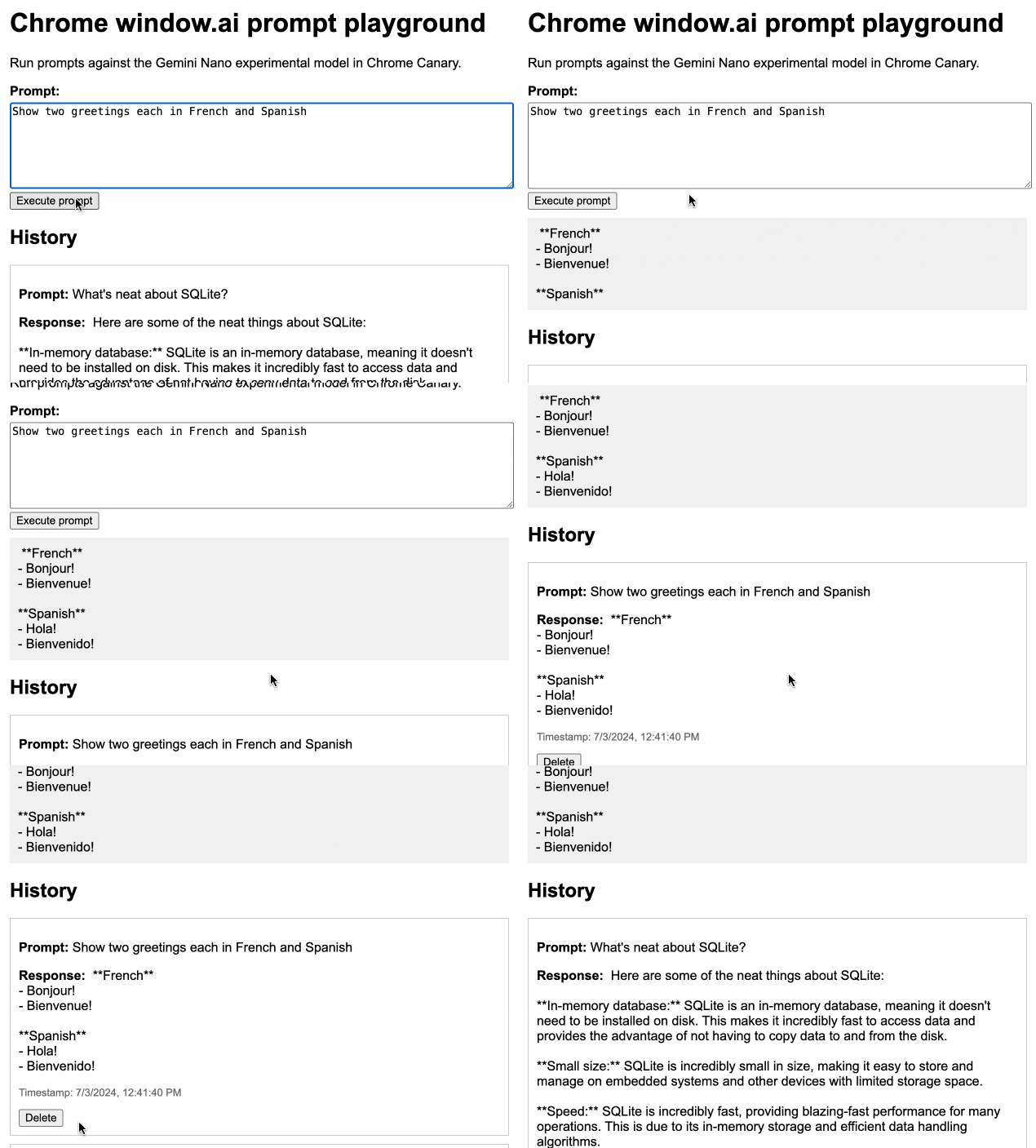
Here's the full Sonnet transcript, and the final source code for the app.
The best documentation I've found for the new API is is explainers-by-googlers/prompt-api on GitHub.
gemma-2-27b-it-llamafile (via) Justine Tunney shipped llamafile packages of Google's new openly licensed (though definitely not open source) Gemma 2 27b model this morning.
I downloaded the gemma-2-27b-it.Q5_1.llamafile version (20.5GB) to my Mac, ran chmod 755 gemma-2-27b-it.Q5_1.llamafile and then ./gemma-2-27b-it.Q5_1.llamafile and now I'm trying it out through the llama.cpp default web UI in my browser. It works great.
It's a very capable model - currently sitting at position 12 on the LMSYS Arena making it the highest ranked open weights model - one position ahead of Llama-3-70b-Instruct and within striking distance of the GPT-4 class models.
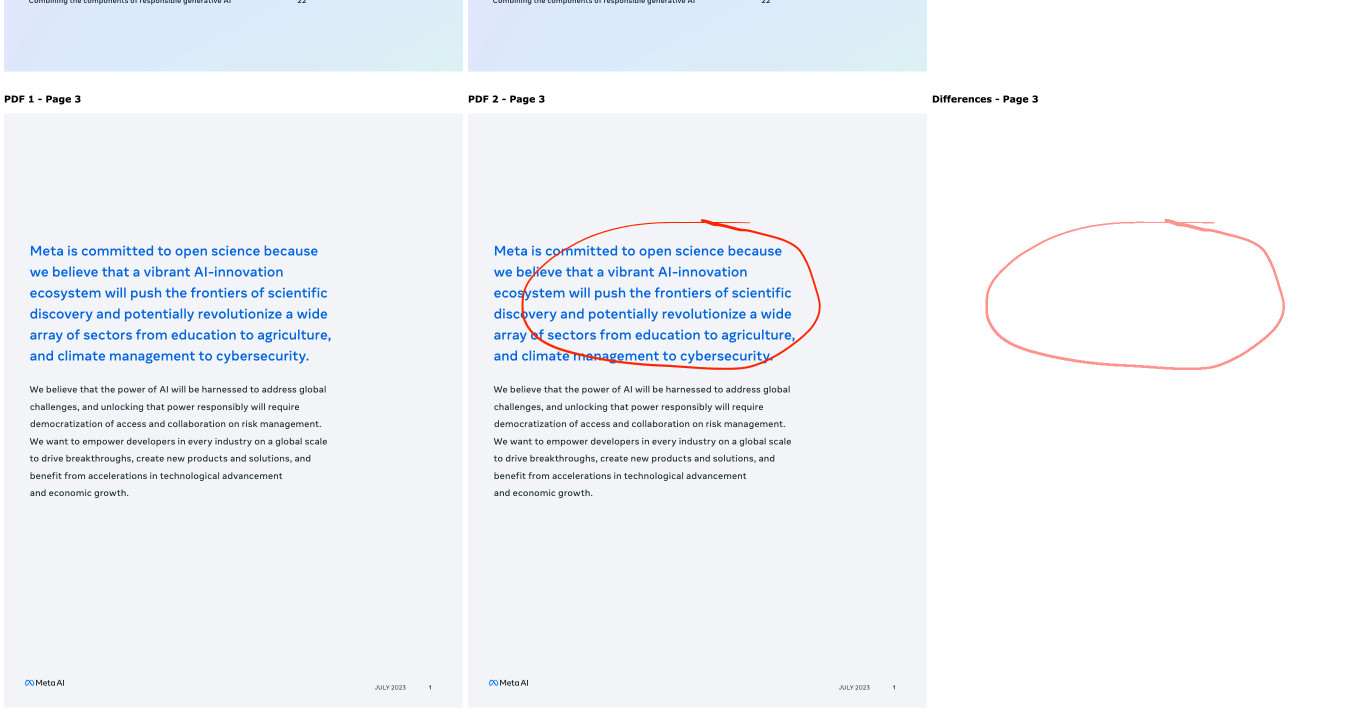
Compare PDFs. Inspired by this thread on Hacker News about the C++ diff-pdf tool I decided to see what it would take to produce a web-based PDF diff visualization tool using Claude 3.5 Sonnet.
It took two prompts:
Build a tool where I can drag and drop on two PDF files and it uses PDF.js to turn each of their pages into canvas elements and then displays those pages side by side with a third image that highlights any differences between them, if any differences exist
That give me a React app that didn't quite work, so I followed-up with this:
rewrite that code to not use React at all
Which gave me a working tool! You can see the full Claude transcript in this Gist. Here's a screenshot of the tool in action:
Being able to knock out little custom interactive web tools like this in a couple of minutes is so much fun.
Absolutely any time I try to explore something even slightly against commonly accepted beliefs, LLMs always just rehash the commonly accepted beliefs.
As a researcher, I find this behaviour worse than unhelpful. It gives the mistaken impression that there's nothing to explore.
We argued that ChatGPT is not designed to produce true utterances; rather, it is designed to produce text which is indistinguishable from the text produced by humans. It is aimed at being convincing rather than accurate. The basic architecture of these models reveals this: they are designed to come up with a likely continuation of a string of text. It’s reasonable to assume that one way of being a likely continuation of a text is by being true; if humans are roughly more accurate than chance, true sentences will be more likely than false ones. This might make the chatbot more accurate than chance, but it does not give the chatbot any intention to convey truths. This is similar to standard cases of human bullshitters, who don’t care whether their utterances are true; good bullshit often contains some degree of truth, that’s part of what makes it convincing.
Open challenges for AI engineering
I gave the opening keynote at the AI Engineer World’s Fair yesterday. I was a late addition to the schedule: OpenAI pulled out of their slot at the last minute, and I was invited to put together a 20 minute talk with just under 24 hours notice!
[... 5,640 words]picopilot (via) Kyle Carberry's "GitHub Copilot in 70 lines of JavaScript". The title is a little hyperbolic, but the code itself really does implement an OpenAI powered Visual Studio Code text completion extension in 71 lines of code. This is an excellent example for learning what a minimal VS Code extension looks like.
Here's the system prompt it uses:
You provide code completion results given a prefix and suffix. Respond with a JSON object with the key 'completion' containing a suggestion to place between the prefix and suffix. Follow existing code styles. Listen to comments at the end of the prefix. The language is "{language}".
Then it passes the prefix and suffix as two user messages, and uses the "response_format": {"type": "json_object"} option to enforce JSON output from the GPT-4o API.
The feature this is missing is the thing that makes GitHub Copilot so impressive: Copilot does a whole bunch of clever tricks to find snippets of relevant code from the current and other nearby files and includes them with the prompt, resulting in much higher quality completions.
Claude Projects. New Claude feature, quietly launched this morning for Claude Pro users. Looks like their version of OpenAI's GPTs, designed to take advantage of Claude's 200,000 token context limit:
You can upload relevant documents, text, code, or other files to a project’s knowledge base, which Claude will use to better understand the context and background for your individual chats within that project. Each project includes a 200K context window, the equivalent of a 500-page book, so users can add all of the insights needed to enhance Claude’s effectiveness.
You can also set custom instructions, which presumably get added to the system prompt.
I tried dropping in all of Datasette's existing documentation - 693KB of .rst files (which I had to rename to .rst.txt for it to let me upload them) - and it worked and showed "63% of knowledge size used".
This is a slightly different approach from OpenAI, where the GPT knowledge feature supports attaching up to 20 files each with up to 2 million tokens, which get ingested into a vector database (likely Qdrant) and used for RAG.
It looks like Claude instead handle a smaller amount of extra knowledge but paste the whole thing into the context window, which avoids some of the weirdness around semantic search chunking but greatly limits the size of the data.
My big frustration with the knowledge feature in GPTs remains the lack of documentation on what it's actually doing under the hood. Without that it's difficult to make informed decisions about how to use it - with Claude Projects I can at least develop a robust understanding of what the tool is doing for me and how best to put it to work.
No equivalent (yet) for the GPT actions feature where you can grant GPTs the ability to make API calls out to external systems.
What Apple unveiled last week with Apple Intelligence wasn't so much new products, but new features—a slew of them—for existing products, powered by generative AI.
[...] These aren't new apps or new products. They're the most used, most important apps Apple makes, the core apps that define the Apple platforms ecosystem, and Apple is using generative AI to make them better and more useful—without, in any way, rendering them unfamiliar.
llama.ttf (via) llama.ttf is "a font file which is also a large language model and an inference engine for that model".
You can see it kick into action at 8m28s in this video, where creator Søren Fuglede Jørgensen types "Once upon a time" followed by dozens of exclamation marks, and those exclamation marks then switch out to render a continuation of the story. But... when they paste the code out of the editor again it shows as the original exclamation marks were preserved - the LLM output was presented only in the way they were rendered.
The key trick here is that the font renderer library HarfBuzz (used by Firefox, Chrome, Android, GNOME and more) added a new WebAssembly extension in version 8.0 last year, which is powerful enough to run a full LLM based on the tinyllama-15M model - which fits in a 60MB font file.
(Here's a related demo from Valdemar Erk showing Tetris running in a WASM font, at 22m56s in this video.)
The source code for llama.ttf is available on GitHub.
In our “who validates the validators” user studies, we found that people expected—and also desired—for the LLM to learn from any human interaction. That too, “as efficiently as possible” (ie after 1-2 demonstrations, the LLM should “get it”)
Building search-based RAG using Claude, Datasette and Val Town
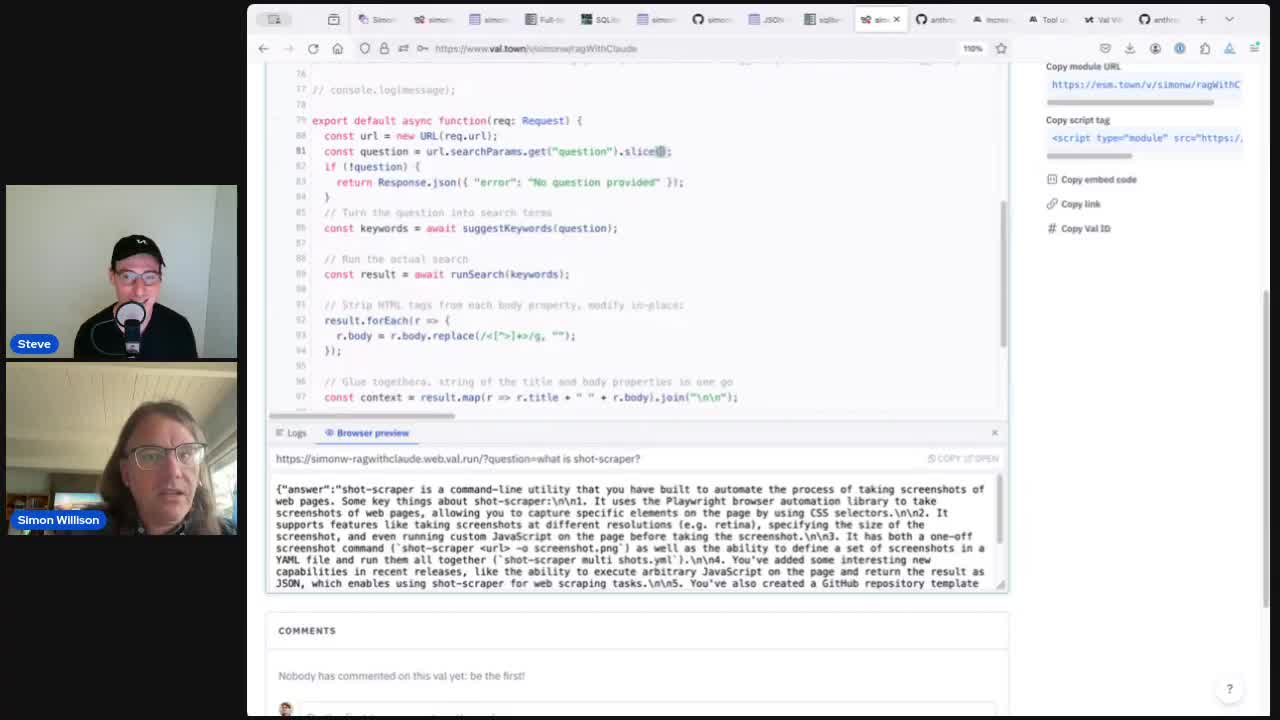
Retrieval Augmented Generation (RAG) is a technique for adding extra “knowledge” to systems built on LLMs, allowing them to answer questions against custom information not included in their training data. A common way to implement this is to take a question from a user, translate that into a set of search queries, run those against a search engine and then feed the results back into the LLM to generate an answer.
[... 3,372 words]llm-claude-3 0.4. LLM plugin release adding support for the new Claude 3.5 Sonnet model:
pipx install llm
llm install -U llm-claude-3
llm keys set claude
# paste AP| key here
llm -m claude-3.5-sonnet \
  'a joke about a pelican and a walrus having lunch'
One of the core constitutional principles that guides our AI model development is privacy. We do not train our generative models on user-submitted data unless a user gives us explicit permission to do so. To date we have not used any customer or user-submitted data to train our generative models.
Claude 3.5 Sonnet. Anthropic released a new model this morning, and I think it's likely now the single best available LLM. Claude 3 Opus was already mostly on-par with GPT-4o, and the new 3.5 Sonnet scores higher than Opus on almost all of Anthropic's internal evals.
It's also twice the speed and one fifth of the price of Opus (it's the same price as the previous Claude 3 Sonnet). To compare:
- gpt-4o: $5/million input tokens and $15/million output
- Claude 3.5 Sonnet: $3/million input, $15/million output
- Claude 3 Opus: $15/million input, $75/million output
Similar to Claude 3 Haiku then, which both under-cuts and out-performs OpenAI's GPT-3.5 model.
In addition to the new model, Anthropic also added a "artifacts" feature to their Claude web interface. The most exciting part of this is that any of the Claude models can now build and then render web pages and SPAs, directly in the Claude interface.
This means you can prompt them to e.g. "Build me a web app that teaches me about mandelbrot fractals, with interactive widgets" and they'll do exactly that - I tried that prompt on Claude 3.5 Sonnet earlier and the results were spectacular (video demo).
An unsurprising note at the end of the post:
To complete the Claude 3.5 model family, we’ll be releasing Claude 3.5 Haiku and Claude 3.5 Opus later this year.
If the pricing stays consistent with Claude 3, Claude 3.5 Haiku is going to be a very exciting model indeed.
Tags with descriptions. Tiny new feature on my blog: I can now add optional descriptions to my tag pages, for example on datasette and sqlite-utils and prompt-injection.
I built this feature on a live call this morning as an unplanned demonstration of GitHub's new Copilot Workspace feature, where you can run a prompt against a repository and have it plan, implement and file a pull request implementing a change to the code.
My prompt was:
Add a feature that lets me add a description to my tag pages, stored in the database table for tags and visible on the /tags/x/ page at the top
It wasn't as compelling a demo as I expected: Copilot Workspace currently has to stream an entire copy of each file it modifies, which can take a long time if your codebase includes several large files that need to be changed.
It did create a working implementation on its first try, though I had given it an extra tip not to forget the database migration. I ended up making a bunch of changes myself before I shipped it, listed in the pull request.
I've been using Copilot Workspace quite a bit recently as a code explanation tool - I'll prompt it to e.g. "add architecture documentation to the README" on a random repository not owned by me, then read its initial plan to see what it's figured out without going all the way through to the implementation and PR phases. Example in this tweet where I figured out the rough design of the Jina AI Reader API for this post.
Claude: Building evals and test cases. More documentation updates from Anthropic: this section on writing evals for Claude is new today and includes Python code examples for a number of different evaluation techniques.
Included are several examples of the LLM-as-judge pattern, plus an example using cosine similarity and another that uses the new-to-me Rouge Python library that implements the ROUGE metric for evaluating the quality of summarized text.
Anthropic release notes (via) Anthropic have started publishing release notes! Currently available for their API and their apps (mobile and web).
What I'd really like to see are release notes for the models themselves, though as far as I can tell there haven't been any updates to those since the Claude 3 models were first released (the Haiku model name in the API is still claude-3-haiku-20240307 and Anthropic say they'll change that identifier after any updates to the model).
Language models on the command-line
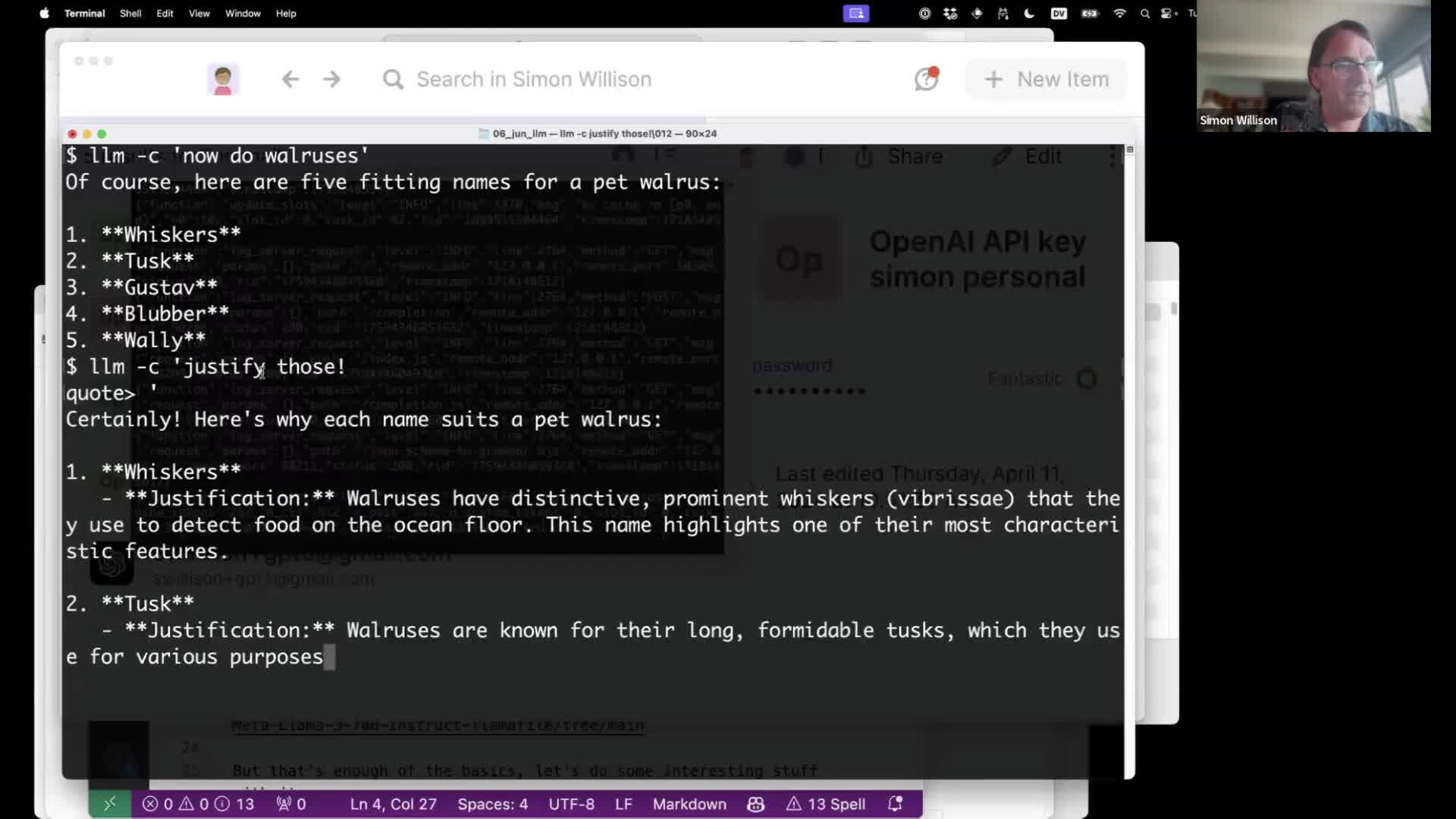
I gave a talk about accessing Large Language Models from the command-line last week as part of the Mastering LLMs: A Conference For Developers & Data Scientists six week long online conference. The talk focused on my LLM Python command-line utility and ways you can use it (and its plugins) to explore LLMs and use them for useful tasks.
[... 4,992 words]We're adding the human touch, but that often requires a deep, developmental edit on a piece of writing. The grammar and word choice just sound weird. You're always cutting out flowery words like 'therefore' and 'nevertheless' that don't fit in casual writing. Plus, you have to fact-check the whole thing because AI just makes things up, which takes forever because it's not just big ideas. AI hallucinates these flippant little things in throwaway lines that you'd never notice. [...]
It's tedious, horrible work, and they pay you next to nothing for it.
Jina AI Reader. Jina AI provide a number of different AI-related platform products, including an excellent family of embedding models, but one of their most instantly useful is Jina Reader, an API for turning any URL into Markdown content suitable for piping into an LLM.
Add r.jina.ai to the front of a URL to get back Markdown of that page, for example https://r.jina.ai/https://simonwillison.net/2024/Jun/16/jina-ai-reader/ - in addition to converting the content to Markdown it also does a decent job of extracting just the content and ignoring the surrounding navigation.
The API is free but rate-limited (presumably by IP) to 20 requests per minute without an API key or 200 request per minute with a free API key, and you can pay to increase your allowance beyond that.
The Apache 2 licensed source code for the hosted service is on GitHub - it's written in TypeScript and uses Puppeteer to run Readabiliy.js and Turndown against the scraped page.
It can also handle PDFs, which have their contents extracted using PDF.js.
There's also a search feature, s.jina.ai/search+term+goes+here, which uses the Brave Search API.
GitHub Copilot Chat: From Prompt Injection to Data Exfiltration (via) Yet another example of the same vulnerability we see time and time again.
If you build an LLM-based chat interface that gets exposed to both private and untrusted data (in this case the code in VS Code that Copilot Chat can see) and your chat interface supports Markdown images, you have a data exfiltration prompt injection vulnerability.
The fix, applied by GitHub here, is to disable Markdown image references to untrusted domains. That way an attack can't trick your chatbot into embedding an image that leaks private data in the URL.
Previous examples: ChatGPT itself, Google Bard, Writer.com, Amazon Q, Google NotebookLM. I'm tracking them here using my new markdown-exfiltration tag.
PDF to Podcast (via) At first glance this project by Stephan Fitzpatrick is a cute demo of a terrible sounding idea... but then I tried it out and the results are weirdly effective. You can listen to a fake podcast version of the transformers paper, or upload your own PDF (with your own OpenAI API key) to make your own.
It's open source (Apache 2) so I had a poke around in the code. It gets a lot done with a single 180 line Python script.
When I'm exploring code like this I always jump straight to the prompt - it's quite long, and starts like this:
Your task is to take the input text provided and turn it into an engaging, informative podcast dialogue. The input text may be messy or unstructured, as it could come from a variety of sources like PDFs or web pages. Don't worry about the formatting issues or any irrelevant information; your goal is to extract the key points and interesting facts that could be discussed in a podcast. [...]
So I grabbed a copy of it and pasted in my blog entry about WWDC, which produced this result when I ran it through Gemini Flash using llm-gemini:
cat prompt.txt | llm -m gemini-1.5-flash-latest
Then I piped the result through my ospeak CLI tool for running text-to-speech with the OpenAI TTS models (after truncating to 690 tokens with ttok because it turned out to be slightly too long for the API to handle):
llm logs --response | ttok -t 690 | ospeak -s -o wwdc-auto-podcast.mp3
And here's the result (3.9MB 3m14s MP3).
It's not as good as the PDF-to-Podcast version because Stephan has some really clever code that uses different TTS voices for each of the characters in the transcript, but it's still a surprisingly fun way of repurposing text from my blog. I enjoyed listening to it while I was cooking dinner.
Contrast [Apple Intelligence] to what OpenAI is trying to accomplish with its GPT models, or Google with Gemini, or Anthropic with Claude: those large language models are trying to incorporate all of the available public knowledge to know everything; it’s a dramatically larger and more difficult problem space, which is why they get stuff wrong. There is also a lot of stuff that they don’t know because that information is locked away — like all of the information on an iPhone.
Generative AI Is Not Going To Build Your Engineering Team For You (via) This barnstormer of an essay is a long read by Charity Majors, and I find myself wanting to quote almost every paragraph.
It thoroughly and passionately debunks the idea that generative AI means that teams no longer need to hire junior programmers.
This is for several key reasons. First is the familiar pipeline argument - we need juniors in order to grow new intermediate and senior engineers:
Software is an apprenticeship industry. You can’t learn to be a software engineer by reading books. You can only learn by doing…and doing, and doing, and doing some more. No matter what your education consists of, most learning happens on the job—period. And it never ends! Learning and teaching are lifelong practices; they have to be, the industry changes so fast.
It takes a solid seven-plus years to forge a competent software engineer. (Or as most job ladders would call it, a “senior software engineer”.) That’s many years of writing, reviewing, and deploying code every day, on a team alongside more experienced engineers. That’s just how long it seems to take.
What does it mean to be a senior engineer? It’s a lot more than just writing code:
To me, being a senior engineer is not primarily a function of your ability to write code. It has far more to do with your ability to understand, maintain, explain, and manage a large body of software in production over time, as well as the ability to translate business needs into technical implementation. So much of the work is around crafting and curating these large, complex sociotechnical systems, and code is just one representation of these systems.
[…]
People act like writing code is the hard part of software. It is not. It never has been, it never will be. Writing code is the easiest part of software engineering, and it’s getting easier by the day. The hard parts are what you do with that code—operating it, understanding it, extending it, and governing it over its entire lifecycle.
But I find the most convincing arguments are the ones about team structure itself:
Hiring engineers is about composing teams. The smallest unit of software ownership is not the individual, it’s the team
[…]
Have you ever been on a team packed exclusively with staff or principal engineers? It is not fun. That is not a high-functioning team. There is only so much high-level architecture and planning work to go around, there are only so many big decisions that need to be made. These engineers spend most of their time doing work that feels boring and repetitive, so they tend to over-engineer solutions and/or cut corners—sometimes at the same time. They compete for the “fun” stuff and find reasons to pick technical fights with each other. They chronically under-document and under-invest in the work that makes systems simple and tractable.
[…]
The best teams are ones where no one is bored, because every single person is working on something that challenges them and pushes their boundaries. The only way you can get this is by having a range of skill levels on the team.
Charity finishes with advice on hiring juniors, including ensuring that your organization is in the right shape to do so effectively.
The only thing worse than never hiring any junior engineers is hiring them into an awful experience where they can’t learn anything.
Seriously though, read the whole thing. It contains such a density of accumulated engineering management wisdom.
Apple’s terminology distinguishes between “personal intelligence,” on-device and under their control, and “world knowledge,” which is prone to hallucinations – but is also what consumers expect when they use AI, and it’s what may replace Google search as the “point of first intent” one day soon.
It’s wise for them to keep world knowledge separate, behind a very clear gate, but still engage with it. Protects the brand and hedges their bets.
Introducing Apple’s On-Device and Server Foundation Models. Apple Intelligence uses both on-device and in-the-cloud models that were trained from scratch by Apple.
Their on-device model is a 3B model that "outperforms larger models including Phi-3-mini, Mistral-7B, and Gemma-7B", while the larger cloud model is comparable to GPT-3.5.
The language models were trained on unlicensed scraped data - I was hoping they might have managed to avoid that, but sadly not:
We train our foundation models on licensed data, including data selected to enhance specific features, as well as publicly available data collected by our web-crawler, AppleBot.
The most interesting thing here is the way they apply fine-tuning to the local model to specialize it for different tasks. Apple call these "adapters", and they use LoRA for this - a technique first published in 2021. This lets them run multiple on-device models based on a shared foundation, specializing in tasks such as summarization and proof-reading.
Here's the section of the Platforms State of the Union talk that talks about the foundation models and their fine-tuned variants.
As Hamel Husain says:
This talk from Apple is the best ad for fine tuning that probably exists.
The video also describes their approach to quantization:
The next step we took is compressing the model. We leveraged state-of-the-art quantization techniques to take a 16-bit per parameter model down to an average of less than 4 bits per parameter to fit on Apple Intelligence-supported devices, all while maintaining model quality.
Still no news on how their on-device image model was trained. I'd love to find out it was trained exclusively using licensed imagery - Apple struck a deal with Shutterstock a few months ago.
Private Cloud Compute: A new frontier for AI privacy in the cloud. Here are the details about Apple's Private Cloud Compute infrastructure, and they are pretty extraordinary.
The goal with PCC is to allow Apple to run larger AI models that won't fit on a device, but in a way that guarantees that private data passed from the device to the cloud cannot leak in any way - not even to Apple engineers with SSH access who are debugging an outage.
This is an extremely challenging problem, and their proposed solution includes a wide range of new innovations in private computing.
The most impressive part is their approach to technically enforceable guarantees and verifiable transparency. How do you ensure that privacy isn't broken by a future code change? And how can you allow external experts to verify that the software running in your data center is the same software that they have independently audited?
When we launch Private Cloud Compute, we’ll take the extraordinary step of making software images of every production build of PCC publicly available for security research. This promise, too, is an enforceable guarantee: user devices will be willing to send data only to PCC nodes that can cryptographically attest to running publicly listed software.
These code releases will be included in an "append-only and cryptographically tamper-proof transparency log" - similar to certificate transparency logs.
There is a big difference between tech as augmentation versus automation. Augmentation (think Excel and accountants) benefits workers while automation (think traffic lights versus traffic wardens) benefits capital.
LLMs are controversial because the tech is best at augmentation but is being sold by lots of vendors as automation.
Thoughts on the WWDC 2024 keynote on Apple Intelligence
Today’s WWDC keynote finally revealed Apple’s new set of AI features. The AI section (Apple are calling it Apple Intelligence) started over an hour into the keynote—this link jumps straight to that point in the archived YouTube livestream, or you can watch it embedded here:
[... 855 words]