26 posts tagged “schema-migrations”
Tools for managing the evolution of database schema.
2026
sqlite-utils 4.0, now with database schema migrations
This morning I released sqlite-utils 4.0, the 124th release of that project and the first major version bump since 3.0 in November 2020. In addition to some small but significant breaking changes (described in this upgrade guide), this version introduces three major features: database migrations, nested transactions (via a new db.atomic() method), and support for compound foreign keys.
sqlite-utils 4.0rc1 adds migrations and nested transactions
sqlite-utils is my combined Python library and CLI tool for working with SQLite databases. It provides an extensive set of higher-level operations on top of Python’s default sqlite3 package, including support for complex table transformations, automatic table creation from JSON data and a whole lot more.
[... 975 words]2024
Django: Test for pending migrations
(via)
Neat recipe from Adam Johnson for adding an automated test to your Django test suite that runs manage.py makemigrations --check to ensure you don't accidentally land code that deploys with a missing migration and crashes your site. I've made this mistake before myself so I'll be adding this to my projects.
pgroll (via) “Zero-downtime, reversible, schema migrations for Postgres”
I love this kind of thing. This one is has a really interesting design: you define your schema modifications (adding/dropping columns, creating tables etc) using a JSON DSL, then apply them using a Go binary.
When you apply a migration the tool first creates a brand new PostgreSQL schema (effectively a whole new database) which imitates your new schema design using PostgreSQL views. You can then point your applications that have been upgraded to the new schema at it, using the PostgreSQL search_path setting.
Old applications can continue talking to the previous schema design, giving you an opportunity to roll out a zero-downtime deployment of the new code.
Once your application has upgraded and the physical rows in the database have been transformed to the new schema you can run a --continue command to make the final destructive changes and drop the mechanism that simulates both schema designs at once.
2023
Stripe: Online migrations at scale (via) This 2017 blog entry from Jacqueline Xu at Stripe provides a very clear description of the “dual writes” pattern for applying complex data migrations without downtime: dual write to new and old tables, update the read paths, update the write paths and finally remove the now obsolete data—illustrated with an example of upgrading customers from having a single to multiple subscriptions.
Database Migrations. Vadim Kravcenko provides a useful, in-depth description of the less obvious challenges of applying database migrations successfully. Vadim uses and likes Django’s migrations (as do I) but notes that running them at scale still involves a number of thorny challenges.
The biggest of these, which I’ve encountered myself multiple times, is that if you want truly zero downtime deploys you can’t guarantee that your schema migrations will be deployed at the exact same instant as changes you make to your application code.
This means all migrations need to be forward-compatible: you need to apply a schema change in a way that your existing code will continue to work error-free, then ship the related code change as a separate operation.
Vadim describes what this looks like in detail for a number of common operations: adding a field, removing a field and changing a field that has associated business logic implications. He also discusses the importance of knowing when to deploy a dual-write strategy.
2022
Sqitch tutorial for SQLite (via) Sqitch is an interesting implementation of database migrations: it’s a command-line tool written in Perl with an interface similar to Git, providing commands to create, run, revert and track migration scripts. The scripts the selves are written as SQL in whichever database engine you are using. The tutorial for SQLite gives a good idea as to how the whole system works.
Simple declarative schema migration for SQLite (via) This is an interesting, clearly explained approach to the database migration problem. Create a new in-memory database and apply the current schema, then run some code to compare that with the previous schema—which tables are new, and which tables have had columns added. Then apply those changes.
I’d normally be cautious of running something like this because I can think of ways it could go wrong—but SQLite backups are so quick and cheap (just copy the file) that I could see this being a relatively risk-free way to apply migrations.
migra (via) This looks like a very handy tool to have around: run “migra postgresql:///a postgresql:///b” and it will detect and output the SQL alter statements needed to modify the first PostgreSQL database schema to match the second. It’s written in Python, running on top of SQLAlchemy.
2021

Porting VaccinateCA to Django
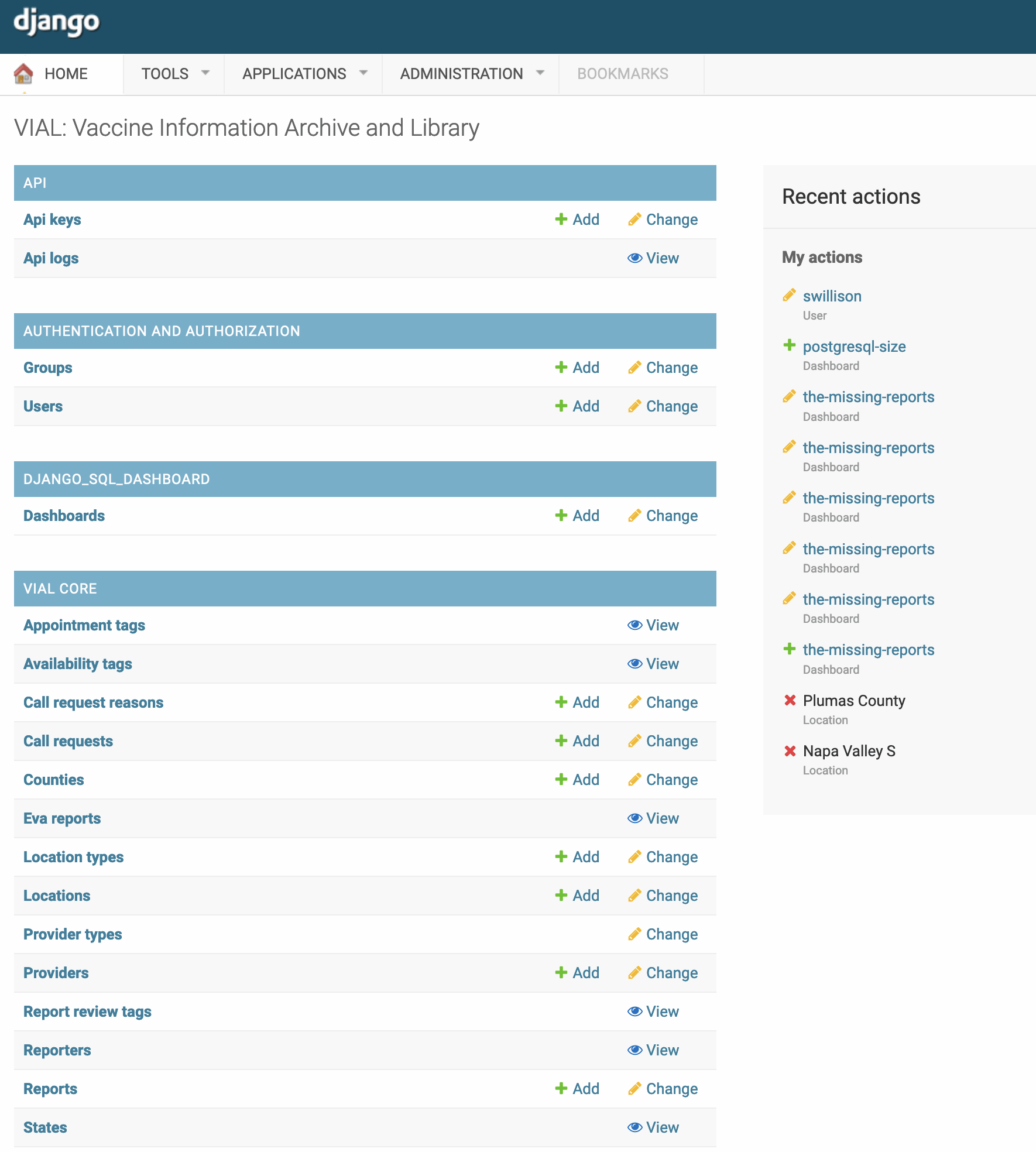
As I mentioned back in February, I’ve been working with the VaccinateCA project to try to bring the pandemic to an end a little earlier by helping gather as accurate a model as possible of where the Covid vaccine is available in California and how people can get it.
[... 2,157 words]2019
How to Create an Index in Django Without Downtime (via) Excellent advanced tutorial on Django migrations, which uses a desire to create indexes in PostgreSQL without locking the table (with CREATE INDEX CONCURRENTLY) to explain the SeparateDatabaseAndState and atomic features of Django’s migration framework.
2018
github/gh-ost: Thoughts on Foreign Keys? The biggest challenge I’ve seen with foreign key constraints at scale (at least with MySQL) is how they conflict with online schema migrations using tools like pt-online-schema-change or GitHub’s gh-ost. This is a good explanation of the issue by Shlomi Noach, one of the gh-ost maintainers.
2017
How Balanced does Database Migrations with Zero-Downtime. I’m fascinated by the idea of “pausing” traffic during a blocking site maintenance activity (like a database migration) and then un-pausing when the operation is complete—so end clients just see some of their requests taking a few seconds longer than expected. I first saw this trick described by Braintree. Balanced wrote about a neat way of doing this just using HAproxy, which lets you live reconfigure the maxconns to your backend down to zero (causing traffic to be queued up) and then bring the setting back up again a few seconds later to un-pause those requests.
2012
What tools and techniques are used for relational database version control (structure and data)?
The term you are looking for is database migrations (sometimes called database change scripts).
[... 308 words]2011
Is South the best tool to use when doing database migrations in Django?
Yes. And I say that as an author of another Django migrations tool (dmigrations) which offered a small subset of South’s current functionality.
[... 42 words]Why isn’t the schema and data migration tool South included in Django by default?
Because shipping things as part of Django means they can’t have separate releases, which means you only get a new released version every 6-12 months. South is improving far faster than that.
[... 113 words]2010
On Django And Migrations. South author Andrew Godwin on the plans for migrations in Django. His excellent South migration library will be split in to two parts—one handling database abstraction, dependency resolution and history tracking and the other providing autodetection and the South user interface. The former will go in to Django proper, encouraging other migration libraries to share the same core abstractions.
2009
South’s Design. Andrew Godwin explains why South resorts to parsing your models.py file in order to construct information about for creating automatic migrations.
Southerly Breezes. Andrew Godwin is slowly assimilating the best ideas from other Django migration systems in to South—the latest additions include ORM Freezing from Migratory and automatic change detection. Exciting stuff.
2008
Gearshift. Whoa, a full migrations library written in JavaScript for Gears (which uses SQLite for its data store).
dmigrations thread on Django Nashville. The Django Nashville Google Group is currently hosting the most interesting discussion of dmigrations.
Announcing dmigrations
The team at Global Radio (formerly GCap Media) is the largest group of Django developers I’ve personally worked with, consisting of 14 developers split into two scrum teams, all contributing to the same overall codebase.
[... 625 words]South. A brand new light-weight Django migrations tool from Andrew Godwin. On first glance, this is spookily similar to the system we’ve been putting together at GCap.
2007
Django Evolution. Really smart take on the problem of updating database tables to reflect changes to Django models. Code that automatically modifies your database tables can be pretty scary, but Evolution seems to hit the right balance.
DbMigration—a schema migration tool for Django. Nice and simple tool for adding schema migrations to a Django application.