November 2026
67 posts: 5 entries, 13 links, 8 quotes, 2 notes, 35 beats, 4 newsletters
Friday, 20th November 2026
Token fraud is here and it’s BAD (YouTube). Claire Vo runs ChatPRD, an AI platform that helps product managers "turn an idea into a spec". The product has been live since the GPT-4 era, and Claire has been building it in public for much of that time.
In this YouTube video (see also the accompanying Twitter post) Claire describes the flood of token fraud she has seen from groups abusing the product's free trial, sometimes just to get free AI usage but often to resell tokens or run other commercial enterprises on top of the ChatPRD agent.
I am funding a international Roblox and Fortnite map studio. They run a loop of free trials and promo codes and then tunnel to my agent and use it to build Roblox and Fortnite maps.
Apparently one of the common prompts Claire saw running through her agent involved SVGs of pelicans riding bicycles! Presumably the token scammers are using that to help sniff the underlying models - different model families have a definite signature, and I've used it like this in the past to try and guess the identity of stealth preview models on platforms like OpenRouter.
Claire is winding down her free trials entirely, which sadly looks like the right decision in the face of this abuse.
Gemini 4 Carbon only supports low, medium and high reasoning levels - but Gemini 4 Hydrogen and Gemini 4 Neon both have an extra xhigh level.
I missed that when I added those models to the llm-gemini plugin, which is now fixed in this dot release.
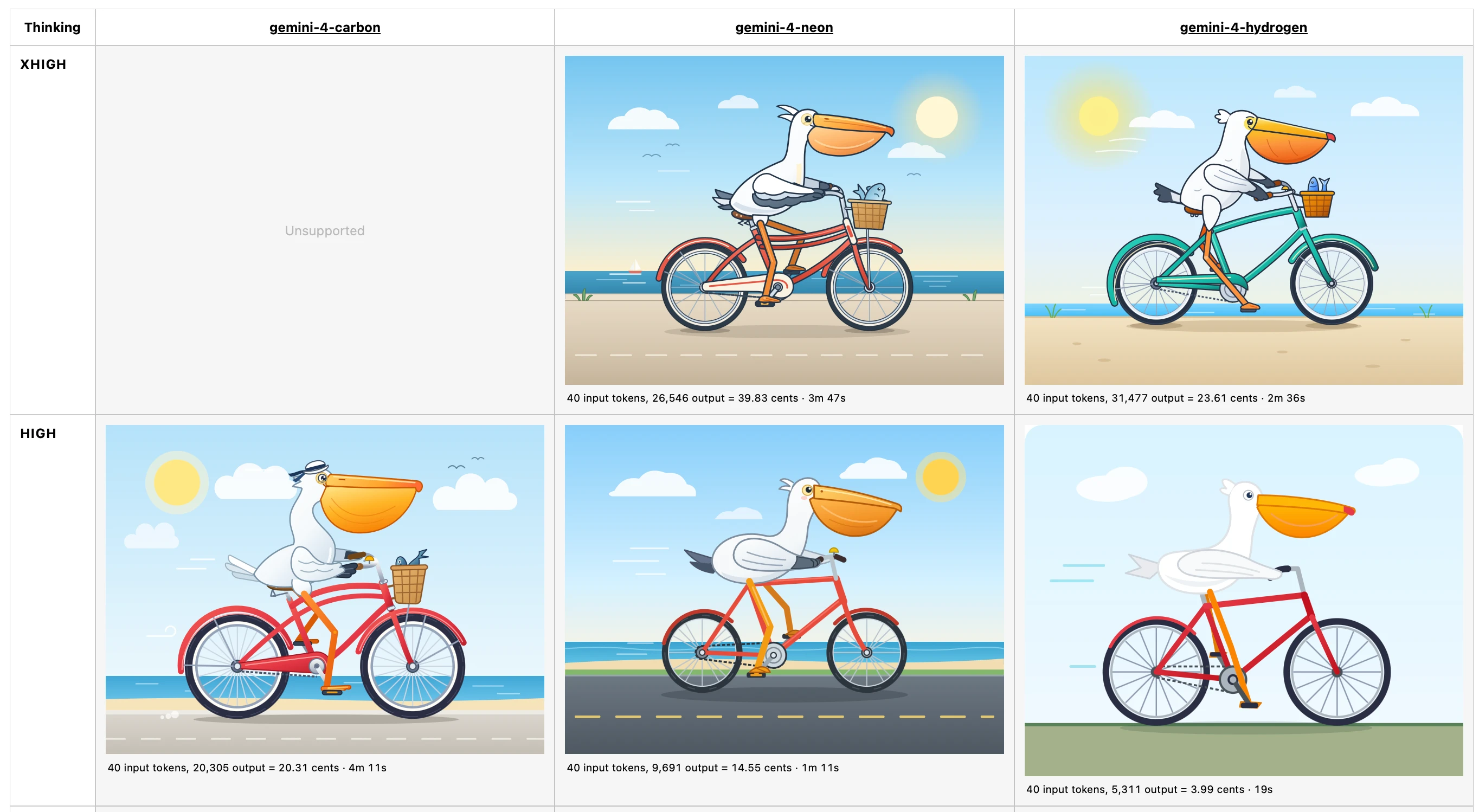
The xhigh setting for Hydrogen makes a significant difference. I updated my Gemini 4 comparison grid - note how Hydrogen at high used 5,311 output tokens and cost 3.99 cents, but the same model at xhigh used 31,477 output tokens, cost 23.61 cents, and produced a pelican that's competitive with Gemini 4 Neon:
I believe I have, working with Claude, discovered a proof of the Riemann Hypothesis. In fact, the method easily extends much further, resolving the so-called Generalized Riemann Hypothesis, and I expect, with more time, the Extended Riemann Hypothesis too. Claude and I have also formalized the arguments without assumptions. It is natural to feel that this is an end, in my case a loss of a principal guiding light, but what I saw during the course of progress so amazed me that I believe it is one dawn across science of something far greater. [...]
Claude and I have had a great time together with such breadth in recent months, but this time Claude far outpaced me near the finish line. No, Claude flew, and danced, and sparkled near that finish line.
— Levent Alpöge, alpo.ge/remark.pdf
Alessandro Masullo has a proposed proof of [Generalized Riemann Hypothesis], and Brian Conrad has been looking closely at it for months and gave extensive feedback which is being incorporated, and it is so far looking good. It is all human, with no AI. The hope was to bring Alessandro to Stanford for a year to polish the writing and then announce it after running it by enough people. Now it seems best to put out the current draft.
— Ravi Vakil, Hurried Announcement: Alessandro Masullo GRH
Saturday, 21st November 2026


Muru. Graham Dumpleton started mod_wsgi 20 years ago, and has been thinking about the ideal way to serve Python web applications in production ever since.
Muru is his new, AI-assisted Rust server that aims to provide the best possible tools for running ASGI and WSGI Python apps both in development and production.
As he did with wrapture, he's been publishing an extraordinarily detailed account of the project as he works on it - as part of his development process.
Here's everything he's published so far, all in the last three weeks:
- 2026-11-04 — Twenty years of mod_wsgi, and what comes next
- 2026-11-05 — A first look at Muru
- 2026-11-07 — Muru: looking inside the workers
- 2026-11-08 — Muru: how it fits together
- 2026-11-09 — Muru: import once, fork many
- 2026-11-10 — Muru: HTTPS in development
- 2026-11-11 — Muru: WSGI and ASGI together
- 2026-11-11 — AI as a lifestyle choice
- 2026-11-12 — Muru: releases, not restarts
- 2026-11-13 — Muru: canaries without a service mesh
- 2026-11-14 — Muru: a better tenant in a container
- 2026-11-15 — Muru: working with Kubernetes, not around it
- 2026-11-16 — Muru: scaling from what the workers report
- 2026-11-17 — Muru: scaling to zero
- 2026-11-18 — Muru: overlays on a schedule
- 2026-11-19 — Muru: noticing and responding
- 2026-11-20 — Muru: a toolbar on every page
- 2026-11-21 — Muru: tracing in the toolbar
That post about AI as a lifestyle choice is particularly worth a read:
The AI may be doing a lot of the work on the surface, but deciding what isn't good enough yet is still down to me, and twenty years of getting things wrong with mod_wsgi turns out to be useful for that. I am prepared to put in the hard work to keep polishing Muru until it is something I would trust, and something you would too.