Releases
Filters: Sorted by date
Some minor improvements, mainly around command option consistency and making the server: mechanism used by both shot-scraper video and shot-scraper multi work if the server takes longer than a second to start serving traffic.
server:processes used byshot-scraper multiandshot-scraper videonow wait up to 30 seconds for the target URL to accept connections, polling for port availability and replacing the previous fixed one-second delay. #197- The
shot-scraper,html,accessibilityandharcommands now have a--js-fileoption for loading JavaScript from a local file, standard input orgh:username/script, as an alternative to--javascriptwhich accepts the string of JavaScript directly as an argument. #192shot-scraper multisupports the equivalentjs_file:YAML key.- The
shot-scraper javascriptandshot-scraper htmlcommands now have a--timeoutoption for consistency with other commands. #118
Mainly a fix for an edge case that regular Claude chat spotted while experimenting with the 4.1 release to answer a question about ON DELETE.
table.transform()now raises aTransactionErrorif called while a transaction is open withPRAGMA foreign_keysenabled and the table is referenced by foreign keys with destructiveON DELETEactions -CASCADE,SET NULLorSET DEFAULT. The pragma cannot be changed inside a transaction, so previously dropping the old table as part of the transform could fire those actions and silently delete or modify referencing rows. See Foreign keys and transactions for details and workarounds. (#794)- The CLI and Python API documentation now cross-reference each other: CLI sections link to the equivalent Python API functionality and Python API sections link back to the corresponding CLI command. (#791)
The first dot-release since 4.0 a few days ago, introducing a number of minor new features.
sqlite-utils insertandsqlite-utils upsertnow accept a--codeoption for providing a block of Python code (or a path to a.pyfile) that defines arows()function orrowsiterable of rows to insert, as an alternative to importing from a file. (#684)
sqlite-utils already had features that allow you to pass blocks of Python code as CLI arguments, for example this one for the sqlite-utils convert command:
sqlite-utils convert content.db articles headline '
def convert(value):
    return value.upper()'
Allowing blocks of code to generate new rows directly was on obvious extension of that pattern:
sqlite-utils insert data.db creatures --code '
def rows():
    yield {"id": 1, "name": "Cleo"}
    yield {"id": 2, "name": "Suna"}
' --pk id
sqlite-utils insertandsqlite-utils upsertnow accept--type column-name typeto override the type automatically chosen when the table is created. This is useful for CSV or TSV columns such as ZIP codes that look like integers but should be stored asTEXTto preserve leading zeros. (#131)
A long-standing feature request which turned out to be a simple implementation.
- New
table.drop_index(name)method andsqlite-utils drop-indexcommand for dropping an index by name. Both acceptignore=True/--ignoreto ignore a missing index. (#626)sqlite-utils querycan now read the SQL query from standard input by passing-in place of the query, for exampleecho "select * from dogs" | sqlite-utils query dogs.db -. (#765)
Two more small features. I had Codex review all open issues and highlight the easiest ones!
sqlite-utils upsertcan now infer the primary key of an existing table, so--pkcan be omitted when upserting into a table that already has a primary key.
Another Codex suggestion, an obvious missing CLI feature from a Python library improvement that shipped in the 4.0 release.
table.transform()andtable.transform_sql()now acceptstrict=Trueorstrict=Falseto change a table’s SQLite strict mode. Omitting the option preserves the existing mode. (#787)- The
sqlite-utils transformcommand now accepts--strictand--no-strictto change a table’s strict mode. (#787)
These two were inspired by Prefer STRICT tables in SQLite by Evan Hahn, which did the rounds on Hacker News today. Evan pointed out that:
Unfortunately, I don’t think there’s a way to ALTER a table to make it strict. I think you have to copy the data out of the non-strict table into the strict one.
That's exactly what the sqlite-utils transform mechanism does, so I extended it to add the ability to switch tables from strict to non-strict and vice-versa.
Here's the GPT-5.6 Sol xhigh Codex transcript I used to implement those new strict table features. One of the most useful prompts I ran was this one:
use uv run python -c and manually exercise the new .transform(strict=) option, see if you can find any edge-cases or bugs
Effectively telling the model to manually test its work, outside of the automated tests it had already written. This turned up two minor issues that we then fixed.
Let's LLM run prompts against the new muse-spark-1.1 model.
- Fix for a bug with OpenAI Chat Completion endpoints where a tool call with empty arguments could result in a JSON error from some providers. #1521
This bug came up when I was testing llm-meta-ai.
The version that retires the library, instead implementing a compatibility shim against the new sqlite-utils 4.0 dependency.
See sqlite-utils 4.0, now with database schema migrations for details.
The last RC before the 4.0 stable release. Mainly implements feedback from a detailed review by Claude Fable 5.
I hoped to release sqlite-utils 4.0 stable this weekend, but as I worked through the backlog of issues and PRs with a combination of Claude Fable 5 and GPT-5.5 the changelog since rc2 kept getting bigger.
The biggest new feature is support for introspecting and creating compound foreign keys - a feature that involves a subtle breaking change to table.foreign_keys and hence needed to land for the 4.0 stable release.
sqlite-utils also now follows SQLite's convention for case insensitive column names, which turned out to touch a bunch of different places at once.
Another Fable 5 experiment. Now that my LLM library has evolved into more of an agent framework it's time to see what a simple coding agent would look like built on it.
I started a new Python library using my python-lib-template-repository GitHub template repository, then ran these two prompts (here's the Claude Code for web transcript):
Write a spec.md for this project - it will depend on the latest “llm” alpha from PyPI and implement a Claude code style coding agent complete with tools for reading and editing files and executing commands
Then:
Commit the spec, then build it using red/green TDD in a series of sensible commits (each with passing tests and updated docs) - occasionally manually test it using the OpenAI API key in your environment
Here's the spec, the resulting README file, and the sequence of commits.
I've shipped a slop-alpha to PyPI, so you can run the new agent like this:
uvx --prerelease=allow --with llm-coding-agent llm code
It's pretty good for a first attempt! Here's the (Fable-authored) README, which lists recipes like llm code --yolo and llm code --allow "pytest*" --allow "git diff*".
It also presents a Python API based around a CodingAgent(model="gpt-5.5", root="/path", approve=True).run("Fix the failing test in tests/test_parser.py") class which I didn't ask for but I'm delighted to see implemented.
Here's the suite of tools it implemented, listed using uvx ... llm tools:
CodingTools_edit_file(path: str, old_string: str, new_string: str, replace_all: bool = False) -> strReplace an exact string in a file.
old_string must match the file contents exactly (including whitespace) and must identify a unique location unless replace_all is true. Returns a diff of the change so it can be verified.
CodingTools_execute_command(command: str, timeout: int = 120) -> strRun a shell command in the session root directory.
Returns combined stdout and stderr followed by an Exit code line. timeout is in seconds (maximum 600); on timeout the whole process tree is killed.
CodingTools_list_files(pattern: str = '**/*', path: str = '.') -> strList files matching a glob pattern, newest first.
Skips hidden directories, node_modules, __pycache__ and (in a git repository) anything covered by .gitignore. Returns at most 200 paths relative to the searched directory.
CodingTools_read_file(path: str, offset: int = 0, limit: int = 2000) -> strRead a text file, returning numbered lines like cat -n.
Paths are relative to the session root. Use offset (0-based first line) and limit (max lines) to page through files too large to read in one call.
CodingTools_search_files(pattern: str, path: str = '.', glob: str = None, max_results: int = 100) -> strSearch file contents for a regular expression.
Returns matches as path:line_number:line, capped at max_results. Use glob (e.g. "*.py") to restrict which files are searched.
CodingTools_write_file(path: str, content: str) -> strCreate or overwrite a file with the given content.
Parent directories are created as needed. Prefer edit_file for modifying existing files.
I tried it out by running llm code --yolo and then prompting:
mkdir /tmp/demo and then in that folder create a simple swiftui CLI app for telling the time in ascii art
Here's the transcript, in which GPT-5.5 reasoning notes that "SwiftUI isn't suitable for a true CLI" and then builds an app that outputs this on swift run AsciiTime:
      █    █████         ████     █             █     ███
     ██    █        █        █   ██      █     ██    █   █
      █    ████           ███     █             █       █
      █        █    █        █    █      █      █      █
     ███   ████          ████    ███           ███   █████
The big new feature is shot-scraper video storyboard.yml, described in detail in Have your agent record video demos of its work with shot-scraper video.
An embarrassingly tiny release. The pyproject.toml had pinned to datasette==1.0a27, inadvertently making this plugin incompatible with all other Datasette versions. It's now datasette>=1.0a27 instead.
I'll write more about this one soon, but it's a big release. Three highlights from the release notes:
- New "Create table" interface in the database actions menu, backed by the
/<database>/-/createJSON API. It can define columns, primary keys, custom column types,NOT NULLconstraints, literal defaults, expression defaults and single-column foreign keys. (#2787)- New "Alter table" table action and
/<database>/<table>/-/alterJSON API for changing existing tables: add, rename, reorder and drop columns; change column types, defaults,NOT NULLconstraints, primary keys and foreign keys; and rename the table. The alter table dialog also includes a "Drop table" button. (#2788)- New Template context documentation listing the variables available to custom templates for Datasette's core pages. Variables documented there are treated as a stable API for custom templates until Datasette 2.0. The documentation is generated from dataclass definitions next to the view code, with tests that compare the documented fields against the actual contexts rendered by the database, table, query and row pages. (#1510, #2127, #1477, #2803)
Here's a rough video demo I made of the new create/alter table feature as part of reviewing the PR:
This release expands
datasette-aclfrom table-only permissions toward a general resource-sharing system.
Alex Garcia did most of the work for this release - we're fleshing out the plugin that will allow multi-user Datasette instances finely grained control over who can access which resources within Datasette.
Quoting the release notes:
The big feature in this alpha is tools to insert, edit and delete rows within the Datasette interface. These features are available on table pages, and edit and delete are also available as action items on the row page.
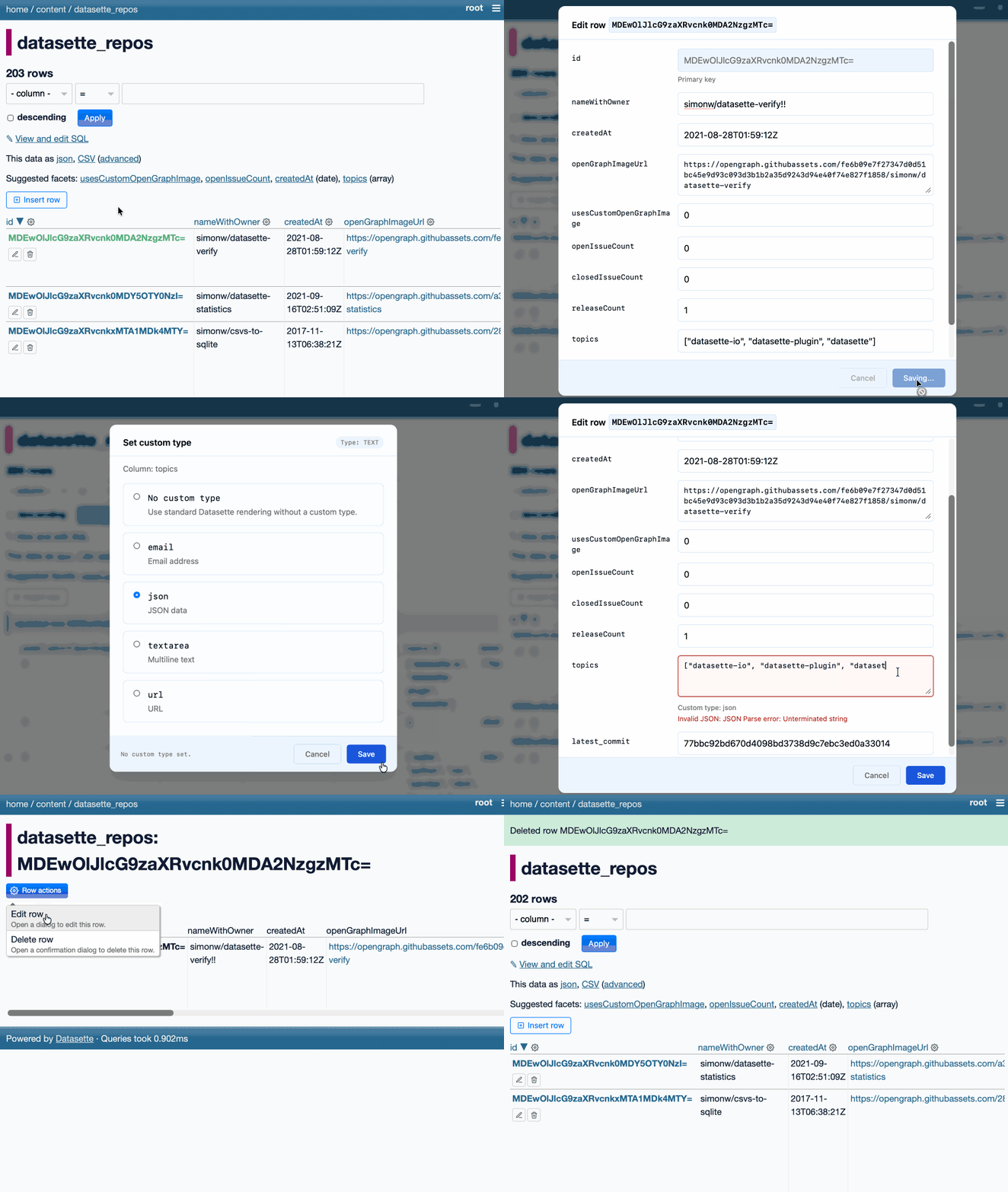
The inspiration for this feature - which is long overdue - was Datasette Agent. I added SQL write support to that the other day which highlighted how absurd it was that you could insert and edit ties via the chat interface but not in the regular Datasette UI!
A very experimental alpha plugin which lets you do this:
datasette tailscale mydata.db \
  --ts-authkey tskey-auth-xxxx --ts-hostname datasette-preview
This starts a localhost Datasette server with a Tailscale sidecar that connects it to your Tailnet, such that http://datasette-preview/ serves Datasette.
It's using the Python bindings for the experimental tailscale-rs library. I filed an issue asking if there's a cleaner way of setting up the proxy mechanism.
- Fixed a bug where users without the
create-apppermission could still create apps. #27- Fixed a bug where it was impossible to grant permission to edit an app to users who were not the app's owner. The rules for edit/delete are now the same as view: if the app is private only the owner can modify it, otherwise permission is controlled by Datasette's regular permission system. #29
- Custom network/CSP origins for apps are now guarded by a new
apps-set-csppermission, with an optionalallowed_csp_originsplugin allow-list for non-privileged users. The Datasette Agent app creation tool enforces the same rules. #24- Stored query picker now supports keyboard navigation and shows the three most recent accessible stored queries when focused.
#fragmentlinks inside apps are no longer intercepted by the external-link confirmation modal. #23- Fixed link confirmation modal and logging panels in
?full=1full-screen mode. #26
- New tool,
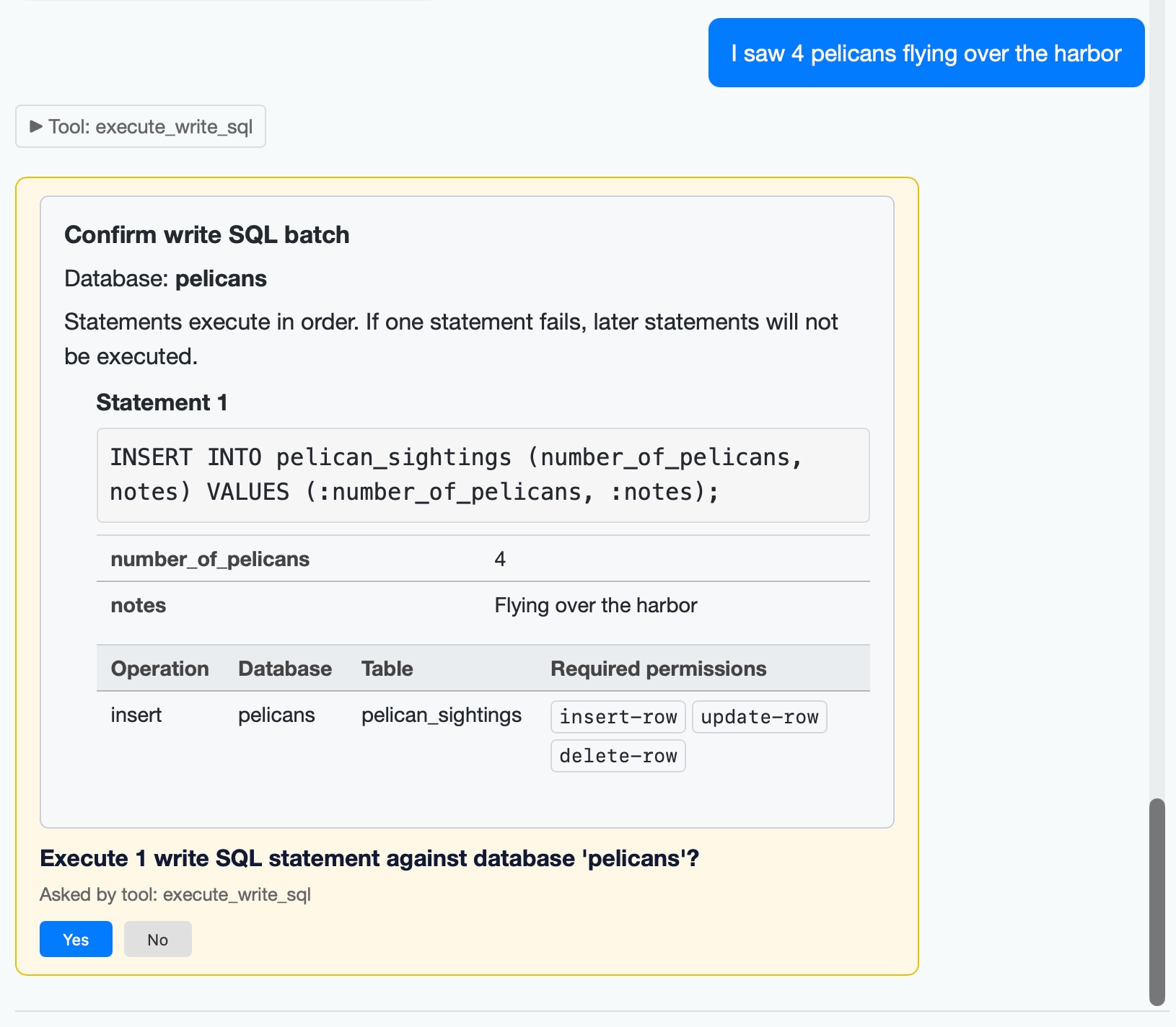
execute_write_sql, which requests user approval and then writes to a database - taking user permissions into account. #27
I added a mechanism for asking user approval in datasette agent 0.2a0. The new execute_write_sql tool can now prompt the user for all kinds of useful operations. Here's an example where I add some pelican sightings to my pelican_sightings table:
The new version also enhances the datasette agent chat terminal mode to support approvals, and adds several new options including --unsafe mode for auto-approving them:
datasette agent chatcan execute tools that require user approval. #30- Three new options for
datasette agent chat---rootto run as root,--yesto approve all ask user questions, and--unsafefor both.- Tools can now provide plain text alternatives to HTML, for display in the
datasette agent chatCLI. #31
The datasette agent chat content.db -m gpt-5.5 --unsafe command can now be used to chat directly with a specific database and directly modify it through prompts like "create a notes table", "add a note about X" etc.
See Publishing WASM wheels to PyPI for use with Pyodide for details.
This alpha is a significant step on the road to a stable 1.0, finally extending the ?_extra= pattern I introduced in Datasette 1.0a3 to cover queries and rows in addition to tables. That pattern is also now documented!
I wrote a whole lot more about the new release on the Datasette project blog: Datasette 1.0a33 with JSON extras in the API.
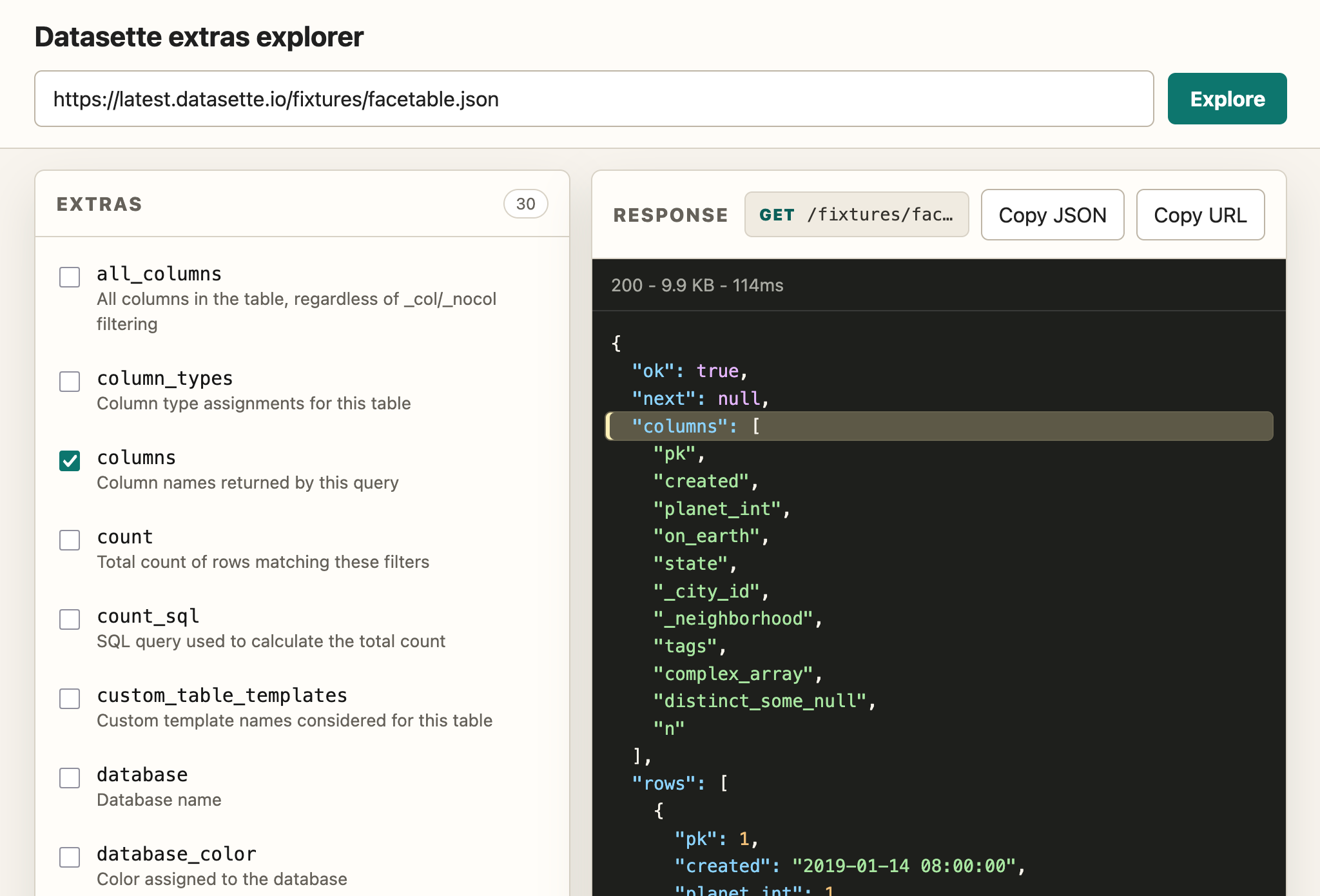
Because API explorer tools are almost free to build now I had Claude Fable 5 in Claude Code (for the plan) and GPT-5.5 xhigh in Codex Desktop (for the implementation) build me this custom extras API explorer to help demonstrate the feature:
I built this utility library to support an asyncio dependency injection pattern a few years ago. I was using it with Datasette and Claude Fable 5 spotted some bugs in the dependency which it then fixed for me. It's a very proactive model!
Highlights from the release notes:
- Tools can now ask the user questions mid-execution. Tools that declare a
contextparameter receive aToolContextobject, andawait context.ask_user(...)can ask a yes/no, multiple-choice (options=[...]) or free-text (free_text=True) question. While a question is unanswered the agent turn suspends: the question renders as a form in the chat UI and persists to the internal database, so suspended conversations survive a server restart. Once answered, the tool re-executes from the top with stored answers replayed, so callask_user()before performing side effects. #20- New built-in
save_querytool: the agent can save SQL it has written as a Datasette stored query. Saving always requires human approval - the agent shows the full SQL plus the proposed name, database and visibility, and nothing is stored until you click Yes. #20
The ask_user() feature was enabled by the new LLM alpha I built yesterday with the help of Claude Fable 5.
Almost entirely written by the new Claude Fable 5, see my write-up for more details.
- Switch to using
MessageChannel()to communicate between parent and child frames. #15- Now registers tools to Datasette Agent can create and modify apps. #16
- SQL queries and
console.log()executed by an app are now shown in a collapsible logging panel. #20- Full screen mode for apps. #21
- Performance optimizations for the create/edit pages. #22
I'm planning several plugins for Datasette Agent which can make edits to existing pieces of text - things like collaborative Markdown editing, updating large SQL queries, and editing SVG files.
Agentic editing of text is a little tricky to get right. My favorite published design for this is for the Claude text editor, which implements the following tools:
view- view sections of a file, with line numbers added to every line.str_replace- find an exactold_strand replace it withnew_str- fail if the original string is not uniqueinsert- insert the specified text after the specified line number
Rather than recreate these patterns for every plugin that needs them I decided to create this base plugin, datasette-agent-edit, which implements the core tools in a way that allows them to be adapted for other plugins.
I added a CLI to micropython-wasm (issue #7), inspired by the first draft of the blog entry when I realized it would be a great way to illustrate the Try it yourself section.