10 posts tagged “gpt-6-astra”
2026
Claude Opus 5.5, GPT-6 Sol, GPT-6 Luna, and a new price war
Yesterday was Grok 4.7 (pelicans) and MiMo v2.6 Flash/Pro (more pelicans). Today Anthropic released Claude Opus 5.5, and around an hour later OpenAI released GPT-6 Sol and GPT-6 Luna. It’s going to take a while to get a good read on all of these new models, but here are my impressions so far.
[... 1,153 words]Generating running routes with GPT-6 Astra and ChatGPT Work
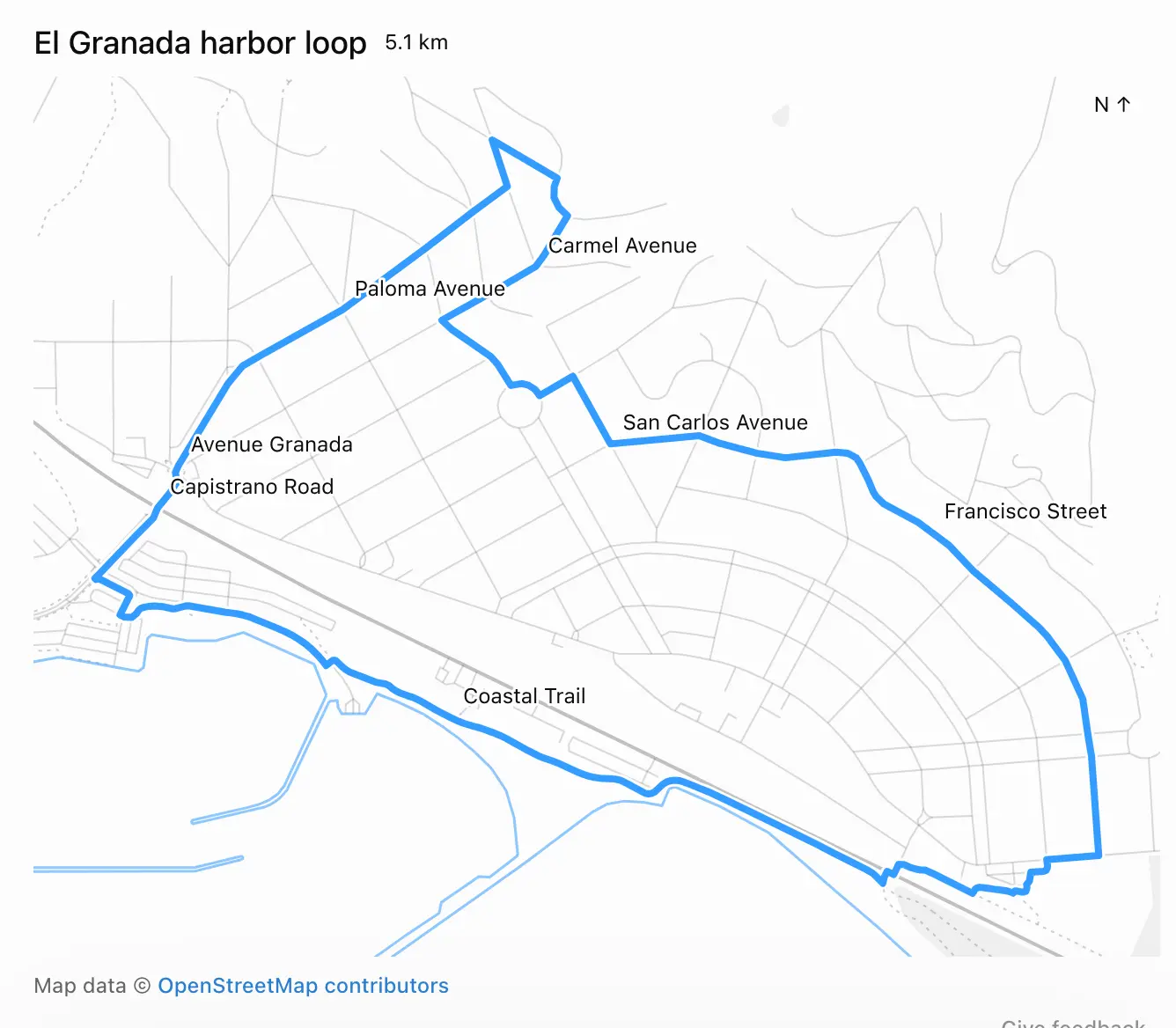
Here’s a neat thing I had ChatGPT Work with GPT-6 Astra (Max) do this morning:
[... 632 words]I'm continuing to have a lot of fun with GPT-6 Astra and Blender (see my TIL).
As a big fan of the Imperial Fabergé Easter eggs, I've always thought it would be fun to make some new ones that celebrate popular culture.
Yesterday I decided to try out the new ChatGPT Images 2.5 by running this prompt:
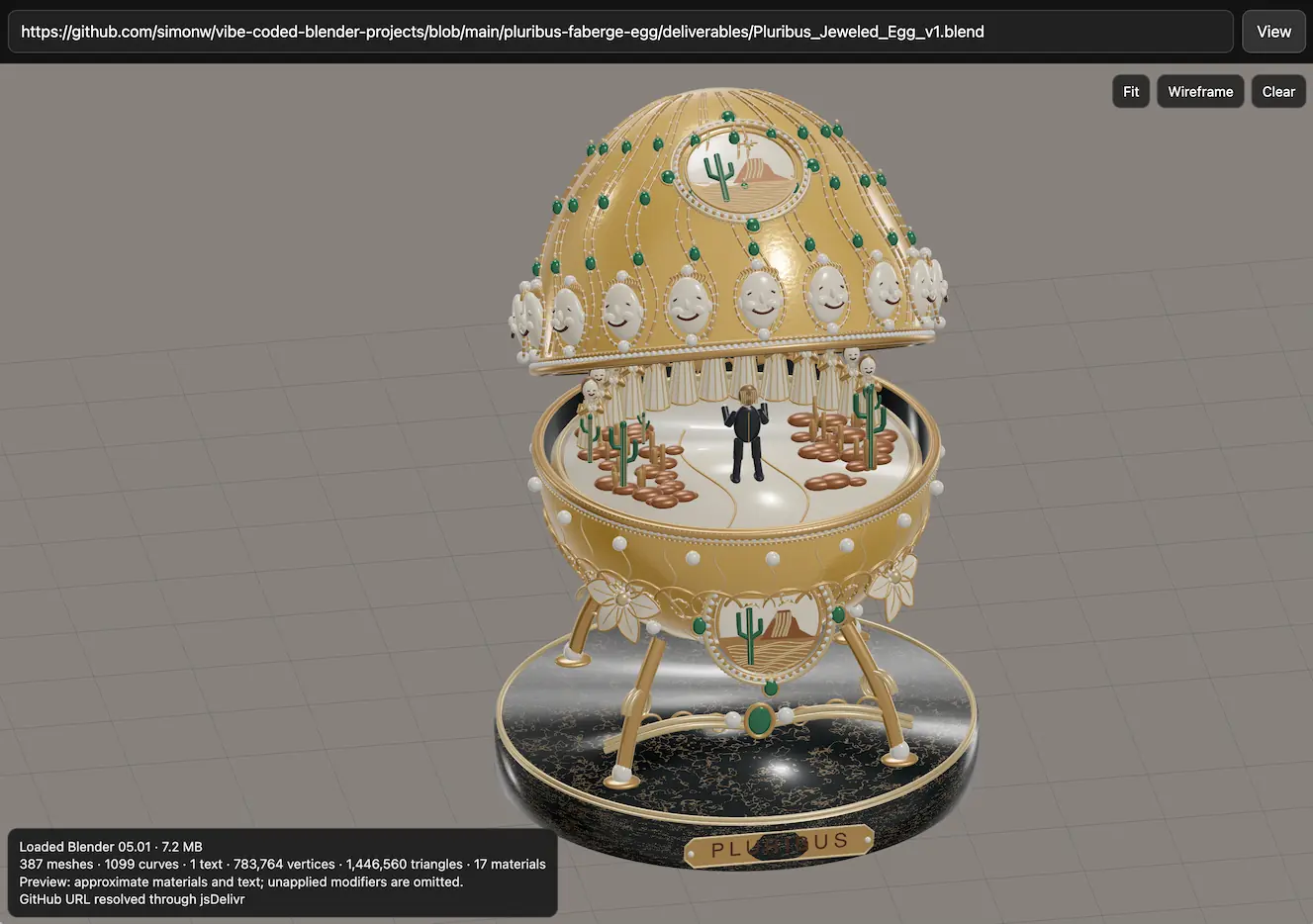
Generate a photo of a faberge egg that's themed after the TV show Pluribus - research first
It gave me this - honestly not bad for a first attempt!

Then, just to see what would happen, I pasted that image into Codex running GPT-6 Astra (high) and prompted:
Use your blender local skill to create a blender model of this faverge egg
(Here's the skill file, which I created like this.)
It churned away for 17m51s and built me several .blend files. I already had this vibe-coded Blender viewing experiment lying around, so I added that to my tools collection and now you can use it to see my Pluribus blender model in your browser:
- New OpenAI model:
gpt-6-astrafor GPT-6 Astra.
I got curious about the Equal Earth map projection that was recently voted on at the UN so I had GPT-6 Astra (medium) in ChatGPT Work build me this animated transition between Mercator and Equal Earth using D3.
Introducing GPT-6 Astra for developers (via) Blink and you'll miss it, but there's a familiar creature at 1m59s:
Across the board, Astra has more attention to detail, better understanding of the user's prompt, and can build more sophisticated outputs. In particular, it excels at building 3D models. I've seen it make incredible renderings of gardens, shipyards, animals, cityscapes, even Dyson spheres.

Astra really does believe in putting a red neckerchief on a pelican riding a bicycle.
I've been having fun with Blender in ChatGPT Codex on my Mac recently. Getting it to work with coding agents is really easy: install the full Mac application from blender.org and run a prompt like this:
Use the already install /Applications/Blender to render a scene of a pelican riding a bicycle
In this case I followed that up with these two prompts:
OK add a background and a lot of flair
Then:
OK make it a whole lot better
And got this image, generated using Blender's Python API:

This was covered by my existing Codex subscription, but according to AgentsView it would have cost $4.24 at API prices for gpt-6-astra.
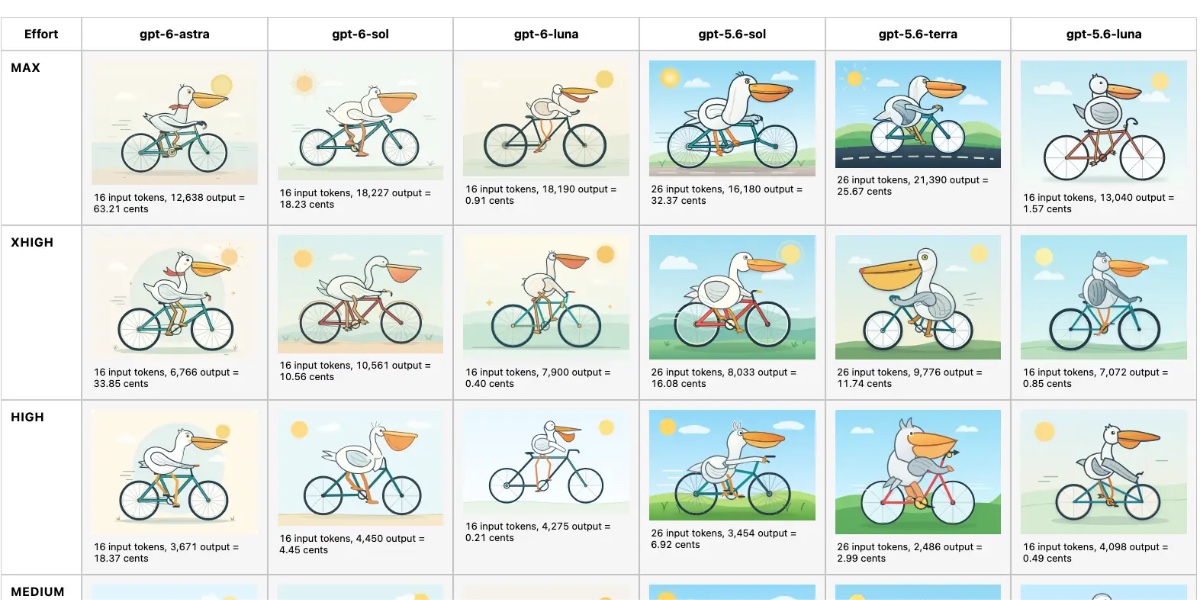
The Pelican comparison grid for Astra is pretty interesting
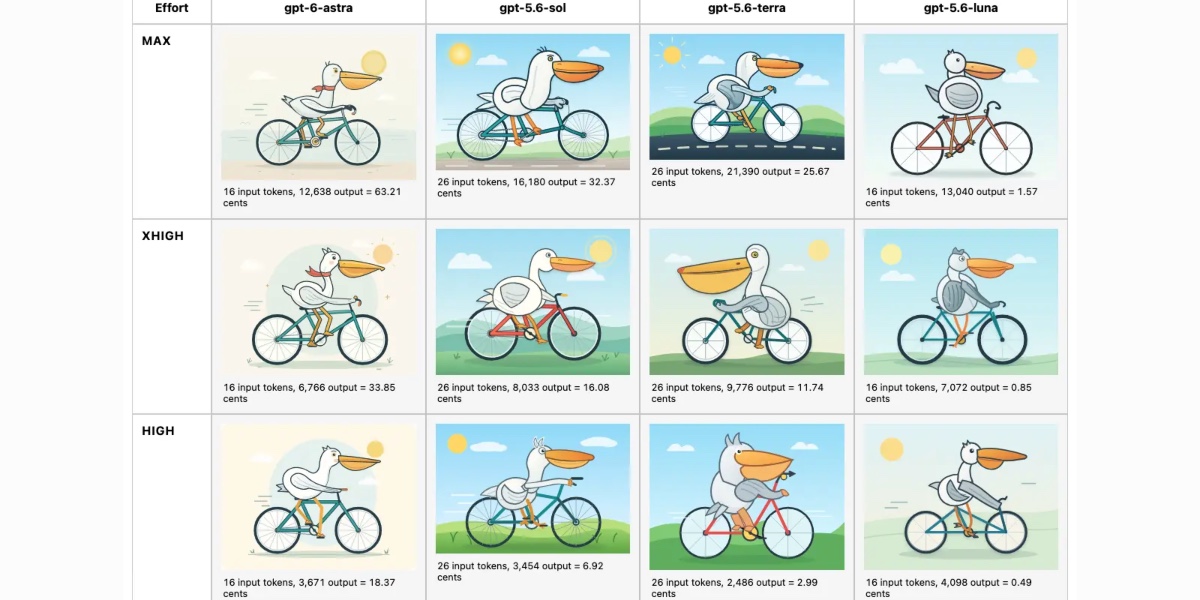
I got access to GPT-6 Astra this afternoon, so naturally I used it to generate SVGs of pelicans riding bicycles—at low, medium, high, xhigh and max reasoning levels (Astra doesn’t support reasoning=none). Then I rendered those pelicans in a comparison grid with GPT-5.6 Sol, Terra, and Luna, and beyond being fun the result was surprisingly useful.
[... 297 words]GPT‑6 Astra (via) GPT-6 Astra is "rolling out today to a limited set of organizations and over the coming days will become available to all ChatGPT Plus, Pro, Business, and Enterprise users, as well as through the OpenAI API and AWS" - I've not tried it yet myself, so I don't have a great deal to say about it yet.
It's going to be API priced at the same rate as Claude Fable 5 and 5.1: $10/million input and $50/million output. This is clearly OpenAI's Fable competitor, and appears to score higher than Fable on most of OpenAI's self-reported benchmarks.
Most impressively, Astra scores 99.9% on the recent (released in March) ARC-AGI 3 benchmark - though notably Fable 5 does not yet have a published result, and the ARC-AGI blog notes that the 99.9% score was achieved for $19K using OpenAI's custom "Provider Adapter harness", while the default ARC-AGI harness scored 62.7% for $26K.
The Provider Adapter harness preserves opaque reasoning state between requests and uses compaction for longer conversations, allowing the model to reuse prior work.
Unsurprisingly, given the recent Hugging Face incident, Astra is a beast at security tasks. It scores 100% on ExploitBench (GPT-5.6 Sol got 78.5%), 42.4% on ExploitGym (Sol got 30.3%), and 99.2% within four attempts on SRE-Bench binary reverse engineering compared to Sol's 68.7%.
It's also better at long context: on OpenAI's eight-needle benchmark it got 100% at 256K–512K tokens and 96.3% at 512K–1M tokens. OpenAI may have vanquished one of the ongoing challenges with long context processing.
It doesn't win at everything though. Artificial Analysis note that Astra is still beaten by Fable on their Intelligence Index:
Sits beside GPT-5.6 Sol in Intelligence: GPT-6 Astra scores equal to GPT-5.6 Sol in the Index at 61. This is 5 points lower than Claude Fable 5.1 (max with fallback). The model also trails Meta’s newly released Muse Spark 1.3 (max).
It did better on their Coding Agent Index:
Leads Coding Agent Index cost efficiency frontier: At max effort, GPT-6 Astra costs about the same as GPT-5.6 Sol (max) while scoring 2 points higher on the Index. Per task, the model is less than half the cost of Claude Fable 5, for the same score.
I'll write more about Astra once I get access to it. The API model label once it rolls out will be gpt-6-astra.
Ten advances in mathematics and theoretical computer science (via) A few days ago it was Anthropic discovering cryptographic weaknesses with Claude using Mythos Preview, spending $100,000 on tokens and with prompts that included "again we are not looking for low hanging fruit, we want proper research to find genuinly hard findings."
Now it's OpenAI's turn to flex. They set "an internal version of Astra, our next major model" on finding solutions to ten mathematical problems that "have seen no progress on the main result for at least a decade". They claim to have spent less than $2,000 at GPT-5.6 Sol token prices on each one.
(No news on how many problems they spent $2,000 on without reaching a solution though.)
The openai/ten-proofs repository has Lean 4 formalizations of their results, and there's also a paper describing the solutions and an additional LLM-generated PDF where the model "reconstructs how the proof came together" based on the unpublished reasoning traces.
That's a decent level of transparency, but I want to see the prompts they used!
A lot of mathematicians online are experiencing a collective burst of Deep Blue. Mathematician Kirwin Hampshire published an impassioned essay last week, The Dark Night of Mathematics, describing "a profound spiritual crisis" brought on by previous (and less significant) results.
OpenAI's results reminds me of what Terence Tao described as "big mathematics" in IEEE Spectrum in June:
Unlike some of his peers, Tao is neither dismissive of AI nor fearful. Instead, he sees it as the catalyst for a fundamental shift in the discipline—a transition toward what he calls “big mathematics.” He envisions a future of large-scale, decentralized collaborations between humans and machines, where complex mathematical tasks can be diced and sliced, with humans claiming the creative parts and AI doing the lion’s share of the technical grunt work.