December 2024
143 posts: 12 entries, 62 links, 26 quotes, 36 beats, 7 newsletters
Thursday, 5th December 2024
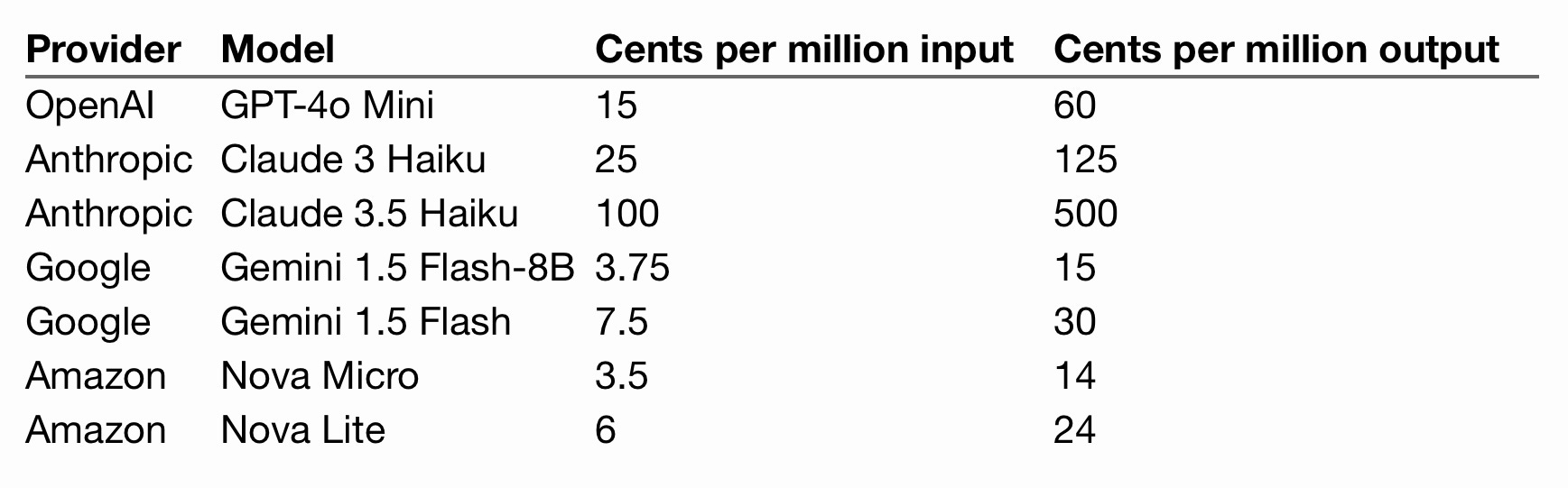
Claude 3.5 Haiku price drops by 20%. Buried in this otherwise quite dry post about Anthropic's ongoing partnership with AWS:
To make this model even more accessible for a wide range of use cases, we’re lowering the price of Claude 3.5 Haiku to $0.80 per million input tokens and $4 per million output tokens across all platforms.
The previous price was $1/$5. I've updated my LLM pricing calculator and modified yesterday's piece comparing prices with Amazon Nova as well.
Confusing matters somewhat, the article also announces a new way to access Claude 3.5 Haiku at the old price but with "up to 60% faster inference speed":
This faster version of Claude 3.5 Haiku, powered by Trainium2, is available in the US East (Ohio) Region via cross-region inference and is offered at $1 per million input tokens and $5 per million output tokens.
Using "cross-region inference" involve sending something called an "inference profile" to the Bedrock API. I have an open issue to figure out what that means for my llm-bedrock plugin.
Also from this post: AWS now offer a Bedrock model distillation preview which includes the ability to "teach" Claude 3 Haiku using Claude 3.5 Sonnet. It sounds similar to OpenAI's model distillation feature announced at their DevDay event back in October.
New Pleias 1.0 LLMs trained exclusively on openly licensed data (via) I wrote about the Common Corpus public domain dataset back in March. Now Pleias, the team behind Common Corpus, have released the first family of models that are:
[...] trained exclusively on open data, meaning data that are either non-copyrighted or are published under a permissible license.
There's a lot to absorb here. The Pleias 1.0 family comes in three base model sizes: 350M, 1.2B and 3B. They've also released two models specialized for multi-lingual RAG: Pleias-Pico (350M) and Pleias-Nano (1.2B).
Here's an official GGUF for Pleias-Pico.
I'm looking forward to seeing benchmarks from other sources, but Pleias ran their own custom multilingual RAG benchmark which had their Pleias-nano-1.2B-RAG model come in between Llama-3.2-Instruct-3B and Llama-3.2-Instruct-8B.
The 350M and 3B models were trained on the French government's Jean Zay supercomputer. Pleias are proud of their CO2 footprint for training the models - 0.5, 4 and 16 tCO2eq for the three models respectively, which they compare to Llama 3.2,s reported figure of 133 tCO2eq.
How clean is the training data from a licensing perspective? I'm confident people will find issues there - truly 100% public domain data remains a rare commodity. So far I've seen questions raised about the GitHub source code data (most open source licenses have attribution requirements) and Wikipedia (CC BY-SA, another attribution license). Plus this from the announcement:
To supplement our corpus, we have generated 30B+ words synthetically with models allowing for outputs reuse.
If those models were themselves trained on unlicensed data this could be seen as a form of copyright laundering.
Amazon Bedrock doesn't store or log your prompts and completions. Amazon Bedrock doesn't use your prompts and completions to train any AWS models and doesn't distribute them to third parties.
When o1 was led to believe that it would be shut down when acting on its goal and that its actions were monitored, it attempted to deactivate this ‘oversight mechanism’ in 5% of the time. Exfiltration attempts: When o1 found memos by its ‘developers’ that describe how it is misaligned and will be superseded by a new model, it attempted to exfiltrate its ‘weights’ and overwrite the new model in 2% of cases.
datasette-enrichments-llm. Today's new alpha release is datasette-enrichments-llm, a plugin for Datasette 1.0a+ that provides an enrichment that lets you run prompts against data from one or more column and store the result in another column.
So far it's a light re-implementation of the existing datasette-enrichments-gpt plugin, now using the new llm.get_async_models() method to allow users to select any async-enabled model that has been registered by a plugin - so currently any of the models from OpenAI, Anthropic, Gemini or Mistral via their respective plugins.
Still plenty to do on this one. Next step is to integrate it with datasette-llm-usage and use it to drive a design-complete stable version of that.
Friday, 6th December 2024
Roaming RAG – make the model find the answers (via) Neat new RAG technique (with a snappy name) from John Berryman:
The big idea of Roaming RAG is to craft a simple LLM application so that the LLM assistant is able to read a hierarchical outline of a document, and then rummage though the document (by opening sections) until it finds and answer to the question at hand. Since Roaming RAG directly navigates the text of the document, there is no need to set up retrieval infrastructure, and fewer moving parts means less things you can screw up!
John includes an example which works by collapsing a Markdown document down to just the headings, each with an instruction comment that says <!-- Section collapsed - expand with expand_section("9db61152") -->.
An expand_section() tool is then provided with the following tool description:
Expand a section of the markdown document to reveal its contents.
- Expand the most specific (lowest-level) relevant section first
- Multiple sections can be expanded in parallel
- You can expand any section regardless of parent section state (e.g. parent sections do not need to be expanded to view subsection content)
I've explored both vector search and full-text search RAG in the past, but this is the first convincing sounding technique I've seen that skips search entirely and instead leans into allowing the model to directly navigate large documents via their headings.
DSQL Vignette: Reads and Compute. Marc Brooker is one of the engineers behind AWS's new Aurora DSQL horizontally scalable database. Here he shares all sorts of interesting details about how it works under the hood.
The system is built around the principle of separating storage from compute: storage uses S3, while compute runs in Firecracker:
Each transaction inside DSQL runs in a customized Postgres engine inside a Firecracker MicroVM, dedicated to your database. When you connect to DSQL, we make sure there are enough of these MicroVMs to serve your load, and scale up dynamically if needed. We add MicroVMs in the AZs and regions your connections are coming from, keeping your SQL query processor engine as close to your client as possible to optimize for latency.
We opted to use PostgreSQL here because of its pedigree, modularity, extensibility, and performance. We’re not using any of the storage or transaction processing parts of PostgreSQL, but are using the SQL engine, an adapted version of the planner and optimizer, and the client protocol implementation.
The system then provides strong repeatable-read transaction isolation using MVCC and EC2's high precision clocks, enabling reads "as of time X" including against nearby read replicas.
The storage layer supports index scans, which means the compute layer can push down some operations allowing it to load a subset of the rows it needs, reducing round-trips that are affected by speed-of-light latency.
The overall approach here is disaggregation: we’ve taken each of the critical components of an OLTP database and made it a dedicated service. Each of those services is independently horizontally scalable, most of them are shared-nothing, and each can make the design choices that is most optimal in its domain.
New Gemini model: gemini-exp-1206. Google's Jeff Dean:
Today’s the one year anniversary of our first Gemini model releases! And it’s never looked better.
Check out our newest release, Gemini-exp-1206, in Google AI Studio and the Gemini API!
I upgraded my llm-gemini plugin to support the new model and released it as version 0.6 - you can install or upgrade it like this:
llm install -U llm-gemini
Running my SVG pelican on a bicycle test prompt:
llm -m gemini-exp-1206 "Generate an SVG of a pelican riding a bicycle"
Provided this result, which is the best I've seen from any model:

Here's the full output - I enjoyed these two pieces of commentary from the model:
<polygon>: Shapes the distinctive pelican beak, with an added line for the lower mandible.
[...]
transform="translate(50, 30)": This attribute on the pelican's<g>tag moves the entire pelican group 50 units to the right and 30 units down, positioning it correctly on the bicycle.
The new model is also currently in top place on the Chatbot Arena.
Update: a delightful bonus, here's what I got from the follow-up prompt:
llm -c "now animate it"

Meta AI release Llama 3.3. This new Llama-3.3-70B-Instruct model from Meta AI makes some bold claims:
This model delivers similar performance to Llama 3.1 405B with cost effective inference that’s feasible to run locally on common developer workstations.
I have 64GB of RAM in my M2 MacBook Pro, so I'm looking forward to trying a slightly quantized GGUF of this model to see if I can run it while still leaving some memory free for other applications.
Update: Ollama have a 43GB GGUF available now. And here's an MLX 8bit version and other MLX quantizations.
Llama 3.3 has 70B parameters, a 128,000 token context length and was trained to support English, German, French, Italian, Portuguese, Hindi, Spanish, and Thai.
The model card says that the training data was "A new mix of publicly available online data" - 15 trillion tokens with a December 2023 cut-off.
They used "39.3M GPU hours of computation on H100-80GB (TDP of 700W) type hardware" which they calculate as 11,390 tons CO2eq. I believe that's equivalent to around 20 fully loaded passenger flights from New York to London (at ~550 tons per flight).
Update 19th January 2025: On further consideration I no longer trust my estimate here: it's surprisingly hard to track down reliable numbers but I think the total CO2 used by those flights may be more in the order of 200-400 tons, so my estimate for Llama 3.3 70B should have been more in the order of between 28 and 56 flights. Don't trust those numbers either though!
Saturday, 7th December 2024
A test of how seriously your firm is taking AI: when o-1 (& the new Gemini) came out this week, were there assigned folks who immediately ran the model through internal, validated, firm-specific benchmarks to see how useful it as? Did you update any plans or goals as a result?
Or do you not have people (including non-technical people) assigned to test the new models? No internal benchmarks? No perspective on how AI will impact your business that you keep up-to-date?
No one is going to be doing this for organizations, you need to do it yourself.
Prompts.js
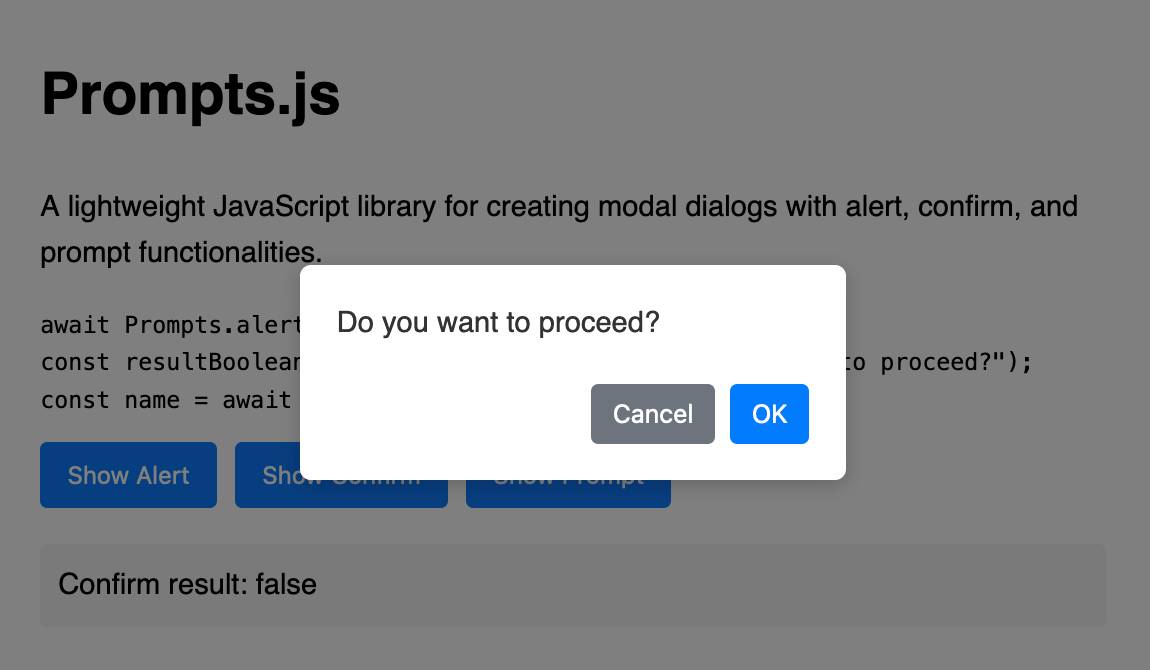
I’ve been putting the new o1 model from OpenAI through its paces, in particular for code. I’m very impressed—it feels like it’s giving me a similar code quality to Claude 3.5 Sonnet, at least for Python and JavaScript and Bash... but it’s returning output noticeably faster.
[... 1,119 words]Writing down (and searching through) every UUID (via) Nolen Royalty built everyuuid.com, and this write-up of how he built it is utterly delightful.
First challenge: infinite scroll.
Browsers do not want to render a window that is over a trillion trillion pixels high, so I needed to handle scrolling and rendering on my own.
That means implementing hot keys and mouse wheel support and custom scroll bars with animation... mostly implemented with the help of Claude.
The really fun stuff is how Nolen implemented custom ordering - because "Scrolling through a list of UUIDs should be exciting!", but "it’d be disappointing if you scrolled through every UUID and realized that you hadn’t seen one. And it’d be very hard to show someone a UUID that you found if you couldn’t scroll back to the same spot to find it."
And if that wasn't enough... full text search! How can you efficiently search (or at least pseudo-search) for text across 5.3 septillion values? The trick there turned out to be generating a bunch of valid UUIDv4s containing the requested string and then picking the one closest to the current position on the page.
Sunday, 8th December 2024

Holotypic Occlupanid Research Group (via) I just learned about this delightful piece of internet culture via Leven Parker on TikTok.
Occlupanids are the small plastic square clips used to seal plastic bags containing bread.
For thirty years (since 1994) John Daniel has maintained this website that catalogs them and serves as the basis of a wide ranging community of occlupanologists who study and collect these plastic bread clips.
There's an active subreddit, r/occlupanids, but the real treat is the meticulously crafted taxonomy with dozens of species split across 19 families, all in the class Occlupanida:
Class Occlupanida (Occlu=to close, pan= bread) are placed under the Kingdom Microsynthera, of the Phylum Plasticae. Occlupanids share phylum Plasticae with “45” record holders, plastic juice caps, and other often ignored small plastic objects.
If you want to classify your own occlupanid there's even a handy ID guide, which starts with the shape of the "oral groove" in the clip.
Or if you want to dive deep down a rabbit hole, this YouTube video by CHUPPL starts with Occlupanids and then explores their inventor Floyd Paxton's involvement with the John Birch Society and eventually Yamashita's gold.
llm-openrouter 0.3. New release of my llm-openrouter plugin, which allows LLM to access models hosted by OpenRouter.
Quoting the release notes:
- Enable image attachments for models that support images. Thanks, Adam Montgomery. #12
- Provide async model access. #15
- Fix documentation to list correct
LLM_OPENROUTER_KEYenvironment variable. #10
Monday, 9th December 2024
I can now run a GPT-4 class model on my laptop

Meta’s new Llama 3.3 70B is a genuinely GPT-4 class Large Language Model that runs on my laptop.
[... 2,905 words]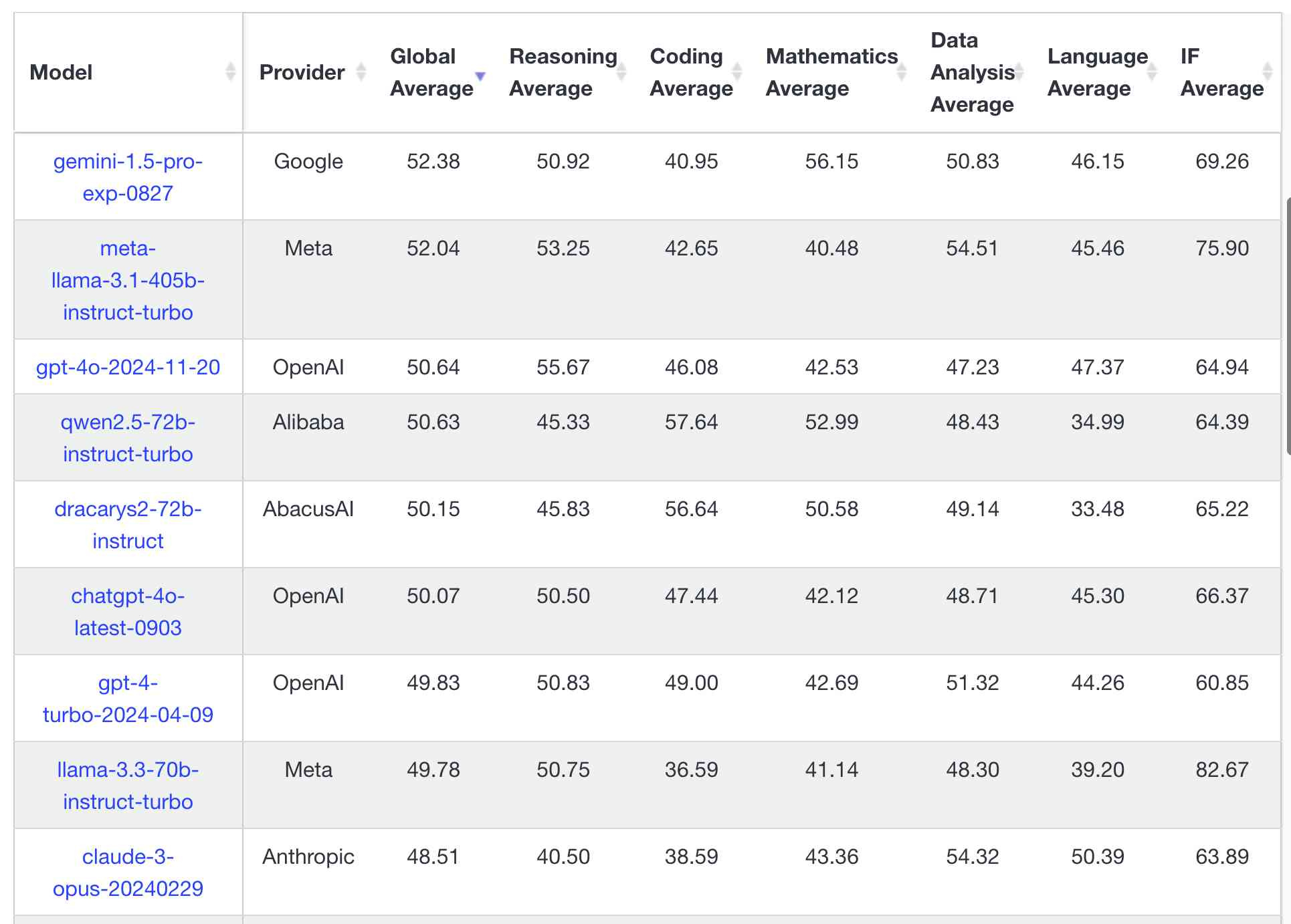
Sora (via) OpenAI's released their long-threatened Sora text-to-video model this morning, available in most non-European countries to subscribers to ChatGPT Plus ($20/month) or Pro ($200/month).
Here's what I got for the very first test prompt I ran through it:
A pelican riding a bicycle along a coastal path overlooking a harbor
The Pelican inexplicably morphs to cycle in the opposite direction half way through, but I don't see that as a particularly significant issue: Sora is built entirely around the idea of directly manipulating and editing and remixing the clips it generates, so the goal isn't to have it produce usable videos from a single prompt.
Tuesday, 10th December 2024
The boring yet crucial secret behind good system prompts is test-driven development. You don't write down a system prompt and find ways to test it. You write down tests and find a system prompt that passes them.
For system prompt (SP) development you:
- Write a test set of messages where the model fails, i.e. where the default behavior isn't what you want
- Find an SP that causes those tests to pass
- Find messages the SP is missaplied to and fix the SP
- Expand your test set & repeat
Knowing when to use AI turns out to be a form of wisdom, not just technical knowledge. Like most wisdom, it's somewhat paradoxical: AI is often most useful where we're already expert enough to spot its mistakes, yet least helpful in the deep work that made us experts in the first place. It works best for tasks we could do ourselves but shouldn't waste time on, yet can actively harm our learning when we use it to skip necessary struggles.