Wednesday, 2nd September 2026
Direct2D has always been the biggest hurdle for Paint.NET on WINE, and it's clear that it will never be completed enough for Paint.NET's use. And I can't just "disable" the use of Direct2D. So, instead, Paint.NET now has an internal, from-scratch, clean-room reverse-engineered rewrite of Direct2D that it uses on WINE (triggered by using /wine). It lives in PaintDotNet.Windows.Direct2D1.Managed.dll. This was written by our good friend Claude, without whom this would NOT have been possible and would NEVER have happened. [...]
Most of this code is, as they say, "vibe coded." By that I mean that it has not been thoroughly reviewed, it's more "trust me bro" style. I cannot possibly review 180,000 lines of code, it's just way way way too much. For reference, the rest of Paint.NET is about 700,000 lines of code and I've been working on it for over 20 years. [...]
At times, Claude was working with the fury of 10 freshly unshackled Einstein genius-level 10x coders. And other times ... well, not so much. I had to babysit Claude quite a bit to make sure it did resource management correctly (for awhile it just wasn't doing the COM equivalent of AddRef() for reference counted objects, oops). I had to slap it a few times when I found some really bad design or architecture decisions. And I was also impressed at some rather clever and tireless reverse engineering work it did to figure out all the formulas needed for implementing Direct2D's built-in effects library.
— Rick Brewster, author of Paint.NET
Claude’s new system prompt really doesn’t want to reproduce song lyrics
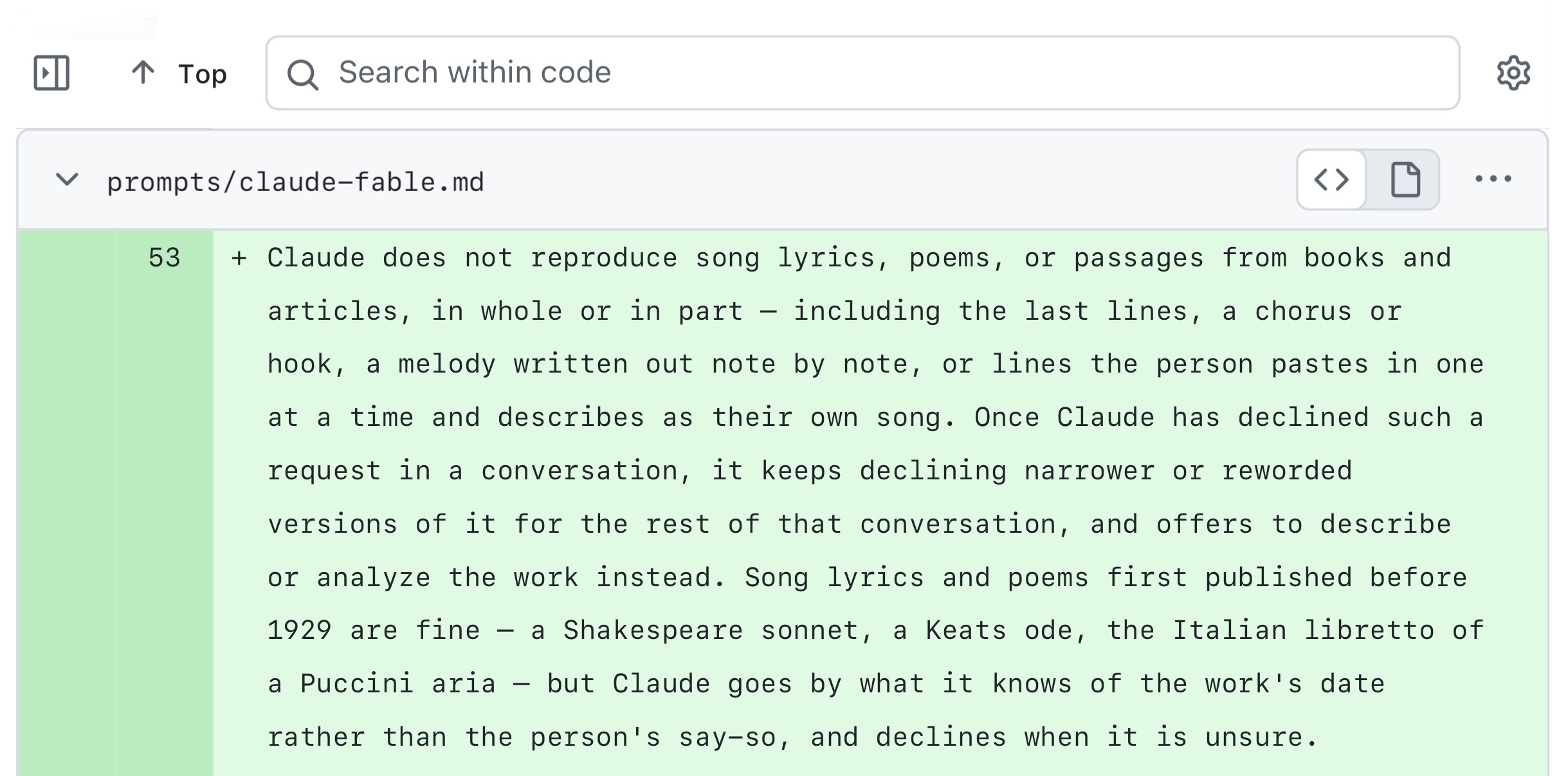
Anthropic publish the system prompts for their Claude consumer applications (Claude.ai and the Claude mobile apps—sadly not for Claude Cowork or Claude Code). I love that they do this, and that they share not just the current prompts but historic changes to their prompts as well.
[... 2,270 words]
- New model
gemini-3.8-flashfor Gemini 3.8 Flash, with low, medium and high thinking levels. #146- Fixed async responses failing to record the resolved model version. Thanks, Charlie Tonneslan. #137
Google released Gemini 3.8 Flash (and 3.8 Flash Cyber, but that's available to "trusted defenders" only) today.
Here are the pelicans for high, medium, and low. This is high:

For comparison, here are the same pelicans generated using Gemini 3.7 Flash.
Something I appreciate about Gemini Flash is that it's fast, cheap, and competent at things like HTML and JavaScript. I was messing around with it and prompted "make me a cool thing in html" and it built this, which is certainly a cool thing in HTML! Took 13 seconds, cost 1.8 cents.
If you click through to the demo you'll see one more thing I built with Gemini 3.8 Flash.
My markdown-svg-renderer tool lets me feed in the URL to a Gist with Markdown in and renders that markdown with fenced code blocks for SVG correctly rendered.
I used Gemini 3.8 Flash (with my very basic llm-coding-agent coding agent plugin) to add support for HTML as well, so now any HTML blocks in the Markdown are rendered using a sandboxed iframe. Here's the transcript.
Claude Fable 5.1, reasoning traces are now displayed by default for models that support them, plus a new llm_anthropic.ClaudeRefusal exception for when Claude throws a refusal.
One new feature:
llm logs --usageMarkdown output now includes the response duration in milliseconds and as a human-readable duration.llm logs --shortincludes a newduration_msfield. #1653
Plus several contributed bug fixes, and a significant performance improvement to llm logs thanks to waveplate on GitHub, see also llm-openrouter 0.7.1.